
Restoration Report – Lee-Enfield No. 5 Mk I "Jungle Carbine"
1. Object Identification
Bolt-action British service carbine based on the Lee-Enfield system, produced at the Birmingham Small Arms Company (BSA) Shirley plant and marked with factory code M47C. This example is a 1945 dated Rifle No. 5 Mk I, serial number BE0123, in .303 British.
Total No. 5 production is usually given at about 251,000 rifles, of which roughly 169,800 were made at ROF Fazakerley and about 81,300 at BSA Shirley, so BSA output is well under half of the total run. Combined with heavy postwar service, scrapping, and later sporter conversions, fully matching BSA-coded Jungle Carbines are noticeably less common than mixed-number No. 5 rifles in general circulation.
On genuine No. 5 rifles the model legend and factory data on the left side of the body are applied by shallow electro-stencilling and pencilling instead of deep roll stamping. BSA examples in particular often show light and uneven pen work that can be hard to read after decades of wear. This rifle retains a legible No. 5 Mk I marking, M47C butt socket code, and BE0123 serial in spite of that characteristic weakness in the original marking process.
| Object Summary | |
|---|---|
| Object Type | Bolt-action military carbine |
| Designation | Rifle No. 5 Mk I "Jungle Carbine" – BSA Shirley (M47C) |
| Serial Number | BE0123 (matching receiver, bolt, magazine and fore-end) |
| Country of Origin | United Kingdom |
| Date of Manufacture | 1945 butt socket date |
| Caliber | .303 British |
| Construction | Steel receiver and barrel, alloy flash hider, hardwood stock set, rubber butt pad |
| Main Artifact Profile | View main Jungle Carbine artifact page |
2. Photo Documentation
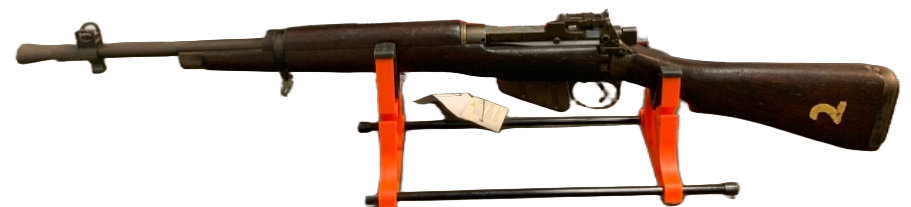
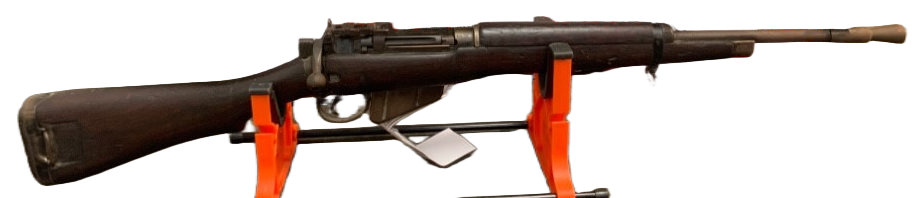
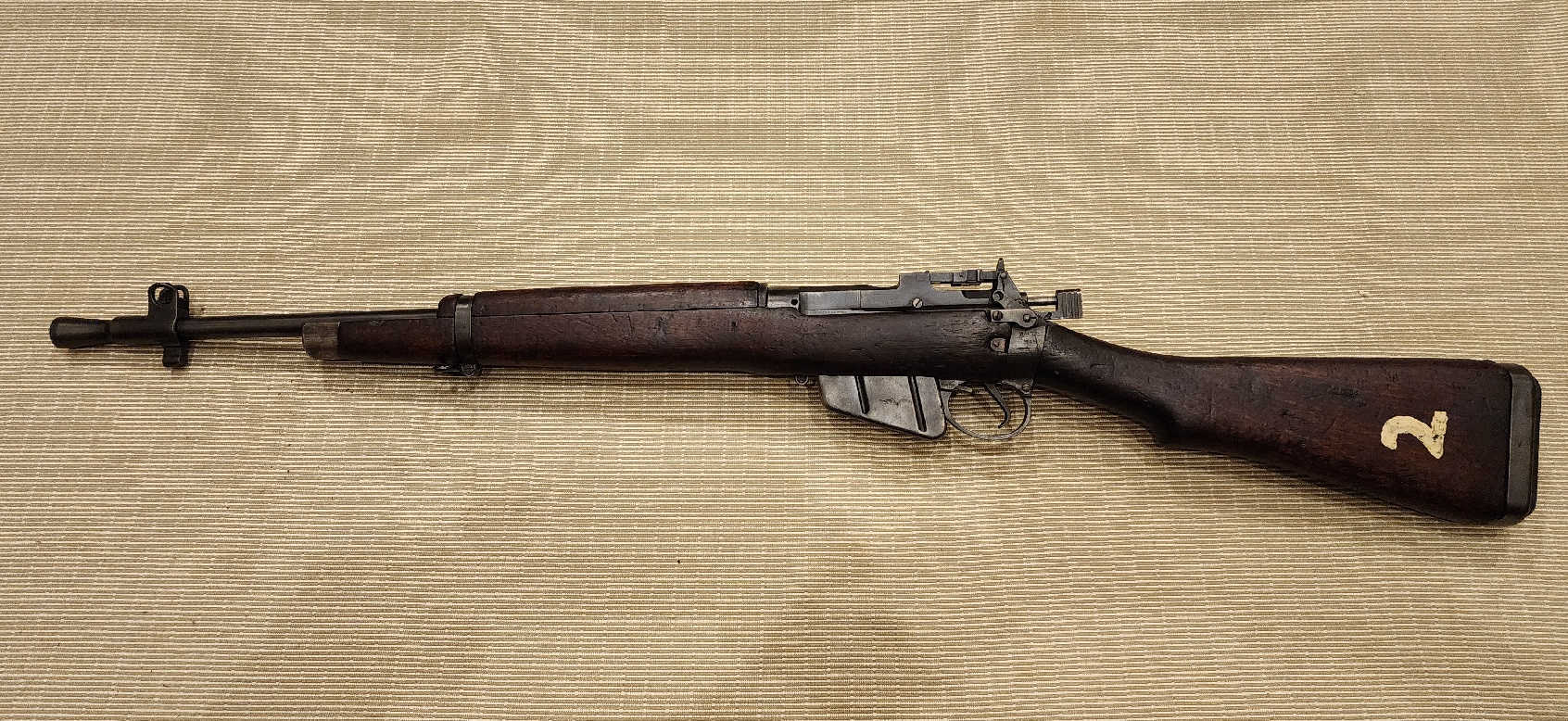
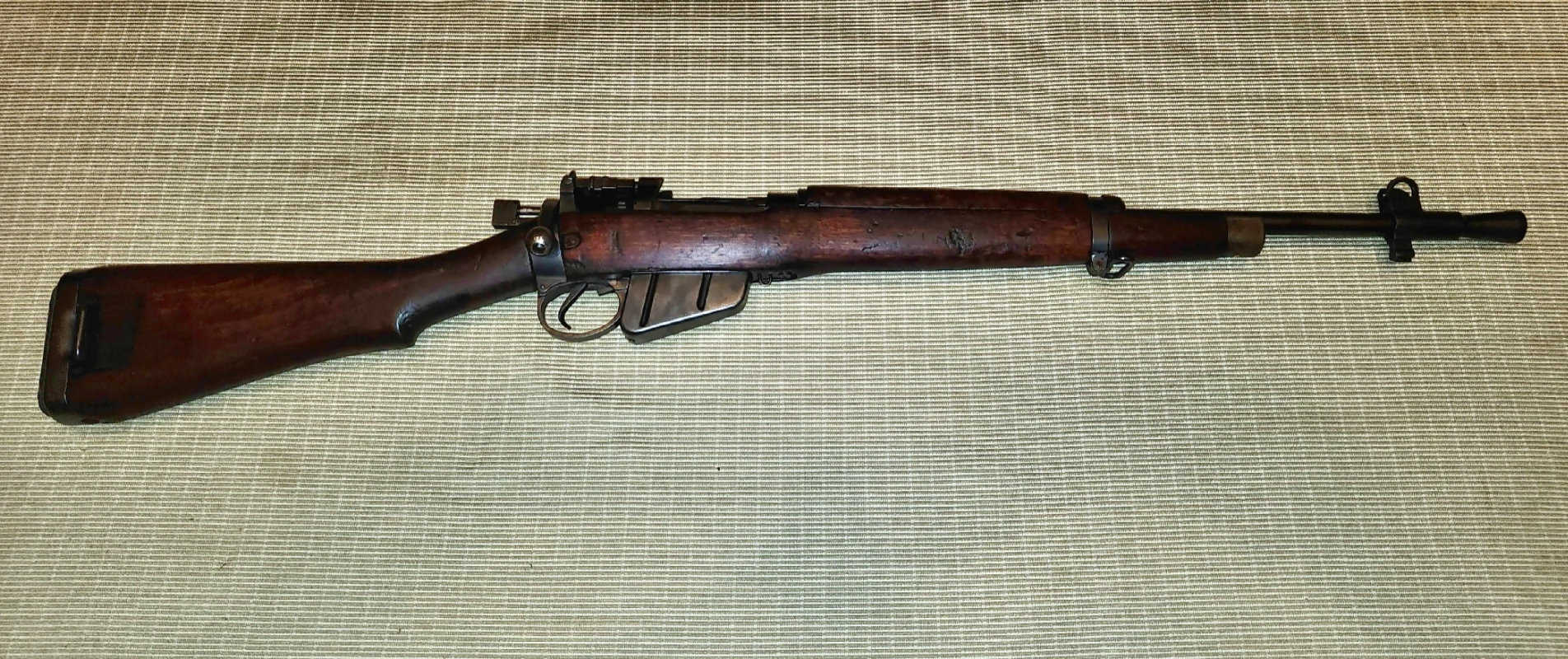
Representative before and after images showing the general condition on arrival and the appearance after conservation and re-browning.
3. Condition Prior to Treatment
On arrival, the carbine was complete and structurally sound, with matching serial numbers and no obvious stock repairs or metal cracks. The overall impression, however, was of a rifle that had seen long storage and handling with most of its factory finish worn away. The stock itself felt slightly spongy and gummy to the touch, which Mick identified as wood and finish saturated with congealed preservative grease and cosmoline rather than any structural softening of the timber.
- Original black factory coating (often referred to as a Suncorite-type stoving enamel) thinned to perhaps ten to fifteen percent coverage, with the remainder worn back to dull grey steel and scattered light oxidation.
- Typical shallow BSA electro-stencilled markings on the receiver and butt socket, some already faint from the original application and easy to lose if polished too aggressively.
- Film of hardened oil and cosmoline in the bolt body, locking lug recesses, magazine housing and trigger mechanism, plus heavy grease in the pores of the stock, all contributing to the soft, gummy feel of the rifle when handled.
- Stock set intact with normal dings, scratches and handling marks, greasy surface and a tired underlying oil finish that no longer offered much protection.
- Bore showed usable rifling with light frost and residue but no major pitting.
4. Conservation Objectives
The restoration brief balanced historical accuracy with practical conservation. Key goals were:
- Remove old cosmoline and storage grime, especially from the stock and inletting, so the wood no longer felt spongy or greasy in hand, while retaining original parts.
- Replace the largely lost factory stoving enamel with a traditional British rust browning that is sympathetic to earlier Enfield practice and to the type of finish an arsenal re-browning could have produced in service.
- Stabilize all exposed steel surfaces and halt ongoing oxidation while preserving original BSA markings and avoiding any re-cutting or artificial sharpening.
- Clean and refresh the stock set, maintaining its service character and dents while improving protection and appearance with a traditional oil finish.
- Confirm mechanical safety, including headspace, firing pin protrusion and basic function tests, so the rifle can be fired with appropriate .303 British loads.
5. Treatment Summary
Restoration work on BE0123 was carried out by Mick Crowder of Classic Firearms Restorations, with final mechanical inspection and test firing handled by Tim Crowder of Iron Will Armory. The rifle was fully disassembled and thoroughly degreased to remove old cosmoline and oils from both metal and wood. Metal surfaces were cleaned back to sound steel, light corrosion was carded away, and a traditional multi-step rust browning process was applied using a different and slightly more acidic solution than common modern cold bluing to build a deep, durable brown-black finish.
The stock set was cleaned to lift the greasy surface, leaving the original dents and marks in place, and the surface was given a fresh hand rubbed oil finish rather than sanding away service wear. All original markings were preserved, with particular care taken around the shallow BSA serial and model legends. After reassembly, the rifle was function tested and then live fired with suitable .303 ammunition to confirm safe operation.
6. Detailed Treatment Steps
- Initial inspection and documentation: The rifle was inspected externally and internally, photographed and documented. Serial numbers and factory codes were recorded on the receiver, butt socket, bolt, magazine and fore-end wood to confirm that the rifle remained an all matching BSA Shirley example.
- Careful disassembly: The rifle was field stripped and then fully disassembled into major assemblies: barrelled action, bolt group, trigger and magazine, stock set and small hardware. Particular care was taken removing screws that had set into the wood to avoid chipping the surrounding stock.
- Degreasing and removal of cosmoline: Old grease and cosmoline were softened with controlled use of heat and solvent-based degreasers, then brushed and wiped away from the bolt body, lug recesses, magazine well and trigger housing. Internal cavities in the butt and forend were likewise cleaned to eliminate heavy grease and the spongy, gummy feel caused by years of absorbed preservatives.
- Metal surface preparation: Loose rust and remaining traces of the original black coating were removed by hand carding and light abrasive work, keeping corners, stampings and machining marks crisp. Difficult areas such as the flash hider and sight protectors were cleaned with small brushes rather than aggressive polishing.
- Rust browning of exposed metal: With the steel clean and evenly prepared, Mick applied a traditional British style browning solution in multiple controlled cycles. Each cycle produced a fine rust that was boiled and carded off, slowly building a stable brown-black finish that offers good protection without looking overly polished or modern. The solution used was a different and slightly more acidic mix than typical modern cold bluing, closer in spirit to older British browning practice.
- Conservation of markings: Around the No. 5 Mk I model legend, M47C butt socket code and BE0123 serials, polishing was kept to a minimum. The new browning darkened the bottom of the electro-stencilled letters slightly, which helps the eye pick them out, but no attempt was made to deepen or re-cut the markings. They remain authentically shallow, as is typical for BSA production.
- Stock cleaning and oil finish: The wood was cleaned with a mild solvent and soft brushes to lift old oil, grease and dirt from the grain and remove the gummy surface feel. No dents were raised; all service marks and handling dings were left intact as part of the rifle’s history. The stock then received multiple applications of a traditional hand rubbed oil finish to restore depth and protection without a heavy modern varnish look.
- Mechanical service and reassembly: Internal bearing surfaces were lightly polished where appropriate, then lubricated with modern gun oil during reassembly. The bolt, safety, trigger, magazine catch and sights were checked for correct function. Headspace and firing pin protrusion were confirmed within safe limits for .303 British service loads.
- Final inspection and test firing: Tim Crowder of Iron Will Armory conducted the final mechanical inspection and test fired the rifle with appropriate ammunition. Cycling, feed, extraction and ejection were verified, and the rifle grouped in a normal pattern for a sound Jungle Carbine barrel and service sight picture.
7. Results and Findings
After treatment, BE0123 presents as a complete, mechanically sound and historically sympathetic example of a BSA Shirley No. 5 Mk I. The new rust browned finish provides uniform protection and appearance while still reading as appropriate military work rather than a bright commercial refinish. The original factory enamel-type coating was already mostly gone, and the chosen browning approach is consistent with traditional British practice and with the sort of re-browning an arsenal could have carried out on earlier Enfield patterns.
The action now cycles cleanly, and the wood has lost the soft, gummy feel that came from old grease and cosmoline. The shallow BSA markings remain intact and legible, which is important for documenting this rifle as one of the smaller BSA share of No. 5 production. Matching numbers on the receiver, bolt, magazine and fore-end wood confirm that the rifle has not been made up from mixed parts in later surplus handling.
- Rifle is fully documented as a 1945 BSA Shirley No. 5 Mk I with matching serials and correct factory coding.
- Metal surfaces are clean, stable and evenly rust browned, with markings preserved and no significant loss of original fabric.
- Stock retains honest service marks but now has a refreshed, protective oil finish and presents well for display and handling.
- Mechanical inspection and test firing confirm safe operation with suitable .303 British loads, returning the carbine to functional as well as interpretive status.
- As a matching BSA-coded Jungle Carbine from the smaller production share, this rifle has above average interest for collectors who track factory output and individual rifle histories.