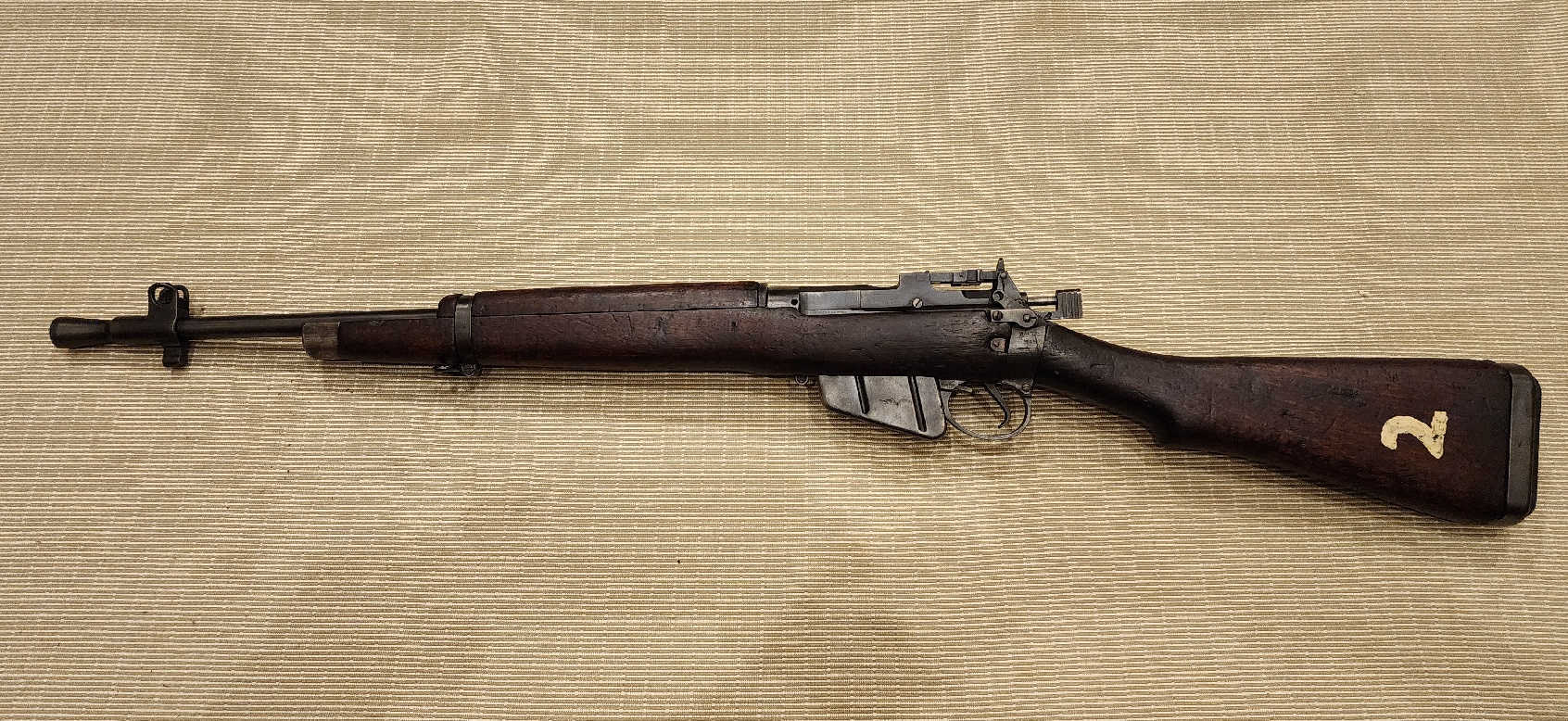
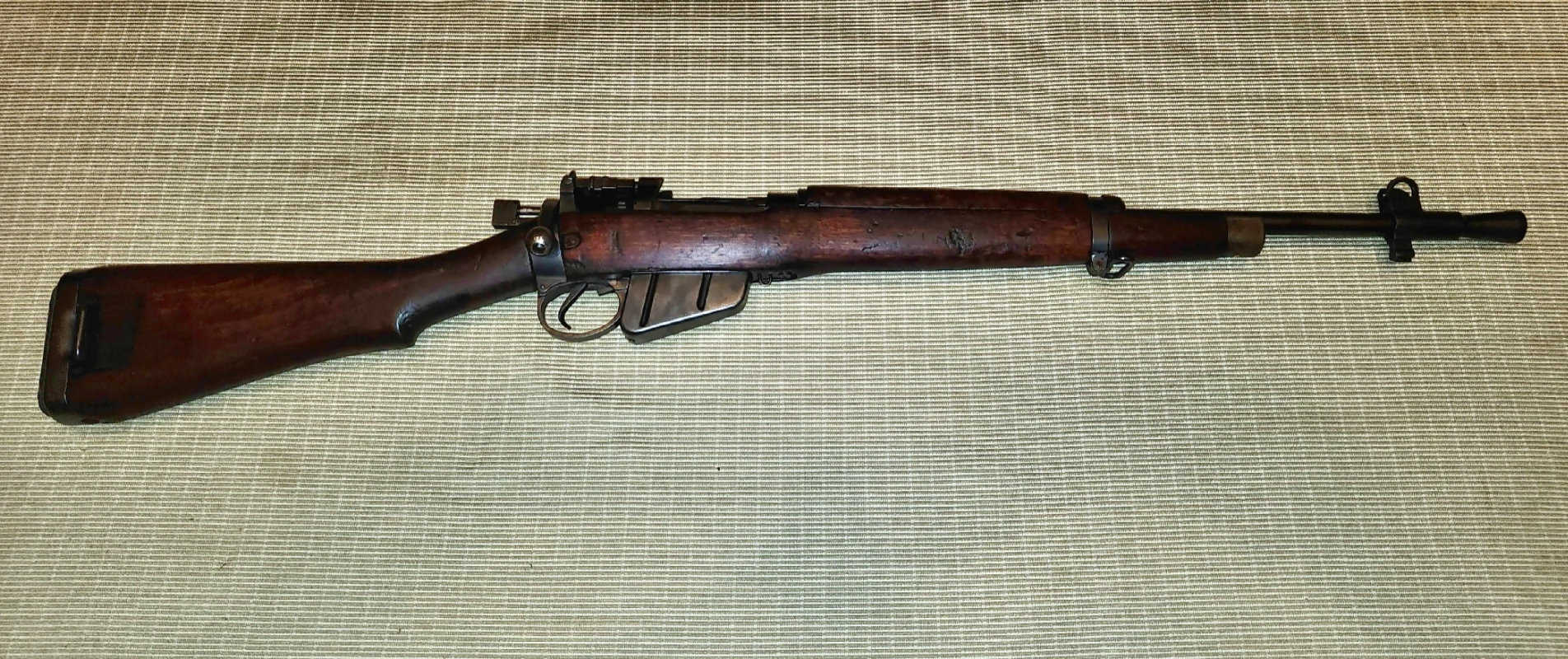
Lee-Enfield No. 5 Mk I "Jungle Carbine"
Lee-Enfield No. 5 Mk I "Jungle Carbine"
BSA Shirley production, 1945
Images
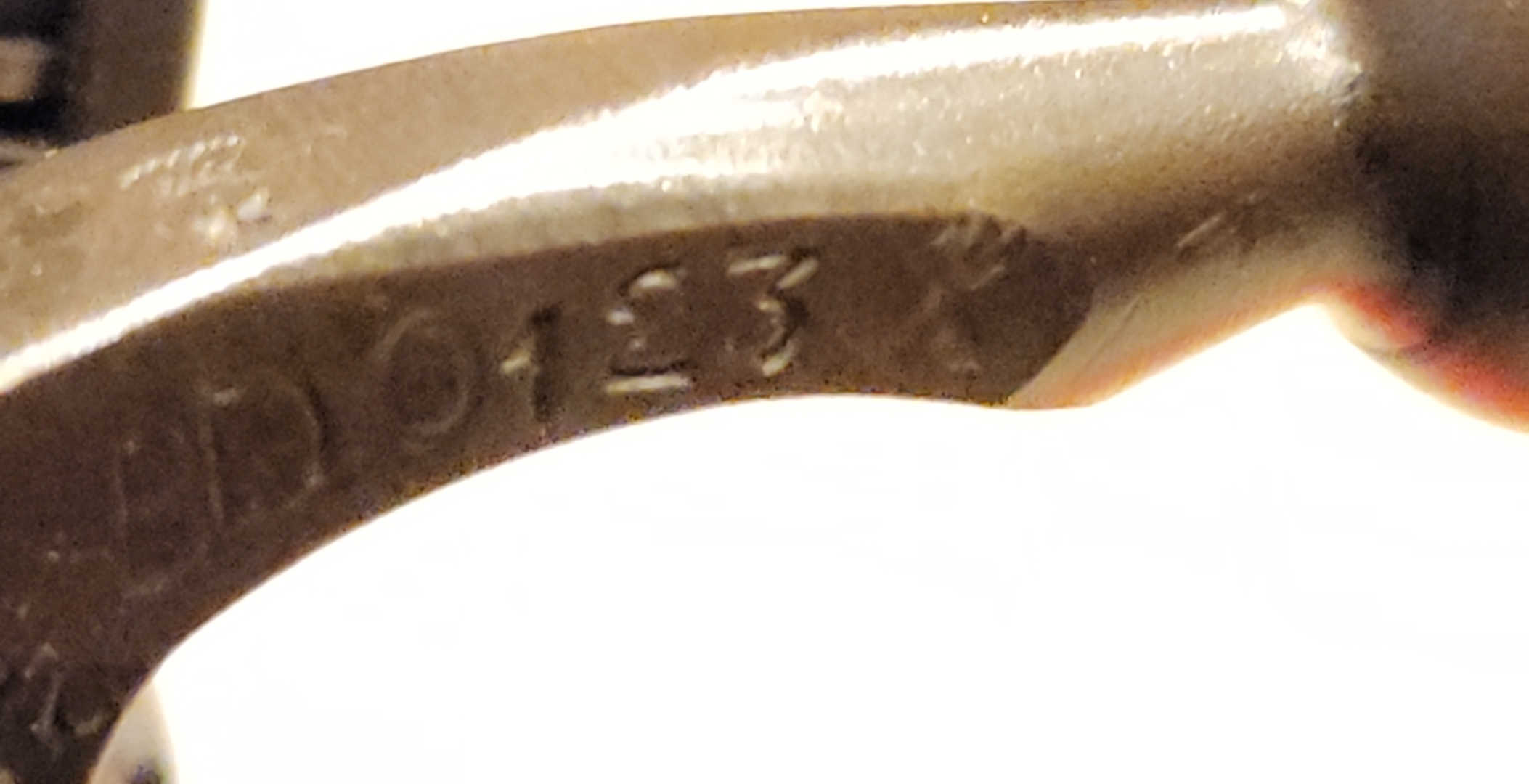
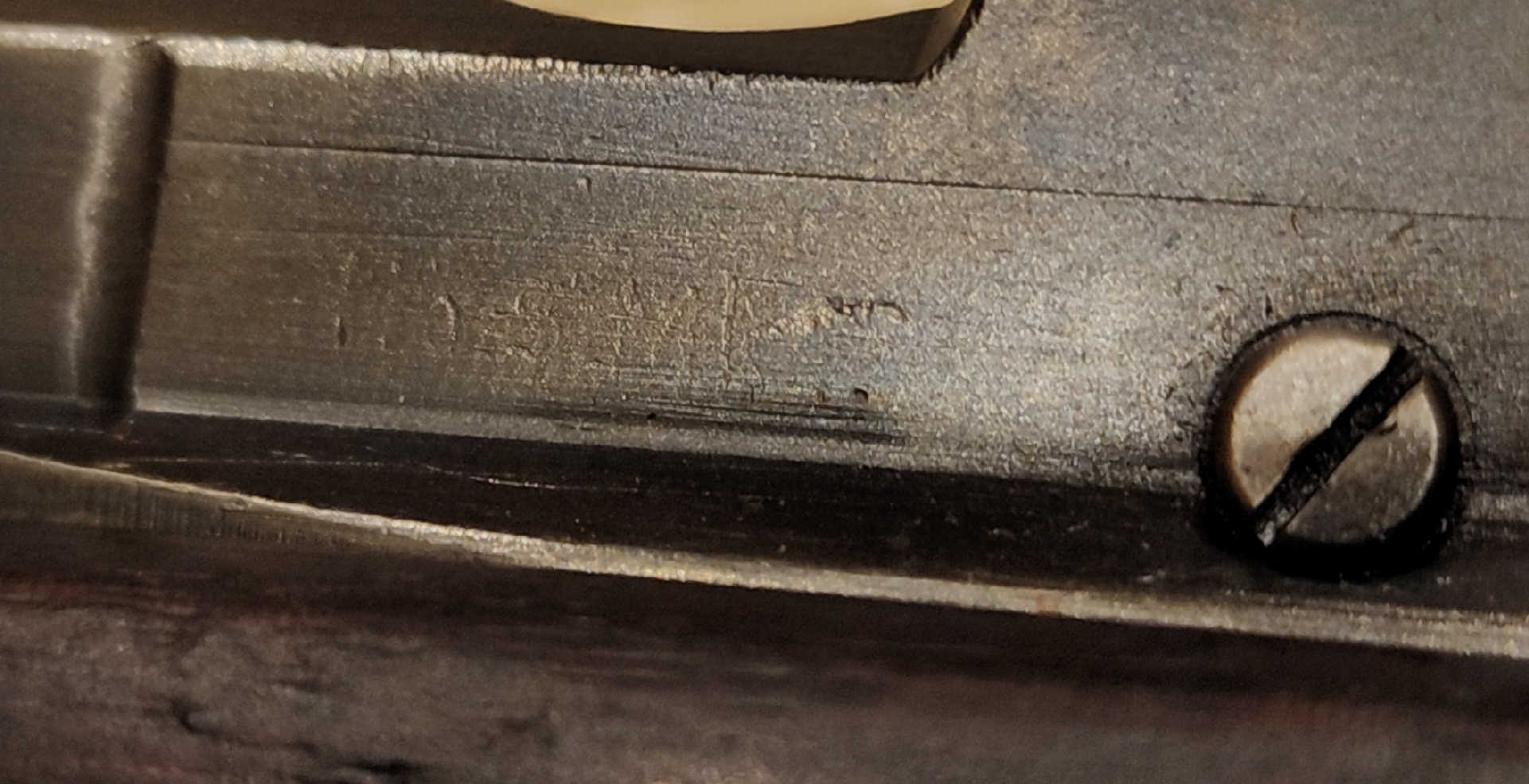
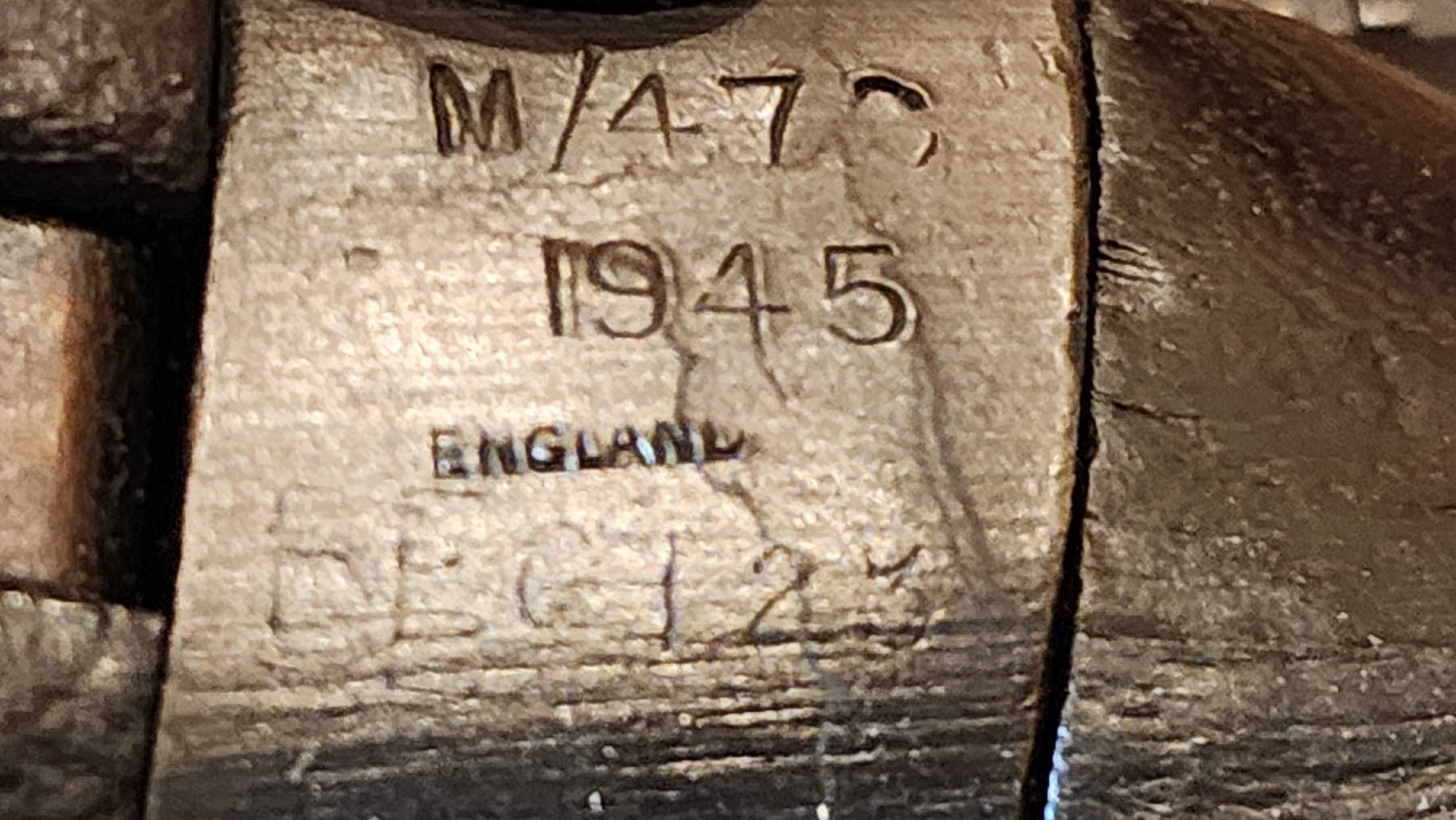
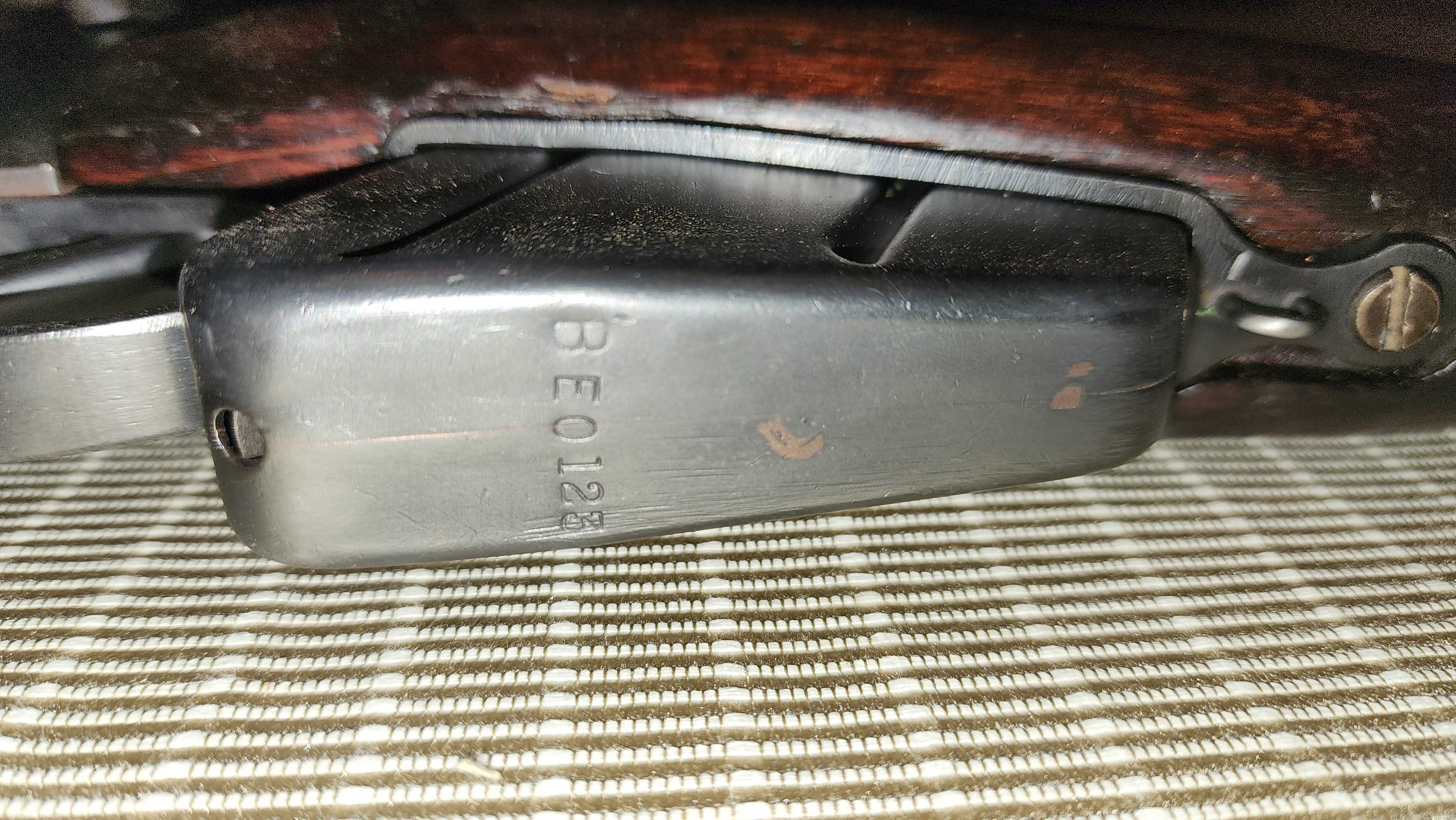
Specifications
| General Information | |
|---|---|
| Manufacturer | Birmingham Small Arms Company, Shirley plant (factory code M47C) |
| Model | Rifle No. 5 Mk I "Jungle Carbine" |
| Year | 1945 butt socket date |
| Caliber | .303 British, proofed ".303 2.22" and "18.5 TONS" |
| Configuration | Shortened and lightened Lee-Enfield carbine with 18.7 inch barrel, conical flash hider, ten round detachable magazine, 800 yard aperture rear sight, hollow bolt knob, rubber butt pad, and lightening cuts in the receiver and barrel knox form. |
| Serial Number | BE0123 (matching on receiver, bolt, magazine and fore-end wood) |
| Production context | Part of roughly 251,000 No. 5 Mk I rifles made between 1944 and 1947, including about 81,329 produced at BSA Shirley and about 169,807 at ROF Fazakerley, so BSA output is well under half of total production. |
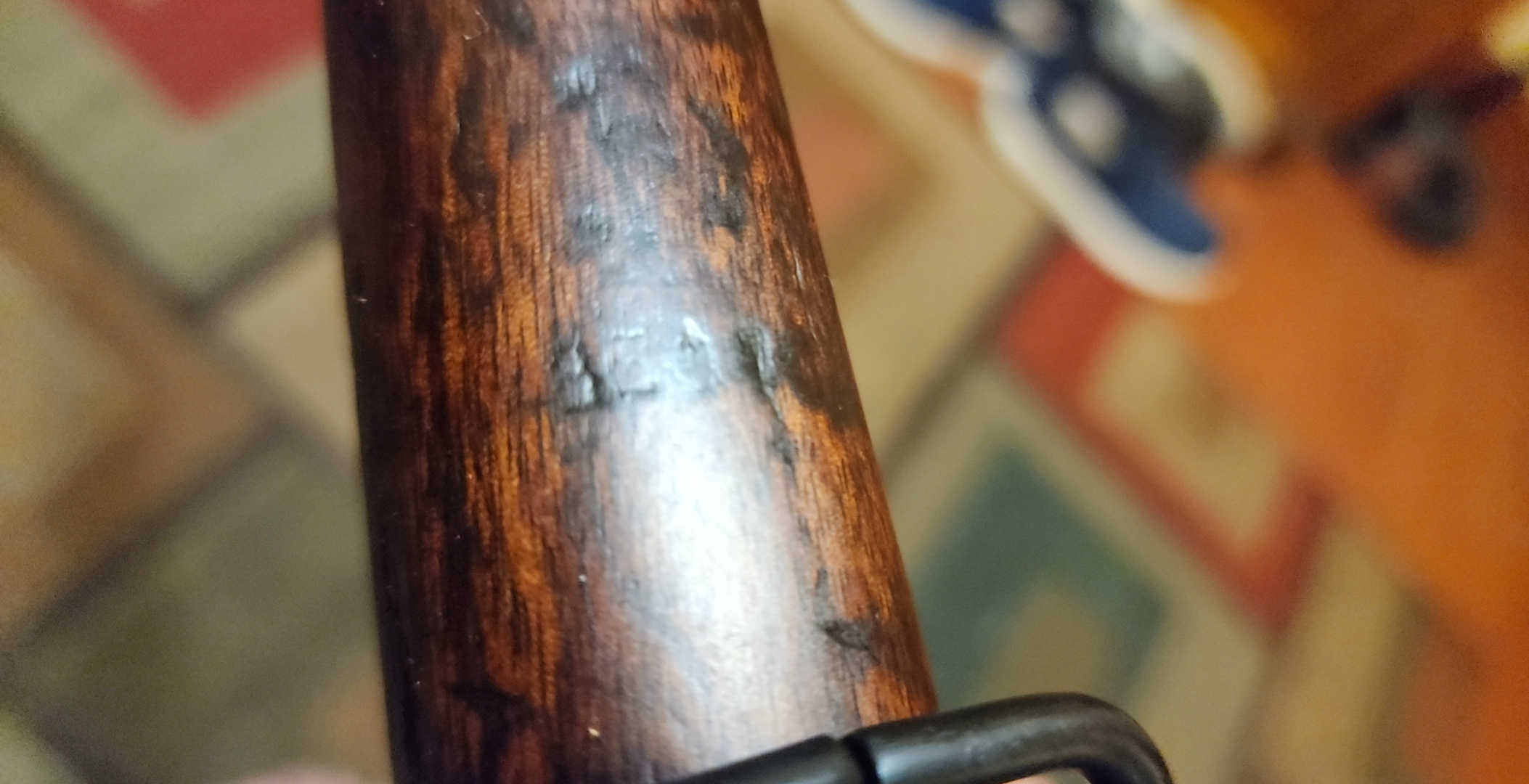
| Markings | Butt socket marked "M47C 1945 ENGLAND BE0123". Left receiver wall carries the electro-stencilled "Rifle No 5 Mk I" legend typical of genuine Jungle Carbines. On No. 5 rifles the factory information and serials on the left of the receiver are normally electro pencilled rather than deeply roll stamped, and on many BSA examples the markings are very faint. This rifle retains a clear model marking, visible M47C code and legible serial, which is better than average for the type. |
Historical Summary
The Lee-Enfield No. 5 Mk I "Jungle Carbine" was adopted in 1944 as a short, handy version of the No. 4 rifle that was intended for close country fighting in places such as Burma and Malaya. Engineers removed weight from the action and barrel, shortened the fore-end, fitted a conical flash hider and rubber butt pad, and retained a ten shot magazine and aperture sight. In return for the lighter package, the design delivered noticeably sharper recoil and a lively muzzle flash.
This rifle is a 1945 production example from BSA Shirley, identified by the factory code M47C on the butt socket and the two letter "BE" serial prefix. Total No. 5 production is generally quoted at about 251,368 rifles, of which approximately 169,807 were made at ROF Fazakerley near Liverpool and about 81,329 at BSA Shirley near Birmingham, so BSA rifles make up a significantly smaller share of the overall run. Many No. 5 carbines saw hard postwar service in the Malayan Emergency and other colonial campaigns, and large numbers were later scrapped or converted into commercial "Jungle Carbine" style sporters, so intact military configuration examples represent only a fraction of what was originally made.
Later export and civilian proof marks on the barrel and receiver show that this rifle was sold out of British government service and passed through commercial channels before eventually reaching the United States, where it now survives as a documented example of a genuine BSA made Jungle Carbine.
Collector Notes
BE0123 remains in correct No. 5 Mk I configuration with the expected lightening cuts, proper BSA markings and a full set of matching serial numbers on the receiver, bolt, magazine and fore-end wood. Matching bolts and magazines are not guaranteed on No. 5 rifles, since many were mixed during service or during later import handling, so a complete matching set is a strong point in this rifle’s favor.
The rifle shows honest service and storage wear while retaining clear markings and a sound bore for a mid war production .303. It has been sympathetically cleaned and checked by Classic Firearms Restorations, with final mechanical safety inspection and test firing carried out by Iron Will Armory. The work focused on careful conservation rather than refinish, so the rifle still reads as a period service arm rather than a modern rebuild.
Because BSA Shirley produced far fewer No. 5 rifles than Fazakerley, and because many Jungle Carbines were lost in field use, destroyed, or later cut down into commercial carbines, a fully matching BSA coded example like BE0123 is less commonly encountered than a typical No. 4 rifle or a mis-matched No. 5. For collectors who focus on factory codes and serial ranges, this rifle offers good research value as a reference for BSA lightened actions, serial prefixes and British proof practice on export.
Provenance
- Manufactured at BSA Shirley (M47C) in 1945 and originally accepted into British government service.
- Later sold out of service, as indicated by Birmingham Nitro Proof marks and the "ENGLAND" export stamp on the butt socket.
- Imported into the civilian market and acquired by the present owner in the United States as a complete, matching Jungle Carbine suitable for research and display.
- Conservation and mechanical inspection performed by Classic Firearms Restorations and Iron Will Armory. Detailed restoration steps and conservation notes are documented separately in the Restoration Lab section of this archive.
Editorial Note
These pages are presented for historical and collector-reference purposes. Relics & Rifles does not sell firearms or facilitate transactions. Any discussion of configuration, markings, or accessories is descriptive and intended to preserve context for research.