
Arisaka Type 99 Identification & Dating
A practical collector reference for identifying the Japanese Arisaka Type 99 by receiver markings, chrysanthemum status, arsenal and subcontractor symbols, series marks, and approximate serial production.
- Overview
- Quick ID Checklist
- Chrysanthemum & Crest
- Japanese Characters
- Arsenal Marks
- Serial Dating
- Estimated Serial Production Chart
- Concentric Circle Rifles
- Collector Notes
Overview
The Type 99 short rifle was the Imperial Japanese Army’s 7.7mm service rifle of the Second World War. For identification purposes, the most useful reading order is top of receiver first, then left side of receiver. The top normally carries the chrysanthemum and type designation. The left side normally carries the series mark, serial number, arsenal mark, and any subcontractor symbol.
Many rifles are encountered today with mixed wartime features, missing accessories, or surrendered and altered receiver crests. Because of that, the best approach is to read the markings first and the physical features second.
Quick Identification Checklist
- Check the top of the receiver for the chrysanthemum.
- Note whether the chrysanthemum is intact, partially ground, or absent.
- Read the type designation on the receiver top.
- Look for the series mark to the left of the serial number.
- Record the serial number exactly as stamped.
- Identify the arsenal mark at the end of the serial number line.
- Look for any subcontractor symbol to the right of the supervising arsenal symbol.
- Compare the series and serial range against the production table.
- Check whether the rifle is a standard Type 99 or a concentric-circle variation.
- Do not date the rifle from stock style or missing accessories alone.
Chrysanthemum and Receiver Crest
The 16-petal chrysanthemum was usually stamped on the receiver of rifles manufactured for the Imperial Japanese Army. It signified Imperial ownership. Rifles surrendered after the war often had the mum at least partly ground off, while rifles captured in the field normally retain it intact.

Imperial chrysanthemum: the standard receiver crest found on most service Type 99 rifles.

Concentric-circle mark: a much less common alternative receiver marking discussed separately below.
Japanese Characters and Type Marking
The type designation on the receiver uses the character shiki for “type” together with Japanese numerals. The quick-reference chart below is useful for reading those markings on the receiver top.
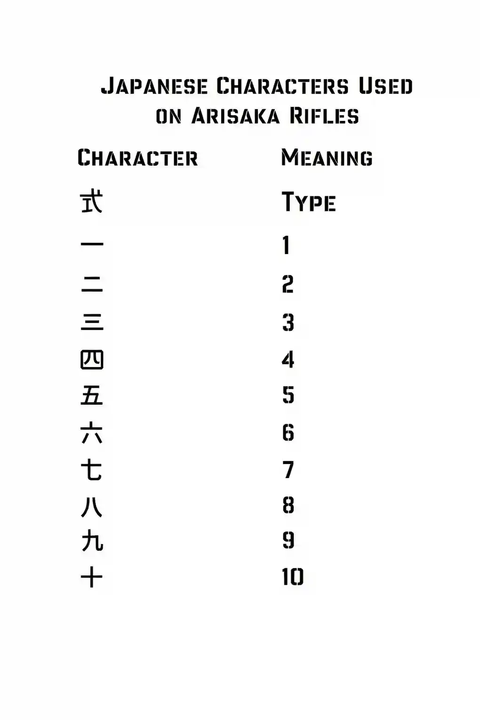
Reference chart for common Japanese characters used in Type designations and receiver markings.
Arsenal and Manufacturer Marks
Each Japanese rifle was marked with the symbol of either the arsenal of manufacture or the arsenal that supervised a subcontractor. This mark is normally found on the left side of the receiver at the end of the serial number line. Rifles made by commercial subcontractors may also show the subcontractor’s symbol to the right of the supervising arsenal mark. The Hoten Camp was a World War II prisoner of war camp in Manchuria. The camp was located near Mukden and was initially called Mukden POW Camp.
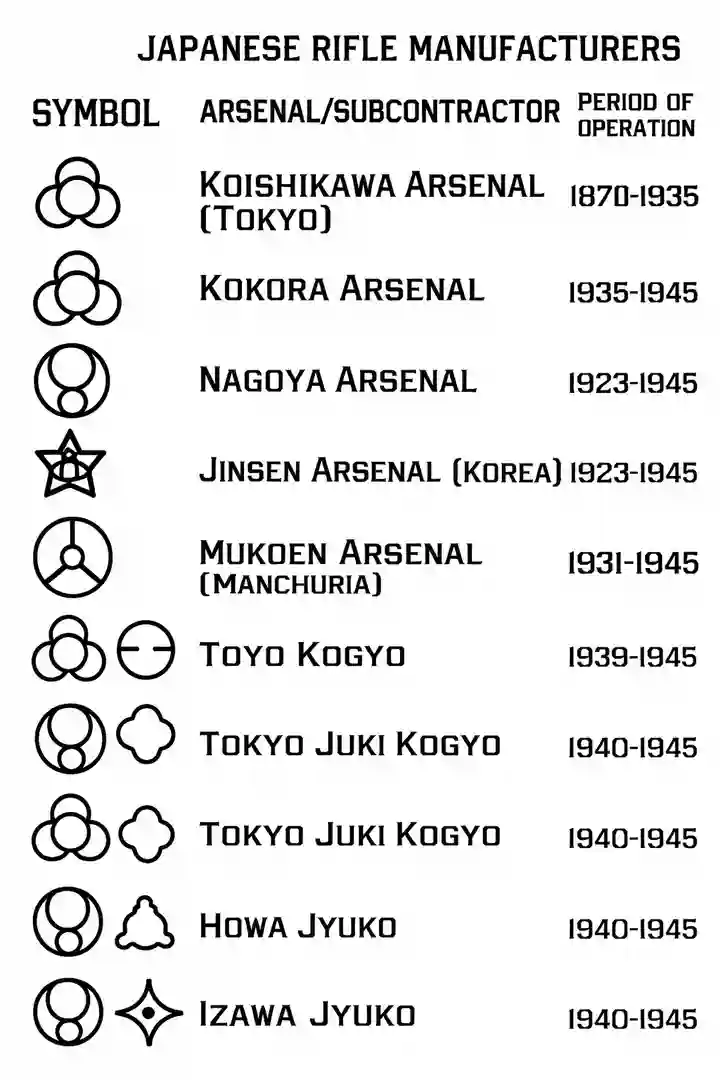
Reference chart showing supervising arsenals and associated subcontractor symbols.
Estimated Serial Production Chart
This visual chart complements the serial dating table above and provides a quick reference for estimated Type 99 series production by manufacturer and year.
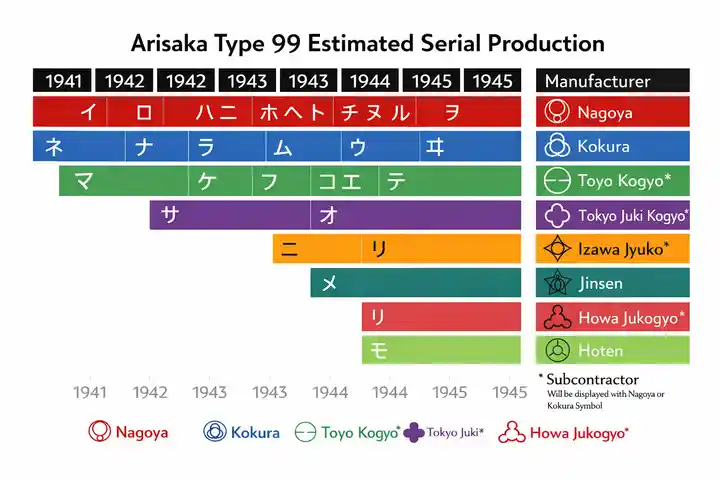
Estimated Type 99 serial production by manufacturer, series, and approximate wartime period.
Concentric Circle Rifles
A small number of Type 38 and Type 99 rifles were marked with two concentric circles in place of the chrysanthemum. Their exact purpose is uncertain, though they have been associated in collector literature with special issue or non-standard service use. Some appear to have had the chrysanthemum removed and replaced, while others appear to have been manufactured with the concentric-circle marking from the outset.
The source data also indicates that concentric-circle Type 99 rifles were serialized separately from standard production pieces.
Collector Notes
- An intact chrysanthemum usually supports original Imperial ownership and often a battlefield capture history.
- A ground mum commonly suggests surrender processing rather than field capture.
- Arsenal and subcontractor marks on the left side of the receiver are often more useful than missing accessories when identifying a rifle.
- Series and serial number should always be read together. The same serial number can appear under different series.
- Late-war simplification features are useful, but they should confirm the markings, not replace them.