
WWII Long Beach Island Wartime Regulations Notice
Framed coastal-security notice governing automobile lighting, beach access, photography, field glasses, and nighttime fishing on Long Beach Island, New Jersey, under Captain E. A. Coffin of the U.S. Coast Guard, Fourth Naval District.
Overview
This original notice records how World War II reached into ordinary life at the Jersey Shore. Its rules controlled where automobiles could park, which headlights could be used near the ocean, when people could enter the beaches, and whether residents or visitors could carry cameras or field glasses. It also prohibited nighttime fishing from beaches, piers, boats, bridges, and causeways.
These restrictions were part of a larger coastal-defense system intended to reduce visible light along the shoreline, limit unauthorized observation, discourage suspicious nighttime movement, and make it easier for military and civilian patrols to recognize unusual activity. The notice names Captain E. A. Coffin, the wartime District Coast Guard Officer of the Fourth Naval District in Philadelphia.
Artifact Photograph
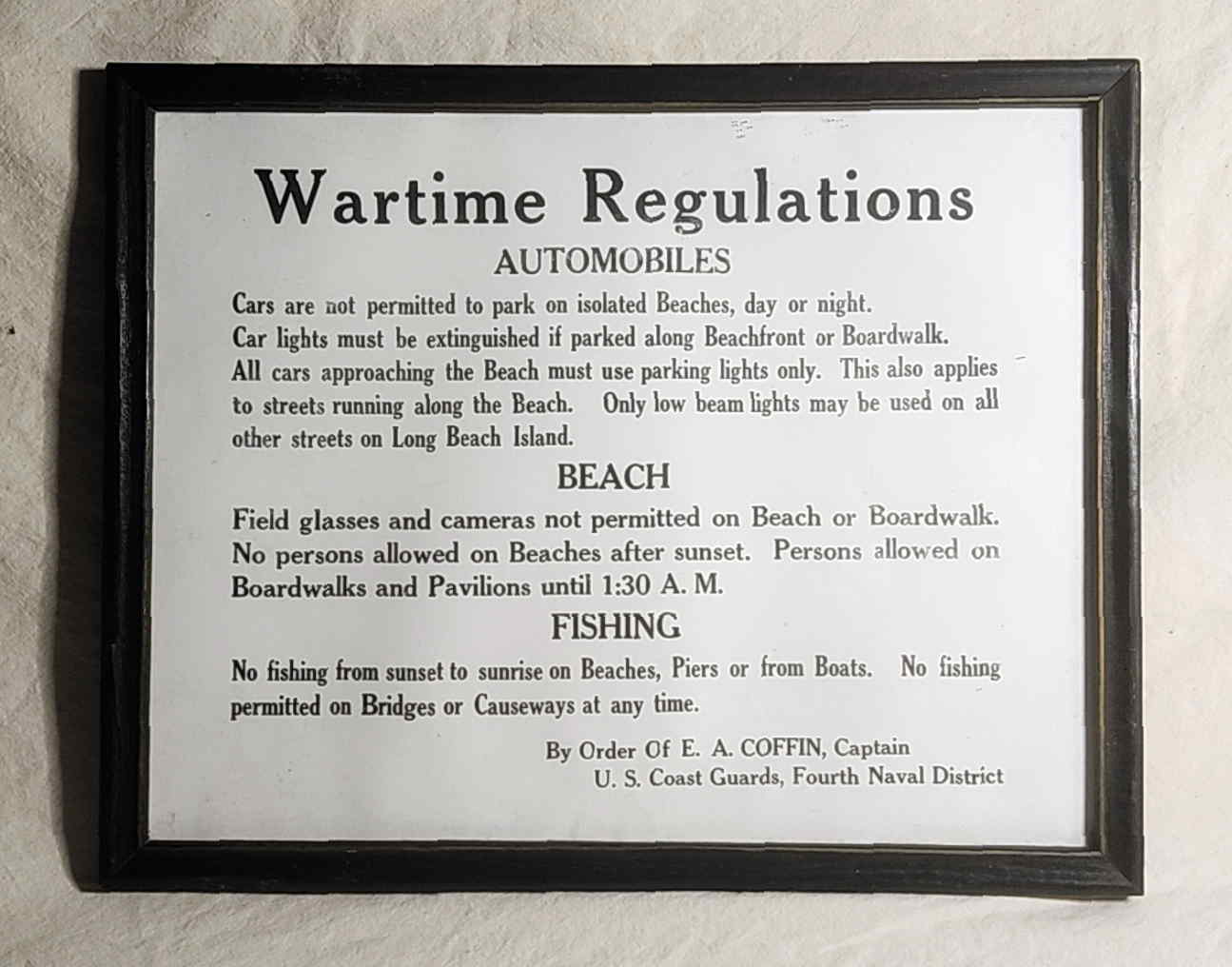
Specifications
| General Information | |
|---|---|
| Object | Original World War II printed wartime regulations notice |
| Country | United States |
| Location Named | Long Beach Island, Ocean County, New Jersey |
| Issuing Authority | U.S. Coast Guard, Fourth Naval District |
| Named Officer | Captain E. A. Coffin, District Coast Guard Officer |
| Date | Circa 1942-1944 |
| Subjects | Blackout lighting, automobile parking, beach curfew, cameras, field glasses, and fishing restrictions |
| Format | Black printed lettering on white cardstock, presently displayed beneath glass in a period dark wooden frame |
| Dimensions | Notice: 14 × 11 inches |
| Provenance | Sourced from Long Beach Island, New Jersey |
| Condition | Notice remains clearly legible; light marks and discoloration are visible, and the frame shows age-related edge and corner wear |
Full Transcription
Wartime Regulations
AUTOMOBILES
Cars are not permitted to park on isolated Beaches, day or night.
Car lights must be extinguished if parked along Beachfront or Boardwalk.
All cars approaching the Beach must use parking lights only. This also applies to streets running along the Beach. Only low beam lights may be used on all other streets on Long Beach Island.
BEACH
Field glasses and cameras not permitted on Beach or Boardwalk.
No persons allowed on Beaches after sunset. Persons allowed on Boardwalks and Pavilions until 1:30 A. M.
FISHING
No fishing from sunset to sunrise on Beaches, Piers or from Boats. No fishing permitted on Bridges or Causeways at any time.
By Order Of E. A. COFFIN, Captain
U. S. Coast Guards, Fourth Naval District
The final line is transcribed as printed. The notice uses the plural wording “U. S. Coast Guards,” although the official service name was the United States Coast Guard.
What the Regulations Meant
Automobile Lighting and the Coastal Blackout
The automobile rules were intended to keep the oceanfront as dark as practicable. A brightly illuminated shoreline could silhouette ships traveling offshore and make them easier for a surfaced submarine to locate. Parked cars therefore had to extinguish their lights, vehicles approaching the beach were limited to parking lights, and low beams were required elsewhere on the island.
The rule against parking on isolated beaches also reduced the number of unexplained vehicles in places where people, signals, supplies, or small boats might be concealed. It gave patrols a simpler standard: a car found in such a location was immediately out of place.
Cameras and Field Glasses
Cameras and field glasses were prohibited on beaches and boardwalks because both could be used to observe or record military patrols, vessels, defensive positions, navigation aids, and activity around inlets or shore facilities. Most people carrying them would have been harmless vacationers, but wartime security rules were written to remove ambiguity rather than judge intent case by case.
Beach Curfews and Fishing Restrictions
Closing the beaches after sunset limited nighttime movement along an exposed coastline. Restrictions on fishing from beaches, piers, boats, bridges, and causeways reduced unauthorized small-craft activity and helped prevent fishermen from being mistaken for enemy agents, signalers, or suspicious vessels. The rules also kept civilians away from areas being watched by Coast Guard personnel and volunteer patrol craft.
Long Beach Island Before World War II
Long Beach Island developed from a sparsely settled barrier island into a chain of fishing communities and summer resorts. Its economy and identity were shaped by the Atlantic Ocean, Barnegat Bay, commercial and recreational fishing, lifesaving stations, hotels, and seasonal visitors from New Jersey and Philadelphia.
Beach Haven was formally founded as a resort in 1874. Rail service reached the island in the mid-1880s and allowed passengers to travel from Philadelphia to Beach Haven, accelerating the construction of hotels, cottages, shops, pavilions, and other shore attractions. The island's boardwalks and fishing facilities were therefore not incidental features. They were central public spaces, which explains why the notice addressed them directly.
At the northern end of the island, Barnegat Lighthouse marked a dangerous change-of-course point for coastal shipping. The present tower was first lighted in 1859. During World War II, the Coast Guard used the lighthouse as a lookout for enemy vessels before it was taken out of service in January 1944.
Beach Haven's established resort landscape was altered by severe storms as well as war. Its historic boardwalk was destroyed during the hurricane of September 14, 1944. The wartime notice therefore preserves the language of an earlier Long Beach Island, when boardwalks, pavilions, fishing piers, and beach access were familiar parts of daily and seasonal life.
The New Jersey Shore at War
U-boats Close to the Coast
The danger behind the regulations was real. German U-boats entered American coastal waters in force during 1942 and attacked merchant shipping along the Eastern Seaboard. Tankers and other vessels were torpedoed off New Jersey, sometimes close enough for residents to see fires or smoke from shore. Oil, wreckage, and bodies reached the beaches, bringing the Battle of the Atlantic directly to coastal communities.
On February 28, 1942, the German submarine U-578 torpedoed and sank the destroyer USS Jacob Jones off Cape May. The same submarine also attacked the tanker R. P. Resor off the New Jersey coast that day. Such attacks gave blackout and beach-security regulations an immediate purpose rather than a merely theoretical one.
Coast Guard and Auxiliary Patrols
In April 1942, privately owned vessels and crews of the Coast Guard Auxiliary's Fourth Naval District began patrolling the New Jersey coast from Manasquan Inlet to Cape May. Their duties supported the regular Coast Guard, reported suspicious activity, and helped protect coastal waters and ports.
After German saboteurs landed from submarines in New York and Florida in June 1942, the Coast Guard expanded its beach-patrol system. Headquarters authorized patrols along vulnerable coastlines on July 25, 1942. Coast Guardsmen known informally as “sand pounders” patrolled on foot and later used dogs, horses, and vehicles while watching for clandestine landings and other suspicious activity.
Atlantic City's “Camp Boardwalk”
Farther south, Atlantic City was transformed into a major military center. From July 1942 until November 1945, the Army Air Forces used Convention Hall as a headquarters and training facility. Hotels became barracks, drill areas, hospitals, and military support facilities, giving the resort the wartime nickname “Camp Boardwalk.” The transformation of Atlantic City illustrates how thoroughly the familiar shore environment was adapted to national defense.
German Soldiers on the Boardwalk?
Jersey Shore folklore includes stories of German sailors or soldiers secretly coming ashore, entering local establishments, or walking along boardwalks before returning to waiting submarines. Similar tales are told in many East Coast communities. They are memorable, and the presence of U-boats close offshore made them seem possible.
No verified contemporary record has been located showing German military personnel walking any New Jersey boardwalk. The documented 1942 submarine landings involved teams of German saboteurs at Amagansett, Long Island, New York, and Ponte Vedra Beach, Florida. Those men quickly changed from German uniforms into civilian clothing and traveled inland. The genuine landings, nearby ship sinkings, strict secrecy, blackout rules, and active beach patrols provided ideal conditions for local rumors to grow.
Captain Eugene A. Coffin
The “E. A. Coffin” named on the notice was Eugene Auguste Coffin, a career Coast Guard officer. He served in the Revenue Cutter Service and Coast Guard during a career that included aviation, cutter command, humanitarian service, port security, and district command.
Coffin was among the Coast Guard's early aviation officers and served during World War I. In 1919, while assigned to the cutter Unalga, he participated in the Coast Guard response to the influenza epidemic at Unalaska, Alaska. He later commanded the cutter Taney from 1936 to 1940.
By 1941, Coffin was serving in Philadelphia as Captain of the Port and District Coast Guard Officer. A July 1943 official publication of the Coast Guard Auxiliary identifies Captain E. A. Coffin as District Coast Guard Officer of the Fourth Naval District and records his leadership over wartime Auxiliary operations. The same publication describes Auxiliary patrols along the New Jersey coast and credits Coffin with supervising the district's expanding home-front role.
Coffin was promoted to commodore and transferred in 1945 to head Coast Guard operations in the Hawaiian area. He later attained the rank of rear admiral. His identification on this notice connects the Long Beach Island rules directly to the Philadelphia-based command responsible for Coast Guard activities in the region.
Dating and Authentication
The printed notice is an original World War II-era Long Beach Island wartime regulations notice. Physical examination of the paper, printing, typography, natural aging, wording, and construction supports its authenticity. Captain E. A. Coffin's documented service as District Coast Guard Officer for the Fourth Naval District further places the notice within its proper wartime administrative setting. Because no issue date is printed, it is most appropriately dated circa 1942-1944.
The dark wooden frame also appears consistent with the period, although its original association with the notice cannot be confirmed. The notice may have been displayed in this frame during the war, placed in a period frame at a later date, or originally posted without a frame. It should therefore be cataloged as an original wartime notice housed in an apparently period frame of uncertain association.
Assessment
This original notice is an unusually direct artifact of the American home front. Rather than describing distant battles, it shows how national defense changed driving, recreation, photography, fishing, and access to the shore. Its Long Beach Island provenance, having been sourced from the island itself, adds to its regional significance, while Captain Coffin's name ties it to the official Coast Guard command structure of the Fourth Naval District.
The piece also illustrates the mixture of real danger and public uncertainty that characterized the Jersey Shore during World War II. U-boats and covert landings were documented realities. Stories of Germans casually walking the boardwalk remain folklore. The notice stands between those two worlds as evidence of what authorities genuinely feared and how they attempted to control the coast.
Sources and Further Reading
- Borough of Beach Haven, “History of Beach Haven”
- New Jersey Department of Environmental Protection, Barnegat Lighthouse State Park
- New Jersey Department of Environmental Protection, Barnegat Lighthouse wartime lookout history
- New Jersey Historic Preservation Office, Beach Haven historic survey
- U.S. Coast Guard Auxiliary, Fourth Naval District, Topside, July 1943 Special Edition
- U.S. Coast Guard Historian's Office, USCGC Taney
- U.S. Coast Guard Historian's Office, Unalga and the 1919 Unalaska influenza response
- U.S. Coast Guard, “The World War II Beach Patrol”
- Federal Bureau of Investigation, “Nazi Saboteurs and George Dasch”
- Naval History and Heritage Command, USS Jacob Jones
- New Jersey Historic Trust, Atlantic City Convention Hall
- WHYY, “The History of Submarine Warfare off the Jersey Coast”