U.S. WWII M-1936 Cotton Web Pistol Belt (NASCO, 1942)
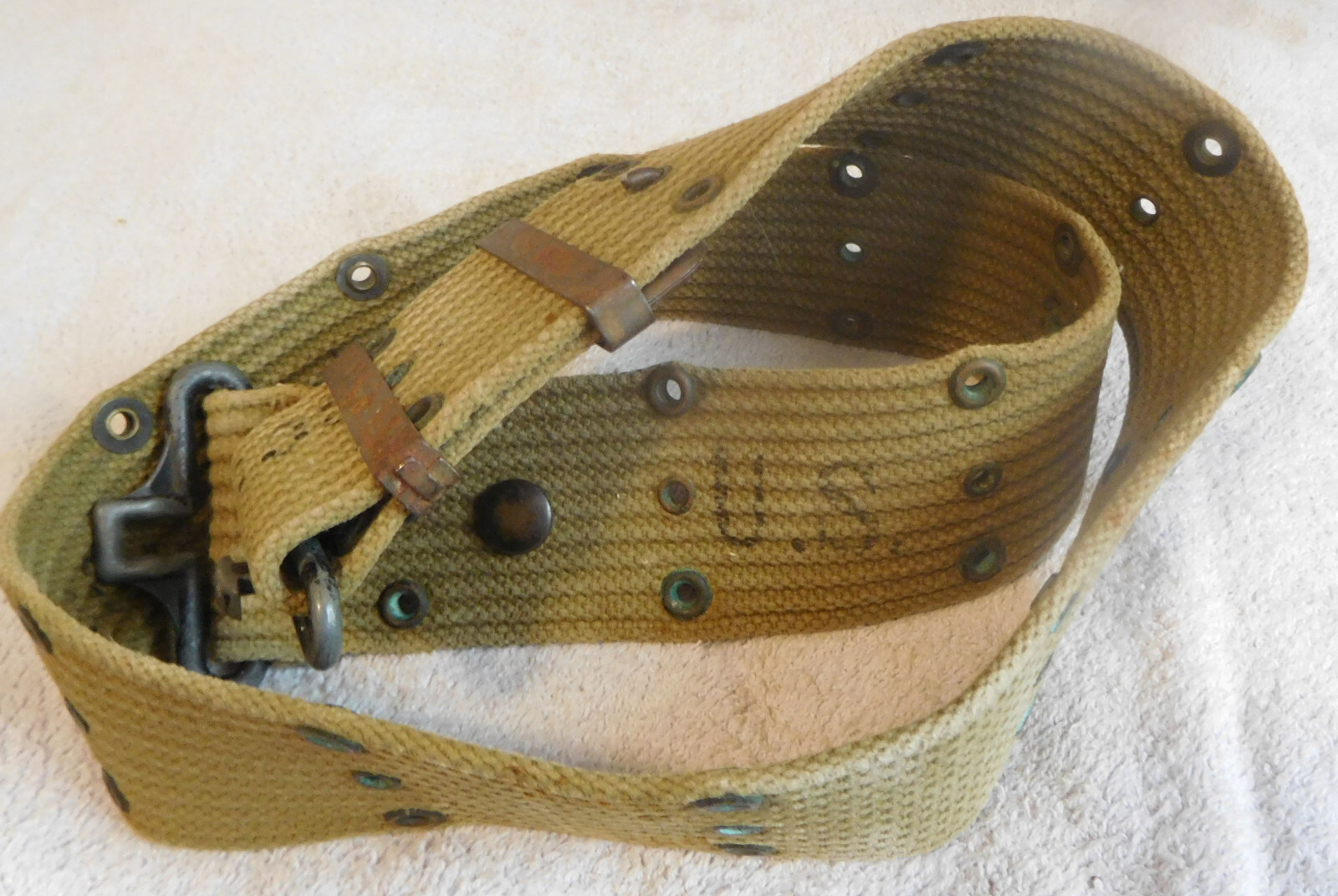
A 1942-dated U.S. Belt, Pistol or Revolver, M-1936, manufactured by NASCO. The belt is made of light olive drab cotton webbing with three rows of metal grommets, adjustable internal hooks, an exterior pouch snap, and a blackened interlocking buckle.
Images
Specifications
| General Information | |
|---|---|
| Official Nomenclature | Belt, Pistol or Revolver, M-1936 |
| Common Name | M-1936 pistol belt or M36 pistol belt |
| Country | United States |
| Service Association | U.S. Army |
| Era | World War II |
| Date | 1942 |
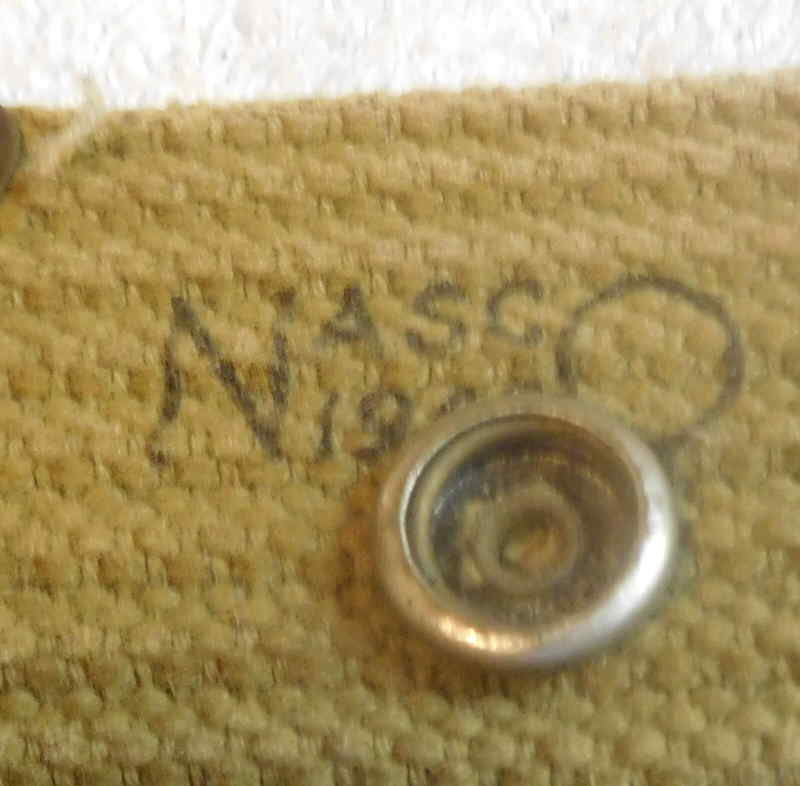
| Maker Marking | NASCO / 1942 |
| Material | Woven cotton webbing with metal hardware |
| Color | Light olive drab or khaki, consistent with early-war OD shade 3 webbing |
| Construction | Adjustable web belt with three horizontal rows of reinforced metal grommets |
| Closure | Two-piece blackened metal interlocking buckle |
| Adjustment | Internal metal hooks engaging the center row of grommets |
| Equipment Attachment | Grommets for suspenders and M1910-pattern double-hook equipment |
| Exterior Snap | Attachment point for compatible pistol or carbine magazine pockets |
| Condition | Service and storage wear, staining, surface oxidation, and localized verdigris; maker and date remain legible |
| Restoration | None. Documented as found. |
Historical Summary
This belt is a 1942 example of the U.S. Army M-1936 pistol and revolver belt, one of the principal foundations for American individual field equipment during World War II. Unlike an infantry cartridge belt, it did not contain fixed ammunition pockets. Instead, it served as an adjustable platform for the holster, magazine pocket, canteen, first-aid pouch, and other equipment required by the wearer.
The M-1936 belt retained the established U.S. grommet-and-hook equipment system while providing an updated buckle and adjustment arrangement. It could be worn alone or supported by M-1936 suspenders, and it was often used with the M-1936 canvas field bag, commonly called the musette bag.
The M-1936 Pistol Belt
The official designation was Belt, Pistol or Revolver, M-1936. The pattern developed from earlier U.S. pistol and revolver belts and was standardized as part of the Army's 1936 equipment revisions. The belt was associated especially with officers, mounted troops, specialist personnel, and soldiers whose weapons or duties did not require the ammunition pockets of the M1923 rifle cartridge belt.
Period equipment combinations show the M-1936 belt carrying the M1916 leather holster for the M1911A1 pistol, an M1923 double pistol-magazine pocket, an M1910 canteen and cover, and an M1924 or M1942 first-aid pouch. It was also used in M1 carbine equipment sets with the appropriate carbine magazine pocket. The exact load depended on the soldier's weapon, assignment, and unit practice.
Construction and Attachment System
The belt is woven from heavy cotton webbing and reinforced with three horizontal rows of metal grommets. Internal metal hooks engage the center row to adjust the length. The upper and lower grommets provide attachment points for suspenders and equipment fitted with the M1910 double-hook system. This arrangement allowed the wearer to move or replace individual items without changing the belt itself.
A large snap fastener is mounted on the outer face near one end of the belt. Compatible magazine pockets looped around the belt and snapped into this fitting to reduce unwanted movement. The two-piece buckle closes by interlocking its shaped metal halves. On this example the buckle retains a dark finish, while several grommets show green verdigris and other hardware shows age-related oxidation.
NASCO 1942 Marking
The inside of the belt is stamped NASCO above the date 1942. The nearby snap partly covers the lower portion of the marking when the belt lies flat, but the full date can be seen by gently lifting the webbing around the snap. The placement and partial obstruction are normal consequences of the belt's construction rather than evidence of an incomplete stamp.
The artifact record preserves the maker's wording exactly as stamped. The uneven impression is consistent with ink applied to coarse woven webbing, and the close-up photograph records the marking in its present condition.
From the M1910 System to M1956 and Beyond
The M-1936 belt belongs to a longer development of American load-carrying equipment. The M1910 equipment system established the familiar use of grommeted web belts and double-hook attachments for the canteen, first-aid pouch, bayonet, and other field items. Early pistol and revolver belts adapted that system for personnel who did not wear the standard rifle cartridge belt.
The M-1936 pattern refined the sidearm belt and integrated it with the M-1936 suspenders and field bag. It remained important through World War II and continued in postwar service beside later equipment. The M1956 Individual Load-Carrying Equipment system then introduced a more universal belt-and-suspender arrangement with standardized ammunition pouches and slide keepers, while still retaining compatibility with some older M1910-hook equipment.
During the Vietnam era, the M1967 Modernized Load-Carrying Equipment shifted major components from absorbent cotton canvas to nylon. The ALICE system followed in the 1970s, continuing the same basic principle of a belt-supported, modular combat load. The 1942 M-1936 belt therefore represents an important middle stage between the M1910 equipment family and the later universal load-carrying systems.
Collector Notes
Important identifying features on this example are the three-row grommet layout, internal adjustment hooks, blackened interlocking buckle, exterior magazine-pocket snap, light olive drab cotton webbing, and the NASCO / 1942 stamp. The staining, oxidation, and verdigris are visible parts of the belt's service and storage history.
Provenance and Assessment
Relics & Rifles collection. The belt was photographed as found, with no restoration performed. It is documented as a U.S. M-1936 cotton web pistol belt manufactured by NASCO in 1942. Its construction, hardware, attachment layout, and maker/date marking make it a representative early World War II example of the belt used as the foundation for sidearm, carbine, and specialist field-equipment sets.