
U.S. Field Telephone Communications Display: EE-8-B, TA-312/PT and WD-1/TT Field Wire
U.S. Field Telephone Communications Display
EE-8-B and TA-312/PT field telephones with a 1968 MX-306A/G dispenser of WD-1/TT field wire, representing U.S. equipment from World War II through the Vietnam era
Images




Identification and Specifications
| Display Overview | |
|---|---|
| Country | United States |
| Period Represented | 1945–1968; World War II through the Vietnam era |
| Display Type | Two field telephones with a portable dispenser of two-conductor field wire |
| Interpretation | A historically coherent, period-correct representation of a two-station field-telephone circuit |
| Telephone EE-8-B | |
| Model | Telephone EE-8-B |
| Manufacturer Marking | CONN. TEL. & ELECTRIC DIV. G.A.I. — Connecticut Telephone & Electric Division, Great American Industries |
| Date / Order Marking | 9960-PH-45-22; the “45” supports a 1945 date |
| Handset | TS-9-AP |
| Case Markings | “FDC / B” on front; “102” on flap; “1 197” on rear |
| Power and Signaling | Two 1.5-volt dry cells for speech; hand-crank magneto for ringing |
| Condition | Operational,canvas case retains dull, worn remnants of a possible period moistureproofing and fungiproofing coating |
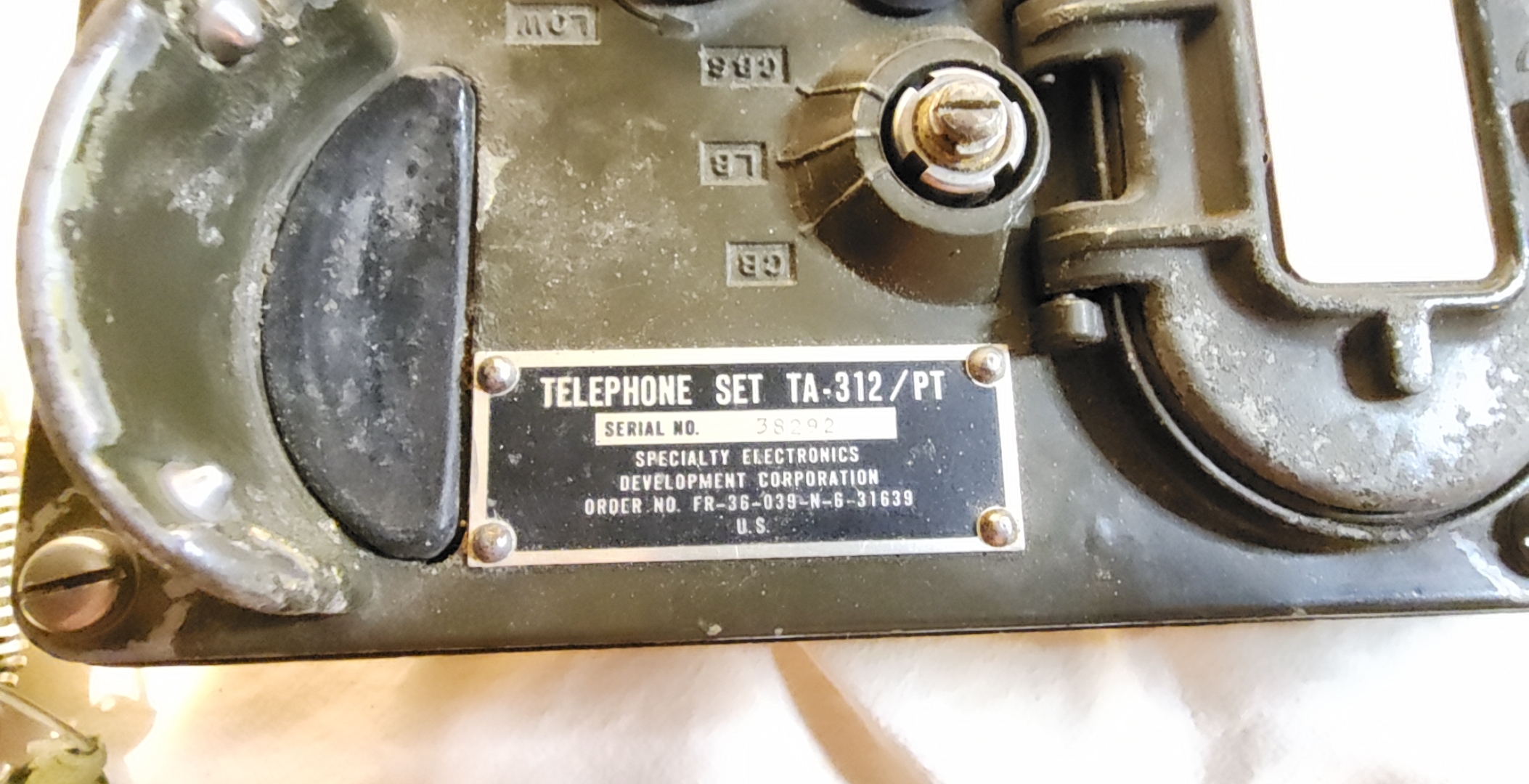
| Telephone Set TA-312/PT | |
| Model | Telephone Set TA-312/PT |
| Manufacturer | Specialty Electronics Development Corporation |
| Serial Number | 38292 |
| Order Number | FR-36-039-N-6-31639; associated with a February 28, 1966 Army Electronics Command award |
| Handset | H-60/PT |
| Case | CY-1277B/PT; faded stencil appears to repeat the telephone’s order number |
| Carrying Strap | U.S. general-purpose strap with partial DSA-100-68-C-… marking; 1968 supply item |
| Modes | Local-battery and common-battery operation; two-wire field line |
| Wire Dispenser MX-306A/G | |
| Model | MX-306A/G |
| Wire | WD-1/TT two-conductor field-telephone wire |
| Nominal Load | 1/2 mile — approximately 2,640 ft (805 m) |
| Manufacturer | Southwire Co. |
| Contract | DSA-500-68-C-8044 |
| Stock Marking | KZ 6145-160-7795 |
| Date Marking | US-1968 |
| End Markings | “STANDING END” and “PAYOUT END” |
A Field-Telephone System in Three Objects
This display brings together the three basic parts of a simple tactical wire circuit: a calling telephone, a receiving telephone, and the wire that connected them. The EE-8-B represents the wartime generation of U.S. local-battery field telephones. The TA-312/PT represents its ruggedized postwar successor, widely associated with Cold War and Vietnam-era service. The MX-306A/G provided a compact, expendable means of carrying and rapidly paying out WD-1/TT field wire between stations.
The artifacts span more than two decades but are technically and historically compatible. U.S. training material paired TA-312/PT telephones with WD-1/TT wire, while EE-8-series magneto telephones could operate on the same basic two-wire local-battery circuit. The resulting display shows both continuity and change in American field communications from World War II into the Vietnam era.
Telephone EE-8-B — Connecticut Telephone & Electric, 1945
The EE-8 family was designed for point-to-point use or connection through field switchboards. Two dry cells powered the carbon transmitter during speech, while a hand-cranked magneto sent ringing current down the line. This division of functions made the set simple, economical, and dependable: batteries were needed for talking, but the operator generated the call signal mechanically.
The internal schematic plate is the best dating evidence on this example. It bears the manufacturer abbreviation “CONN. TEL. & ELECTRIC DIV. G.A.I.” and the code “9960-PH-45-22,” identifying Connecticut Telephone & Electric Division of Great American Industries and supporting a 1945 production or procurement date. The handset is marked TS-9-AP.
The front stencil “FDC / B” is interpreted as Fire Direction Center, Battery B, a use consistent with the telephone’s role in an artillery wire network. The additional “102” and “1 197” markings are recorded as they appear on the case.
TM 11-333 devoted a maintenance section to moistureproofing and fungiproofing EE-8-series equipment used in tropical areas with extremely high temperature and humidity. The prescribed treatment used a moisture- and fungus-resistant varnish for protection against fungus, insects, corrosion, salt spray, and moisture. The dull, transparent coating remnants on this canvas case are consistent with such a period service treatment and have worn away over most of the exposed surface.
Telephone Set TA-312/PT — 1966 Contract
The TA-312/PT retained the two-wire, local-battery concept while placing the telephone in a sealed metal housing with weather-resistant controls and an H-60/PT handset. It could be used point-to-point or through a switchboard and could remain inside its CY-1277-series canvas case while operating. The line-binding posts and generator crank were accessible through the case openings.
The data plate identifies this set as Serial No. 38292, made by Specialty Electronics Development Corporation under Order No. FR-36-039-N-6-31639. A U.S. Government Accountability Office decision records that the Army Electronics Command awarded Specialty Electronics a TA-312/PT contract on February 28, 1966. The same decision describes an urgent Southeast Asia requirement with priority designator 02, placing this order firmly in the Vietnam-era procurement program.
The faded case stencil appears to read “CASE, TELEPHONE SET / CY-1277B/PT / FR-36-039-N-6-31639(E).” Repetition of the telephone’s order number evidence that the case belongs with the 1966 contract. The attached general-purpose shoulder strap is marked with a separate DSA-100-68-C-… contract number, dating the strap’s procurement to fiscal year 1968.
MX-306A/G and WD-1/TT Field Wire — Southwire, 1968
The MX-306A/G is a portable field-telephone wire dispenser. Its stencils identify a nominal half-mile load of WD-1/TT, a lightweight two-conductor wire used for tactical telephone circuits. The payout face gives contract DSA-500-68-C-8044 and names Southwire Co.; the opposite face is marked “US-1968.”
The 1947 War Department manual for the closely related MX-306/G describes the dispenser as an expendable drum container designed to feed wire from the center. A short standing-end lead allowed a telephone connection to remain active while wire paid out from the other end, and multiple dispensers could be connected in tandem for a longer run. The manual describes laying wire by hand, from vehicles, or from aircraft. On this example, the missing end closures, exposed wire, and worn fabric show that the container was opened and used; the amount of wire remaining cannot be determined.
From Forward Observer to Fire Direction Center
In an artillery communications chain, a forward observer positioned where the target area could be seen transmitted target locations and corrections to the fire direction center. Located with the artillery organization, the FDC converted that information into firing commands and passed the commands to the gun line.
The “FDC / B” case gives the display a strong operational theme: one telephone represents the observer or another calling station, the WD-1/TT wire forms the physical link, and the marked EE-8-B represents the receiving telephone at Battery B’s fire direction center.
Condition and Collector Notes
- The EE-8-B is reported operational after a careful cleaning and light lubrication.
- The EE-8-B case retains unusually evocative field-applied markings and dull remnants of a transparent coating consistent with period moistureproofing and fungiproofing treatment for tropical service.
- The TA-312/PT telephone and CY-1277B/PT case appear contract-matched through the repeated 1966 order number.
- The TA-312/PT shoulder strap carries its own 1968 procurement marking and is best cataloged separately from the telephone’s date.
- The MX-306A/G has substantial wear but retains excellent identification, maker, contract, date, and end-use stencils.
- The dispenser was originally packed with one-half mile of wire; the present length has not been measured.
Provenance
- Three U.S. military communications artifacts assembled as a research and display grouping
- EE-8-B marked “FDC / B,” “102,” and “1 197”
- TA-312/PT, Serial No. 38292, Order No. FR-36-039-N-6-31639
- MX-306A/G dispenser, Southwire Co., DSA-500-68-C-8044, marked US-1968
- Photographed, identified, and preserved as part of the Relics & Rifles research archive
Sources
- Primary artifact evidence: identification plates, schematic plate, canvas stencils, and owner photographs reproduced on this page
- U.S. War Department, TM 11-333, Telephones EE-8, EE-8-A and EE-8-B (March 1945)
- Department of the Army, TM 11-5805-201-12, Telephone Set TA-312/PT (manual index and scans)
- U.S. Government Accountability Office, Decision B-158025 (August 10, 1966)
- U.S. War Department, TM 11-2240, Wire Dispenser MX-306/G (January 1947)
- U.S. Marine Corps, “Fire Direction Center Provides Data During Exercise Desert Scimitar”
- Southwire, Company History
Editorial Note
These pages are presented for historical and collector-reference purposes. Relics & Rifles does not sell artifacts or facilitate transactions. Any discussion of configuration, markings, or accessories is descriptive and intended to preserve context for research.