Japanese Military Service Bag (奉公袋)
WWII-era Japanese Hōkōbukuro, a cloth service or mobilization bag used to carry military papers, insignia, and other required documents when reporting for duty.
Images
Specifications
| General Information | |
|---|---|
| Item | Japanese Military Service Bag |
| Japanese Name | 奉公袋 |
| Romanization | Hōkōbukuro |
| Country | Japan |
| Era | World War II |
| Type | Service or mobilization bag for reporting to military duty |
| Material | Lightweight khaki cloth with printed black text and white drawstring |
| Dimensions | Approx. 12 in. x 8 in. |
| Closure | Gathered drawstring top |
| Front Marking | 奉公袋 with smaller boxed owner identification panel |
| Reverse Heading | 収容品 ("Contents") |
| Likely Function | Holding military papers, insignia, and other required personal service items when answering a call-up or reporting for duty |
| Reported Provenance | Acquired in Shimane, Adachiku, Japan |
Overview
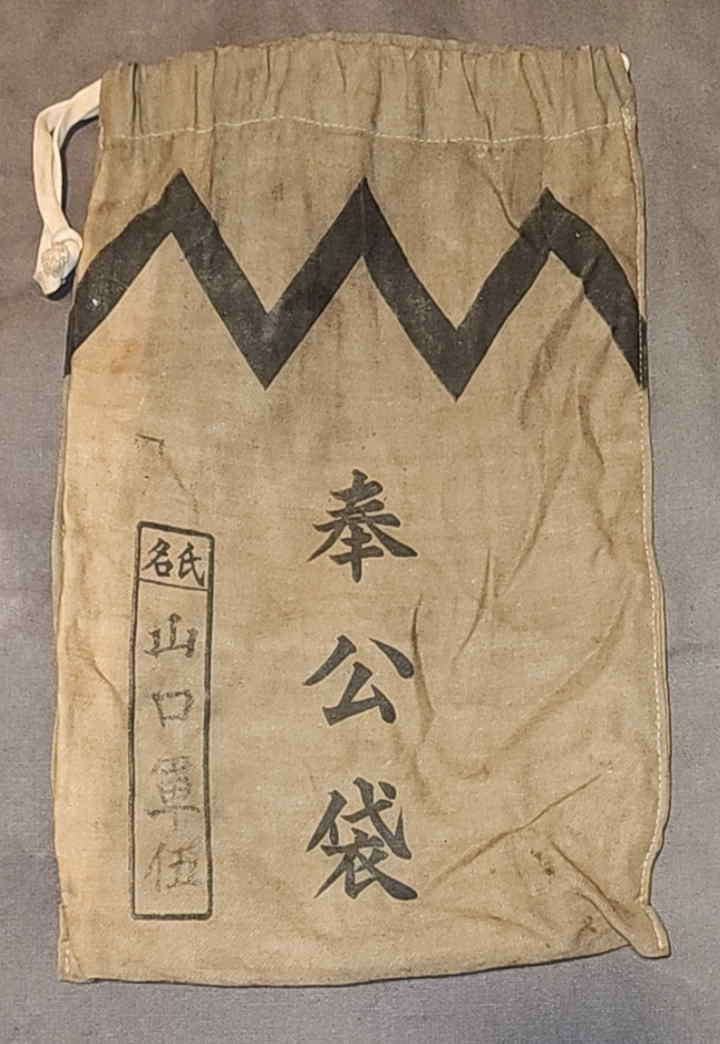
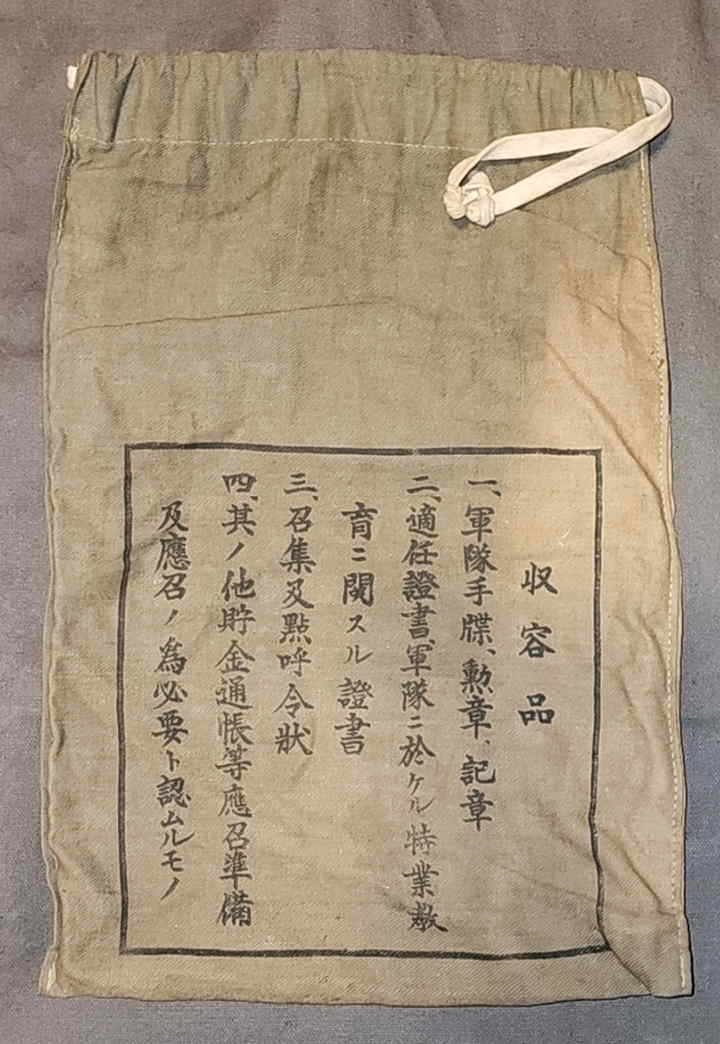
This cloth drawstring bag is a Japanese military 奉公袋 (Hōkōbukuro), a wartime service or mobilization bag for men reporting for military duty. At first glance it is a simple khaki cloth sack, but the printed markings make its purpose much more specific. The front carries a bold title, while the reverse preserves a contents panel explaining what the bag was intended to hold. That printed text is what elevates the piece from a generic cloth pouch to a documented military-related item tied to wartime administration, mobilization, and personal readiness.
It should not be understood as combat field gear in the same sense as webbing, a haversack, or a backpack. Instead, it belongs more to the administrative and personal side of military service. Comparable surviving Japanese examples are described as bags used when going to the military or answering a summons, with official and personal documents kept ready inside. That makes this a particularly interesting artifact because it reflects a part of wartime life that is often overlooked, namely the paperwork, preparedness, and institutional structure behind military service.
Markings & Translation
The large central inscription on the front reads 奉公袋, identifying the item as a service bag. The smaller vertical boxed panel at left appears to function as an owner identification field, likely intended for the bearer's name. A faint handwritten entry is still visible, although it is no longer fully legible from the present photograph. That detail is important because it gives the bag a more personal character and supports the idea that it was meant to be individually marked and carried by its owner.
The reverse is the most historically important side. It bears the heading 収容品, meaning "Contents," followed by a printed checklist in older Japanese orthography. In practical terms, the list indicates the sort of papers and personal service-related items that were expected to be kept inside:
1. Army service handbook, medals, and badges or insignia.
2. Qualification certificates and certificates relating to special military training.
3. Call-up and roll-call orders.
4. Savings passbook and other items considered necessary for mobilization preparation and for reporting to service.
Even if the exact wording varies slightly from surviving examples, the overall meaning is clear. This was a bag meant to keep official documents and other required items together in readiness for military duty. That purpose is stated directly on the artifact itself, which is one of the strongest features any collector could hope to find on a cloth item of this kind.
Physical Description
The bag is made of lightweight plain-woven cloth in a khaki or tan shade, with a gathered top closed by a white drawstring cord. Construction is straightforward and utilitarian, with stitched side seams and no unnecessary embellishment beyond the printed markings. The bold black title on the front and the boxed contents panel on the reverse were applied for legibility and function, not decoration, although the graphic zig-zag band near the top of the front gives the piece a striking visual identity.
Condition appears honest and consistent with age. The cloth shows wrinkling, general wear, and areas of staining or discoloration, but remains intact and displayable. The printed text still reads well, especially on the reverse, and the drawstring survives in place. From a collector's standpoint, it is exactly the kind of wear that supports authenticity rather than detracting from it. The bag does not appear over-cleaned or restored, and it retains the soft, used look expected of a period service accessory.
Historical Context
The safest and most accurate way to describe this piece is as a wartime Japanese military service or mobilization bag used when reporting for duty. It may well have been associated with recruits, reservists, or other men called into service, but the bag's printed wording points more broadly to military readiness and reporting obligations rather than to one single category of user. For that reason, it is better to avoid the overly narrow claim that it was simply "given to every new recruit" and instead identify it as a service-related bag intended to hold required papers and personal military documents.
Items like this reflect the bureaucratic side of wartime mobilization. A soldier did not report for service with only uniform pieces or field equipment. He also needed orders, handbooks, certificates, insignia, and other documents that formally tied him to the institution. This bag served as a practical way to keep those items together. In that sense, it stands at the intersection of the personal and the official. It is both a humble cloth carrier and a material reminder of how wartime states organized, documented, and moved men into service.
Comparable examples in Japanese museum and archival holdings show that the Hōkōbukuro was a recognized category of wartime material. Some are tied generally to military service, while others are associated with reservist or patriotic organizations. That wider context suggests that the term covered a family of related service bags connected with mobilization culture in the Showa period. The printed checklist on the present example fits squarely within that interpretation.
Collector Notes
From a collector's standpoint, this is a very appealing piece because it is both visually distinctive and historically readable. Many period cloth bags survive with little or no indication of their original purpose, but this one identifies itself directly. The front title is bold, the reverse contents panel is highly informative, and the owner panel adds a personal touch that helps the item feel connected to an individual rather than remaining a purely generic wartime pouch.
It is also a valuable display piece because it represents a lesser-seen side of Japanese military history. Collectors often focus on helmets, field gear, edged weapons, or ammunition, but service accessories tied to mobilization and official paperwork are less commonly encountered and often less well explained. This bag fills that gap nicely. It works especially well in a field gear collection because, while simple in form, it helps tell the story of how a serviceman prepared to leave for duty and what sort of items had to accompany him at that moment.
Provenance / Assessment
This piece was acquired in Shimane, Adachiku, Japan. That reported provenance should be preserved with the artifact record as received. While the bag itself is modest in construction, the printed markings give it strong interpretive value and place it within the broader framework of wartime Japanese service and mobilization material.
Based on the text, overall form, and comparison to documented Japanese examples of this type, the piece is an authentic wartime 奉公袋. The identification is: Imperial Japanese military service or mobilization bag for carrying required documents, insignia, and other personal service-related items when reporting for duty.