
Japanese Digestive Patent Medicine Packet
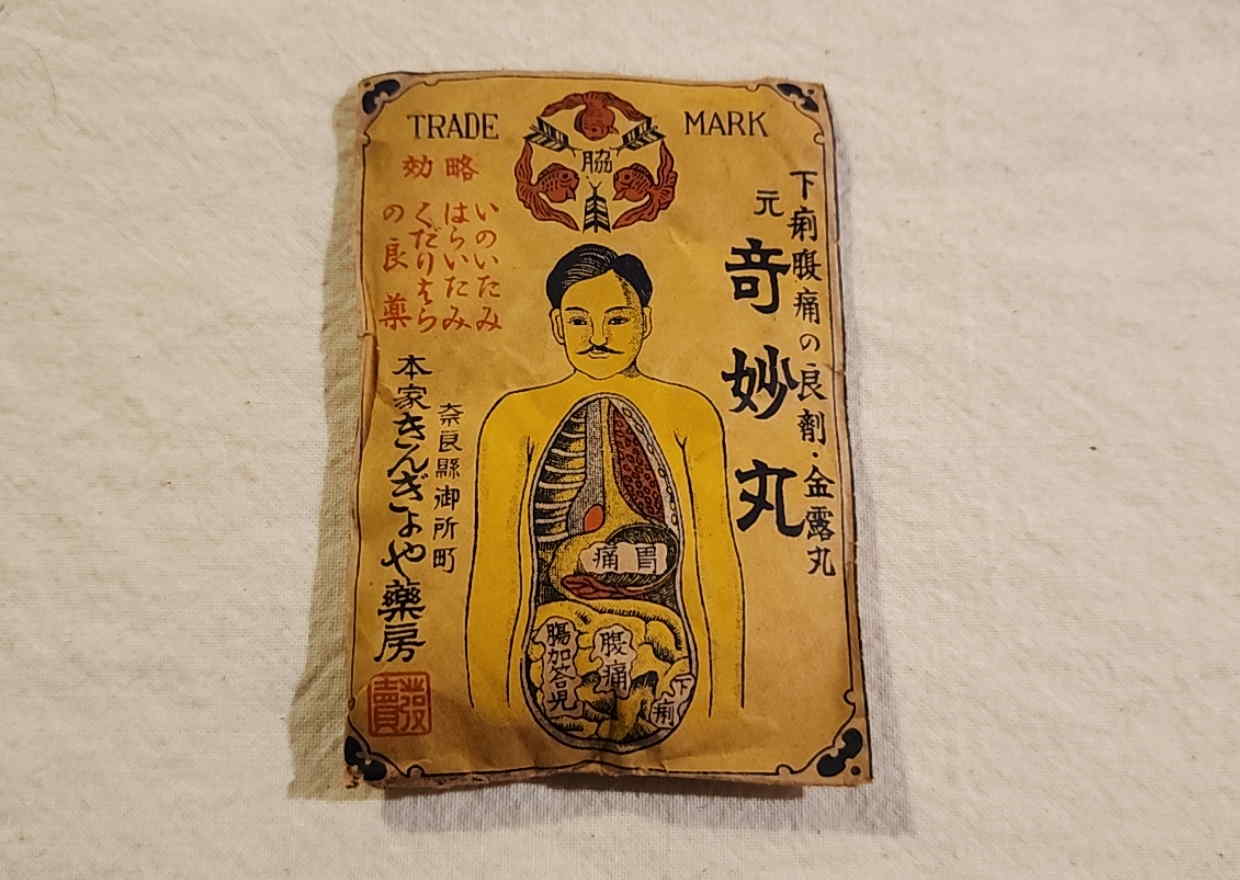
Marked 奇妙丸 and 金露丸, a traditional Japanese stomach and intestinal remedy from Nara Prefecture, late Meiji to early Showa period.
Images
Specifications
| General Information | |
|---|---|
| Artifact | Japanese Digestive Patent Medicine Packet |
| Main Product Name on Front | 奇妙丸 |
| Associated Remedy Name in Side Text | 金露丸 |
| Type | Traditional Japanese digestive and intestinal patent medicine |
| Region of Origin | Nara Prefecture, Japan |
| Date Range | Late Meiji to early Showa period, circa 1890s to 1930s |
| Attributed Seller / Pharmacy | Kingyo-ya Pharmacy, Nara |
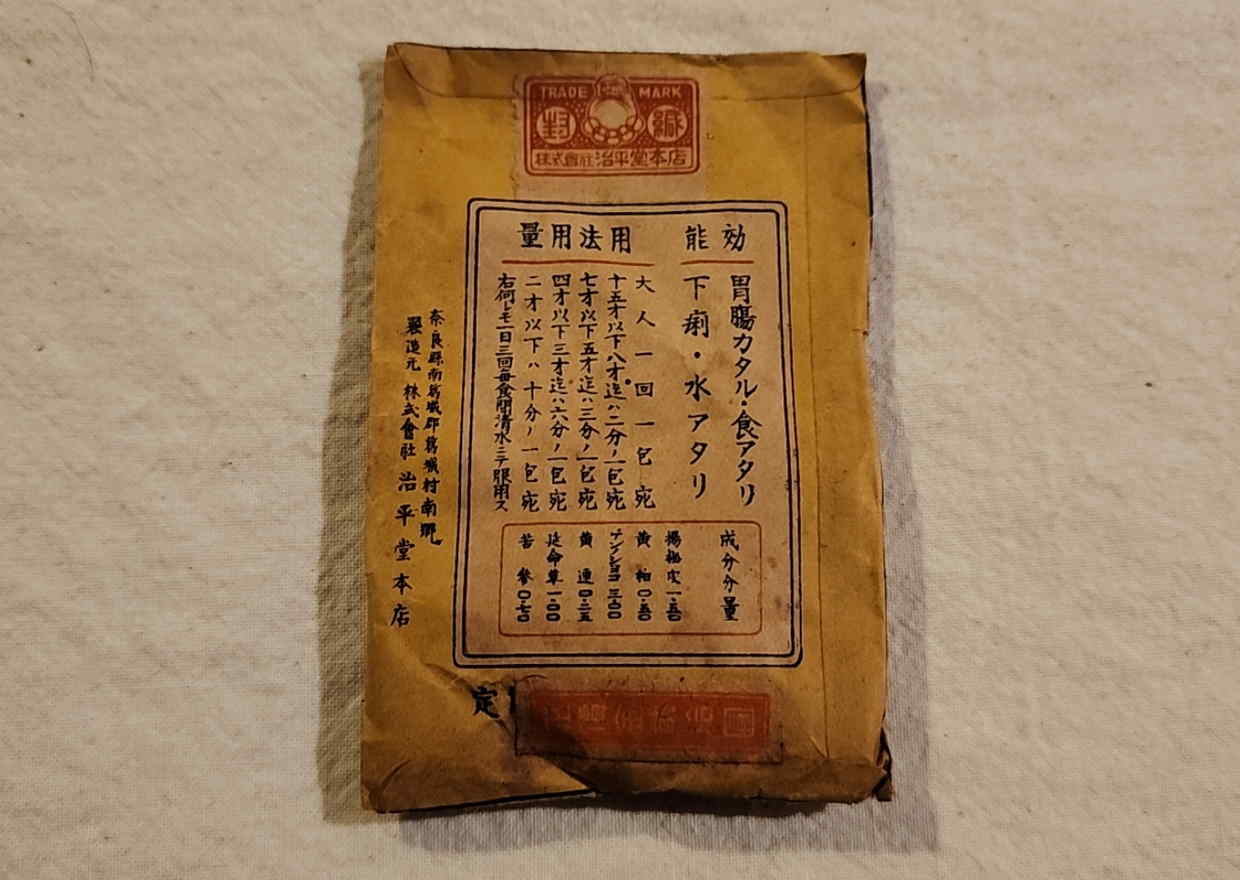
| Stated Uses | Diarrhea, abdominal pain, stomach and bowel complaints, food-related digestive upset, and bad-water complaints |
| Noted Ingredients | Traditional herbal ingredients including Amur cork tree bark and Coptis root, with additional listed crude-drug components |
| Dosage Form | Small pill medicine |
| Packaging Features | Printed paper packet with anatomical figure, trademark emblem, dosage panel, and period commercial typography |
Historical Summary
Name and Interpretation
This packet is best understood as a pre-war Japanese digestive patent medicine rather than a modern antacid. The wrapper itself preserves two names. The large central title on the front reads 奇妙丸, while the vertical wording at the right includes 下痢腹痛の良剤・金露丸, identifying it as a good remedy for diarrhea and abdominal pain and explicitly using the name 金露丸. Because both names appear on the packet, the most accurate presentation is to preserve both rather than force a single reading. In practical terms, the medicine was marketed as a stomach and intestinal remedy for common household complaints.
Digestive Remedies in Everyday Japan
Small paper medicine packets like this were once ordinary features of daily life in Japan. Long before modern branded pharmaceuticals dominated the market, families often relied on herbal and semi-proprietary remedies sold through pharmacies, medicine shops, and traveling vendors. Digestive complaints were especially common targets for these medicines because they affected daily work, travel, and household routines. Stomach upset, diarrhea, abdominal pain, spoiled food, and bad water were all practical problems in an era when sanitation varied and many families kept simple medicines on hand for immediate use. This piece belongs to that world of personal health management, where traditional remedies and commercial branding existed side by side.
Nara and the Herbal Tradition
The Nara attribution is important. Nara and the wider Yamato region have long been linked to the cultivation, study, and trade of medicinal plants. Japanese herbal practice drew heavily from Chinese medical traditions, but over time those ideas were localized into what became known as Kampo. Even after Western medicine gained official favor during the Meiji period, traditional herbal remedies remained active in everyday commerce. Many local pharmacies continued to sell trusted named preparations for ordinary ailments, especially those involving the stomach and bowels. A surviving packet such as this reflects that continuity. It is not simply a medicine wrapper. It is evidence of how traditional healing culture adapted to a modernizing consumer society.
Graphic Style and Dating
The visual design strongly supports a late nineteenth to early twentieth century date. The front uses a bold anatomical figure to show the internal organs and to make the medicine’s intended purpose immediately understandable. This kind of direct body imagery was common in Meiji, Taisho, and early Showa commercial medicine packaging, where vivid illustrations helped products stand out in crowded shop displays. The trademark emblem at the top, the formal vertical script, and the overall printed style all fit well with pre-war Japanese patent medicine culture. The reverse side continues the practical tone with clearly organized uses, dosage information, and ingredient content. Together, the two sides present a complete commercial object: attractive on the front, functional on the back.
Collector Importance
Although modest in size, this is a very strong personal-effects type artifact. Most such packets were disposable and were rarely saved once empty, which makes survivors useful for collectors interested in daily life, pharmacy history, medical ephemera, and Japanese material culture. In a Relics & Rifles context, it adds a human layer that larger field gear pieces often cannot provide. Rather than representing combat equipment alone, it reflects the quieter realities of bodily discomfort, self-treatment, and ordinary commercial life in historic Japan. That small-scale, personal quality gives the piece much of its charm and research value.
Collector Notes
This packet is especially appealing because it combines strong graphics, clear stated purpose, and regional attribution in a compact format. It should be described as a digestive patent medicine or stomach and intestinal remedy, not simply an antacid. It also remains sealed and unopened, with at least two original pills still physically detectable through the packet. That level of survival is especially desirable from a collector standpoint, as most comparable packages were discarded after use or survived only as empty wrappers. The dual appearance of 奇妙丸 and 金露丸 should also be preserved in the description, since both are visible on the wrapper. For collectors of Japanese ephemera, pharmacy history, or pre-war household material culture, that dual-name feature is not a problem. It is part of what makes the packet interesting.