German Reichswehr Army Belt Buckle
Weimar Republic pattern for enlisted men and NCOs; interwar attribution, approximately 1920s–mid-1930s
Images
Specifications
| General Information | |
|---|---|
| Country | Germany |
| Service | Reichsheer, the army component of the Reichswehr |
| Type | Enlisted men’s and noncommissioned officers’ box belt buckle |
| Pattern | Weimar Republic military design with republican eagle |
| Period Attribution | Interwar, approximately 1920s–mid-1930s; exact production year unidentified |
| Construction | One-piece stamped body with separately attached fastening hardware and edges turned inward to form a shallow box |
| Material | Likely nickel silver; exact composition unconfirmed |
| Inscription | GOTT MIT UNS — “God with us” |
| Emblem & Decoration | Weimar-style national eagle with downward-spreading wings, tied laurel branches, and ribbed detail |
| Surface | Finely pebbled background with raised circular central device |
| Fastening Hardware | Separate catch secured at two points; opposing roller assembly with two belt-adjustment prongs |
| Leather Support Tab | Not present |
| Manufacturer & Date | No maker or date mark identified |
| Original Wearer | Unidentified |
Historical Background
This belt buckle represents the enlisted men’s and noncommissioned officers’ pattern associated with the Reichsheer, the army component of Germany’s Reichswehr. Its republican eagle, GOTT MIT UNS inscription, and laurel decoration identify the familiar Weimar military design.
The Reichswehr was Germany’s armed force during the Weimar Republic and continued into the early Nazi period before becoming the Wehrmacht in 1935. Under the Treaty of Versailles, its army was restricted to 100,000 personnel. The buckle design retained the traditional military motto while placing the republican eagle at its center.
A replacement army buckle bearing the Wehrmacht eagle was officially introduced in January 1936, with some overlap in wear of the two patterns. Accordingly, the Weimar design alone does not establish that an individual buckle was manufactured before 1933.
Buckle Design & Symbolism
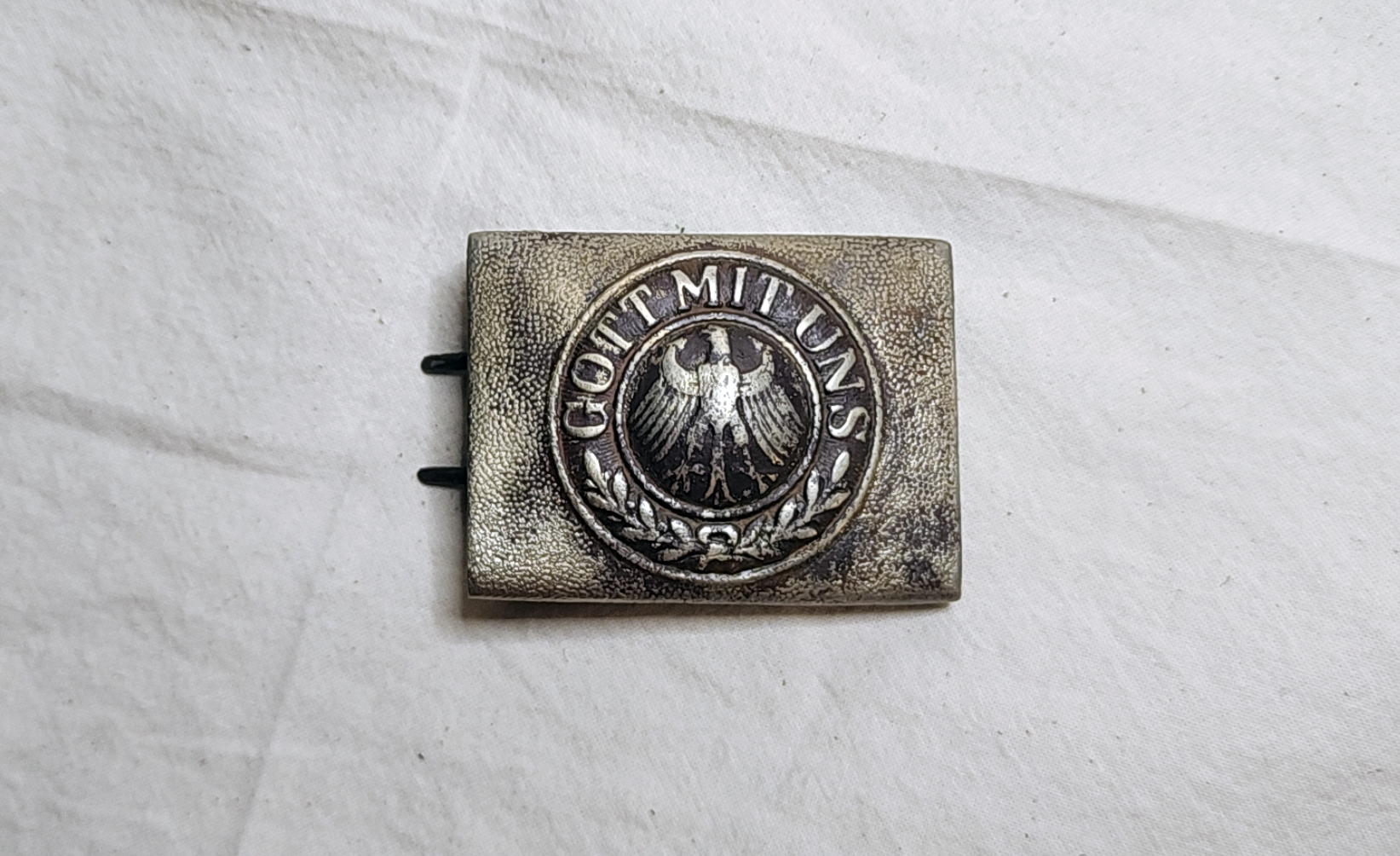
The front has a finely pebbled background surrounding a raised circular device. At its center is the Weimar-style national eagle with downward-spreading wings. The inscription GOTT MIT UNS, translated as “God with us,” occupies the upper portion of the surrounding ring, with tied laurel branches below.
Fine ribbing fills the space behind the lettering and foliage, while narrow decorative borders frame the device. The eagle, motto, and laurel arrangement remain clearly recognizable despite wear to the raised surfaces.
Construction & Fastening
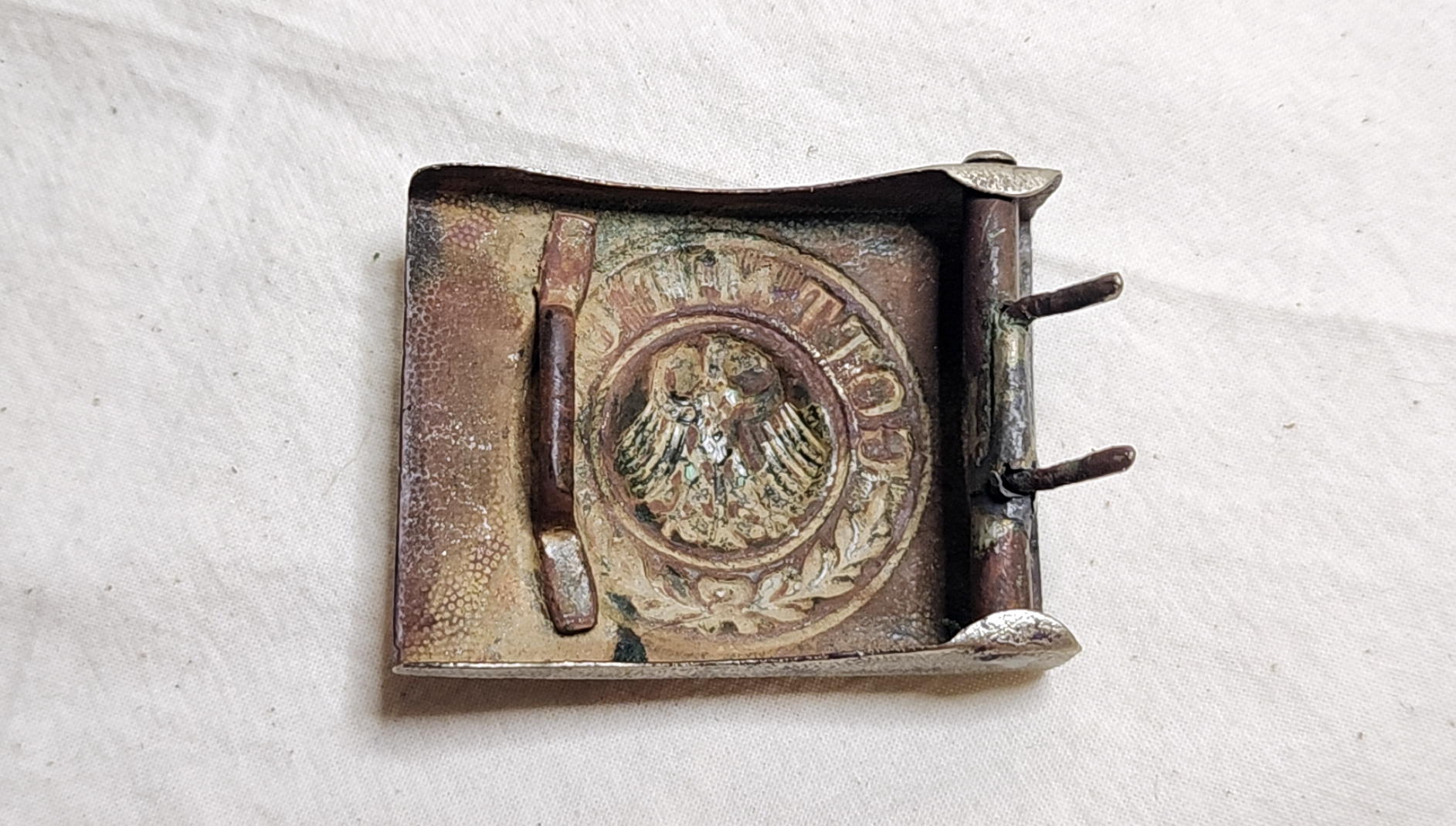
The reverse preserves the recessed impression of the front design, showing that the eagle, lettering, and surrounding decoration were pressed directly into the buckle body. The edges are turned inward to form the shallow box shape. Comparable examples have the same pebbled surface and one-piece, die-stamped construction.
A separate catch is secured at two attachment points on one side. The opposite side carries the roller assembly and its two belt-adjustment prongs. No leather support tab is present.
Attribution & Dating
This example is identified in the collection as an original period piece following examination of the pressing, roller construction, and two catch attachments. These structural details support that assessment alongside the surface wear and patina.
The period attribution is interwar, approximately the 1920s through the mid-1930s. No maker or date mark has been identified, and the exact production year and original wearer remain unknown. The buckle is thought to be nickel silver, but its exact composition has not been confirmed.
Condition & Collector’s Notes
The buckle shows silver-colored high points, darker recessed areas, and mottled brown and green discoloration on the reverse. Wear is visible on the eagle, lettering, borders, and fastening hardware, but the principal design remains clearly recognizable.
The recessed reverse impression, turned edges, roller construction, and two catch attachments are useful features for documenting this example. Its Weimar design places it within the transition between Germany’s interwar army equipment and the later Wehrmacht pattern, while the precise maker and production date remain unidentified.