U.S. M1 Bayonet, Union Fork & Hoe
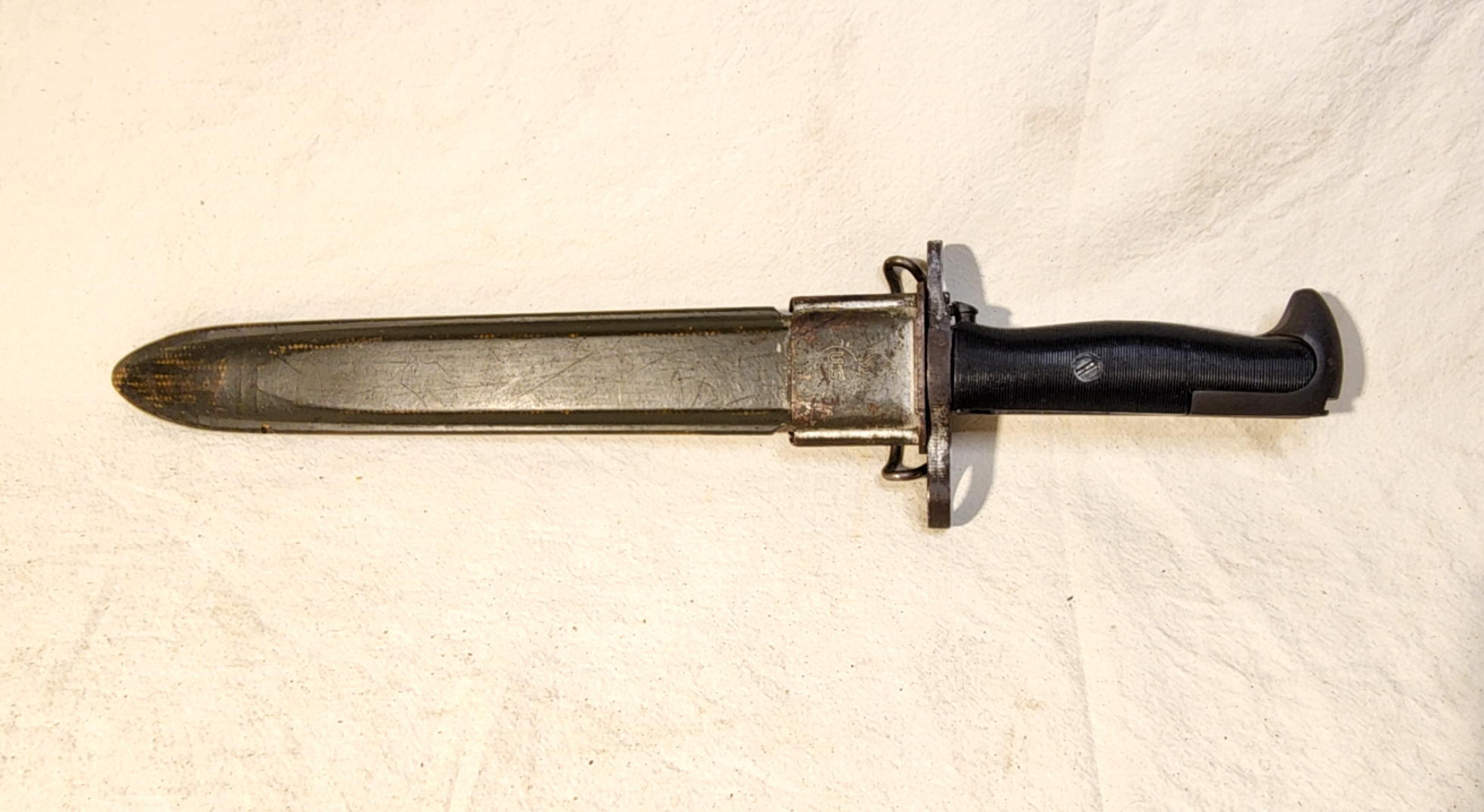
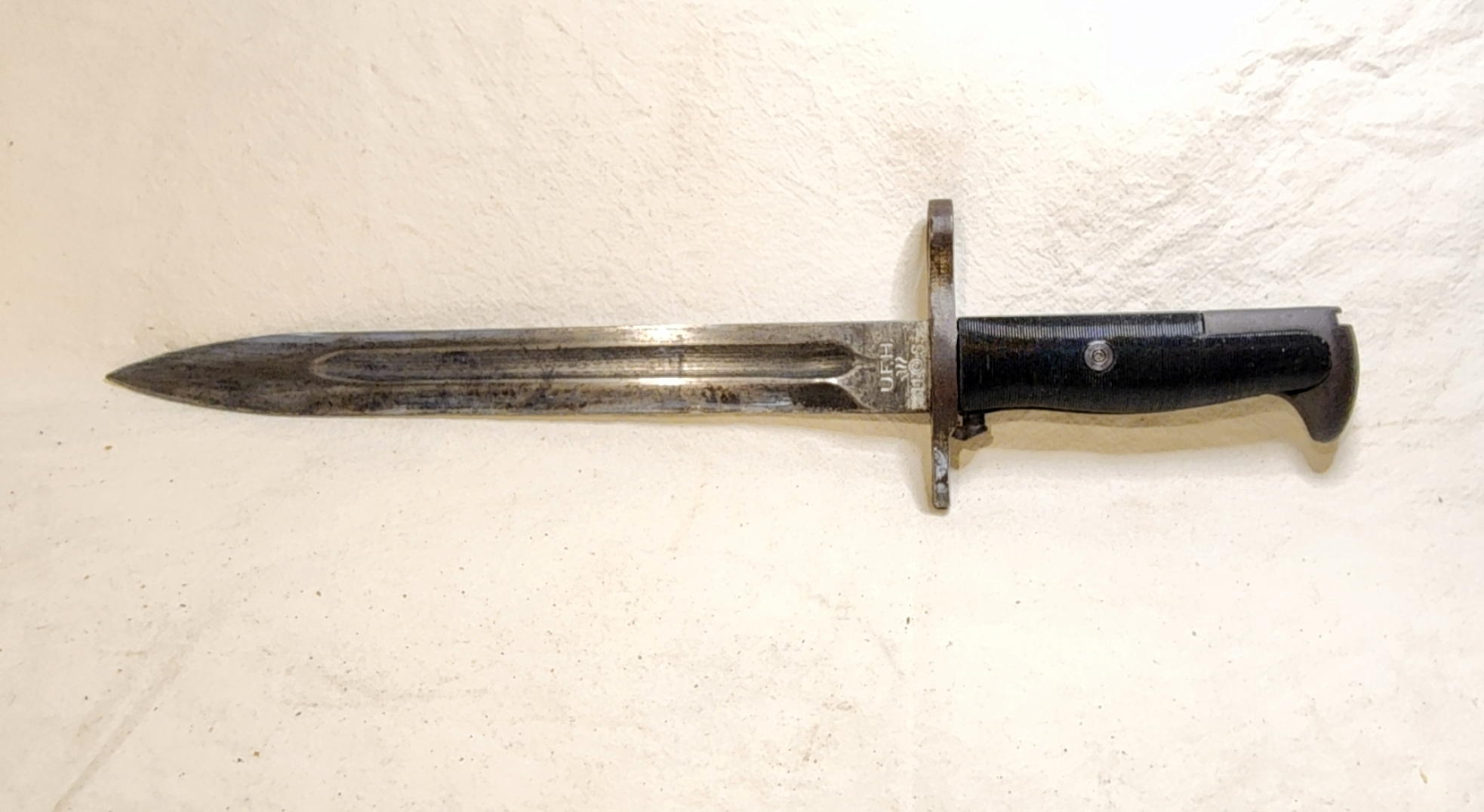
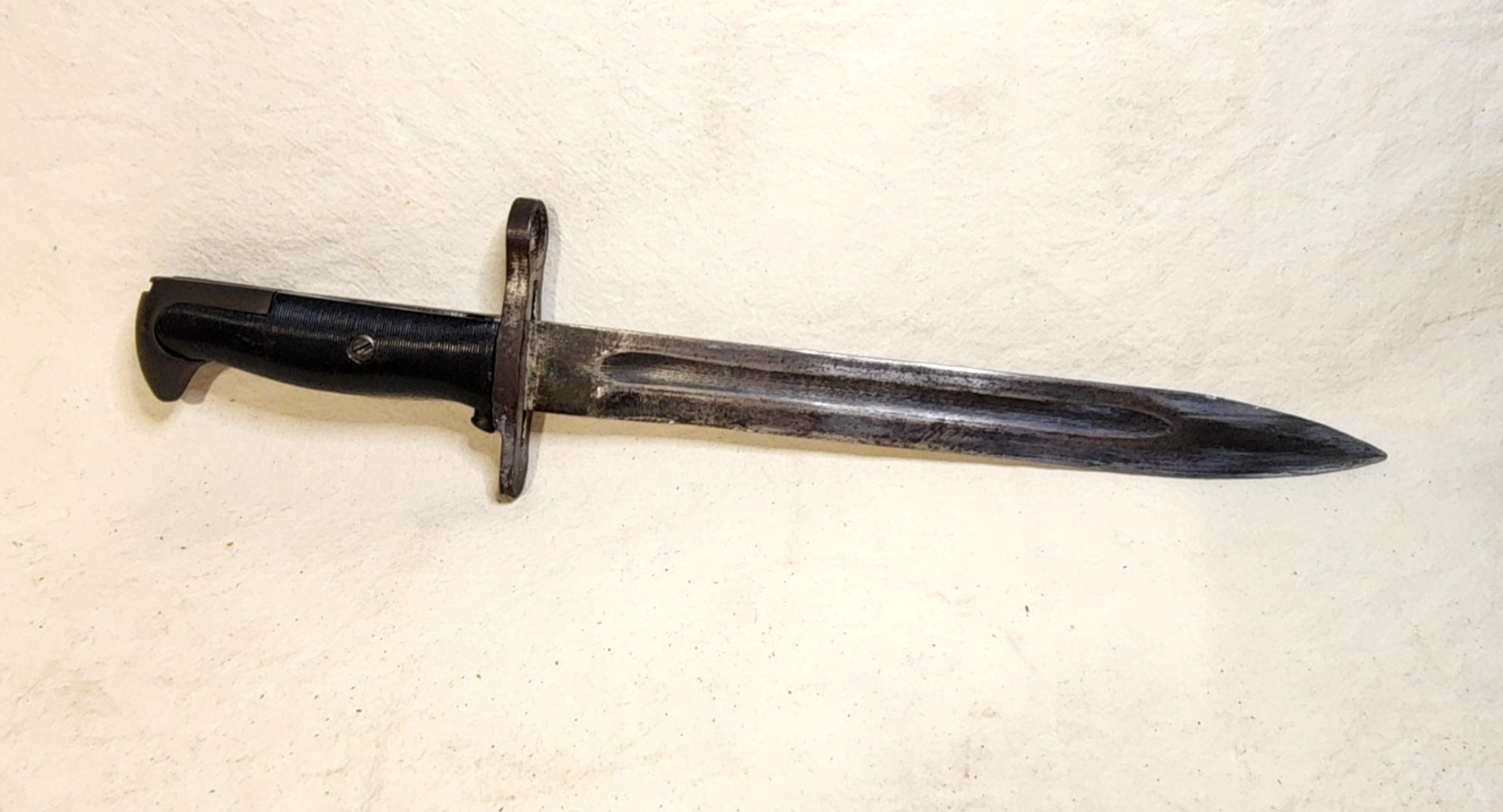
World War II ten-inch bayonet with Norton Laboratories grips, an H-marked pommel, and an M7-length scabbard
Images
Specifications
| General Information | |
|---|---|
| Identification | U.S. Bayonet, M1, manufactured with a ten-inch blade |
| Country and Period | United States; World War II, approximately 1943–1945 |
| Manufacturer | Union Fork & Hoe (U.F.H.) |
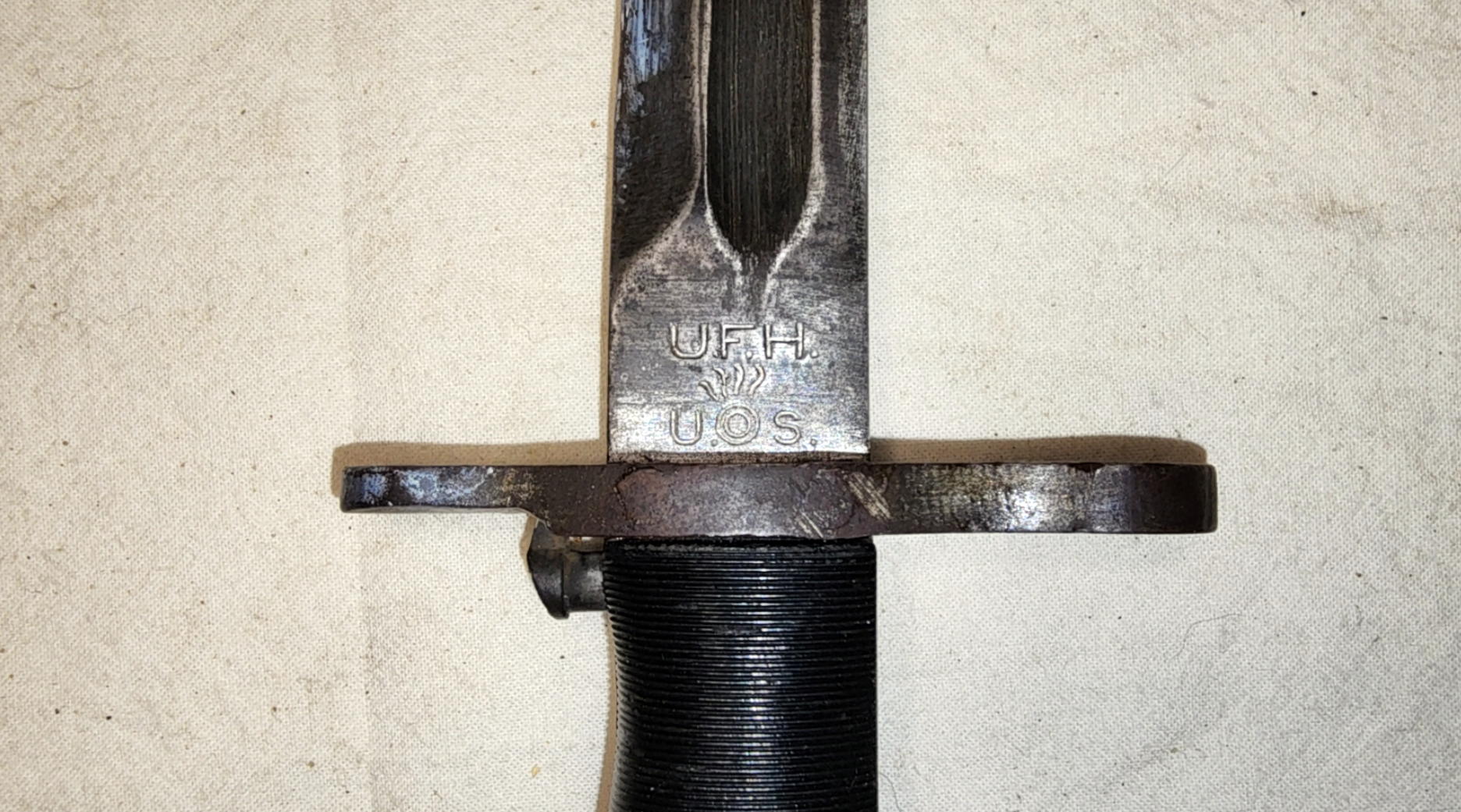
| Markings on Blade | U.F.H., U.S., and U.S. Ordnance shell-and-flame emblem on one ricasso; opposite face unmarked |
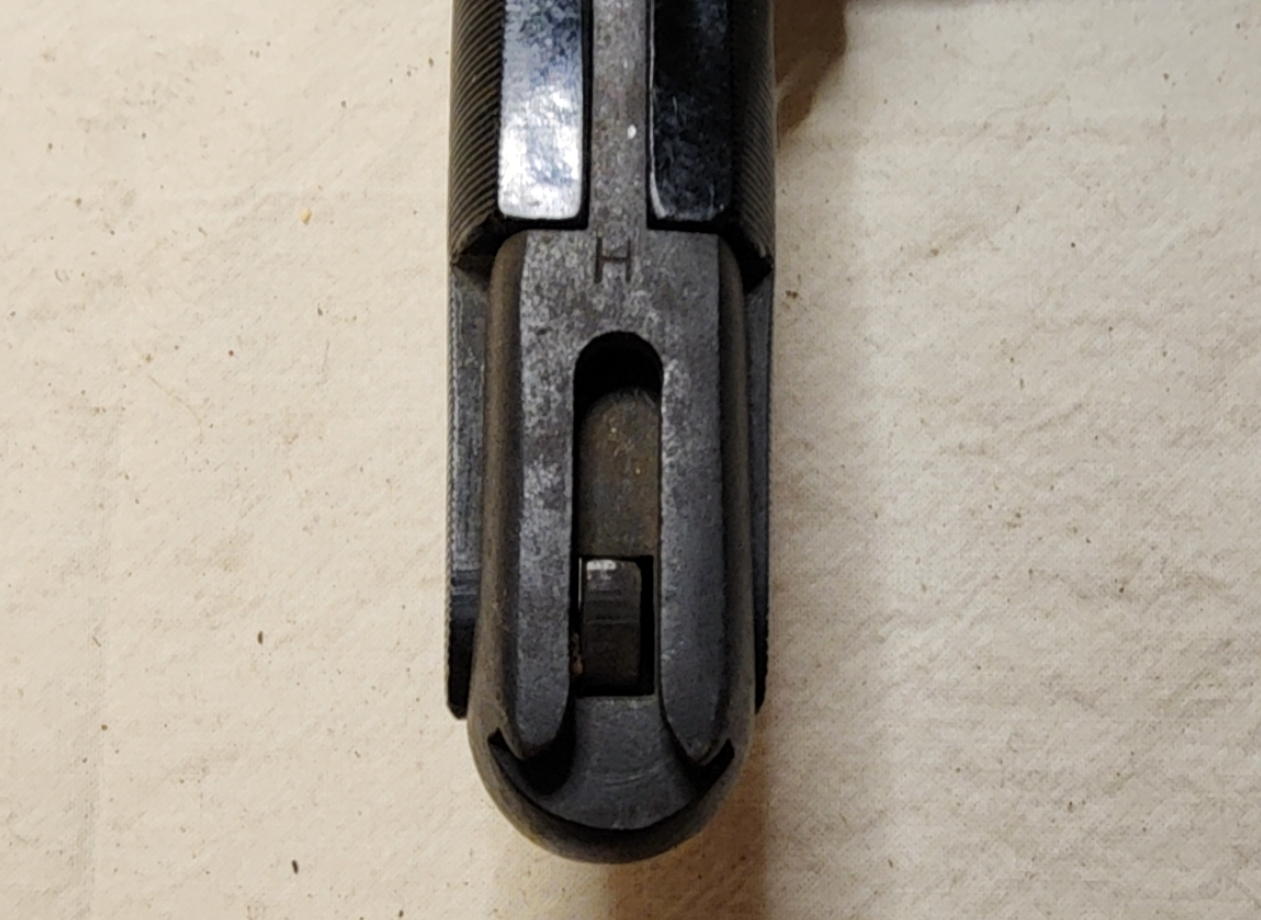
| Pommel Mark | H stamped near the T-shaped mounting slot; precise meaning undetermined |
| Blade | Single-edged, fullered steel blade with spear point |
| Blade Length | Approximately 10 in (254 mm), standard M1 specification |
| Overall Length | Approximately 14.4 in (366 mm), standard M1 specification |
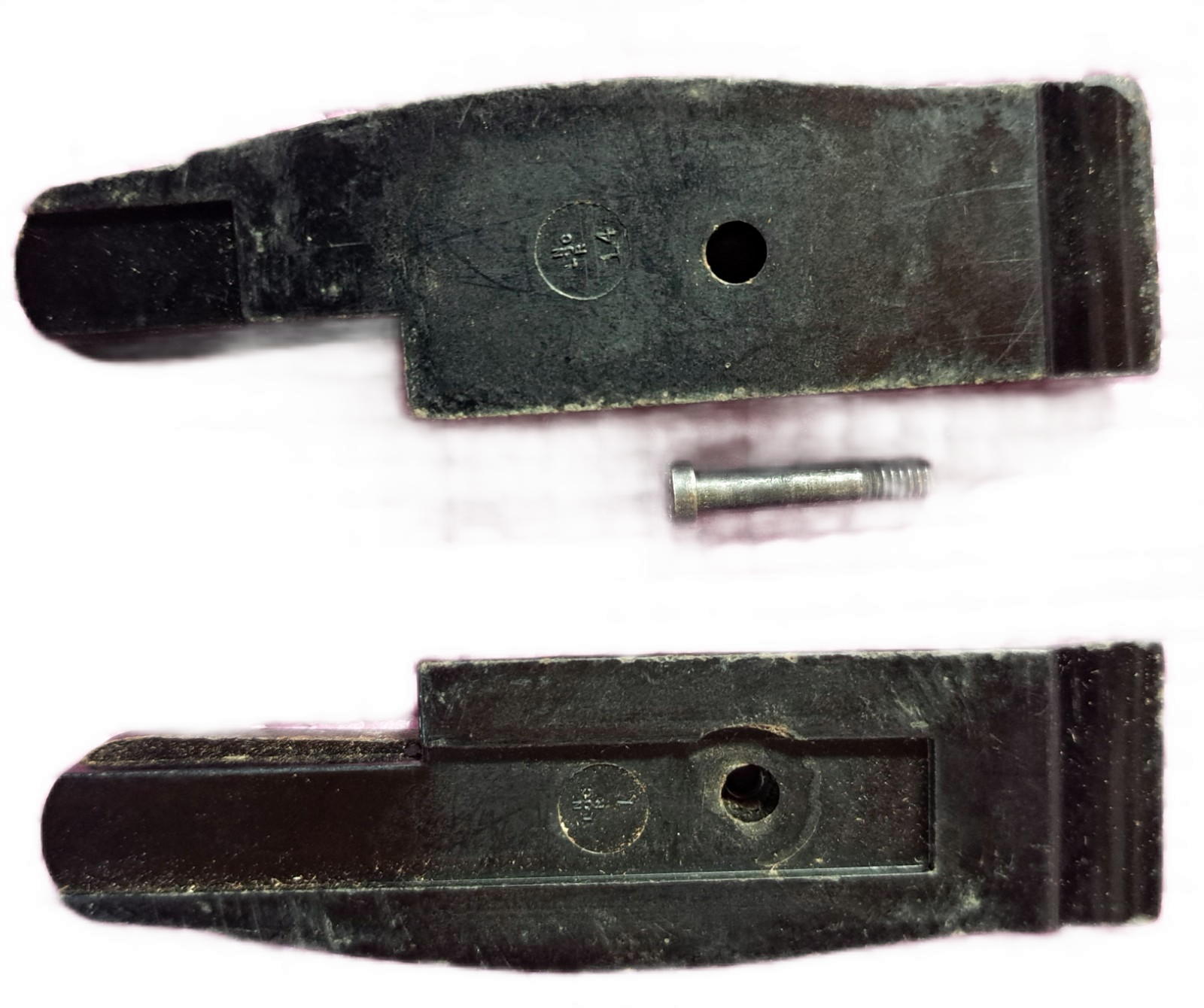
| Grips | Black grooved molded phenolic panels attributed to Norton Laboratories; undersides marked NOR LOC 14 and NOR LOC 1 |
| Mounting System | Muzzle-ring crossguard, T-slot pommel, and spring-loaded catch |
| Compatible Rifles | U.S. M1 Garand, M1903 Springfield, and M1903A3 Springfield |
| Scabbard | U.S. M7-length composite-bodied scabbard with steel throat and M1910-pattern wire hanger; an M3 shortened to M7 length |
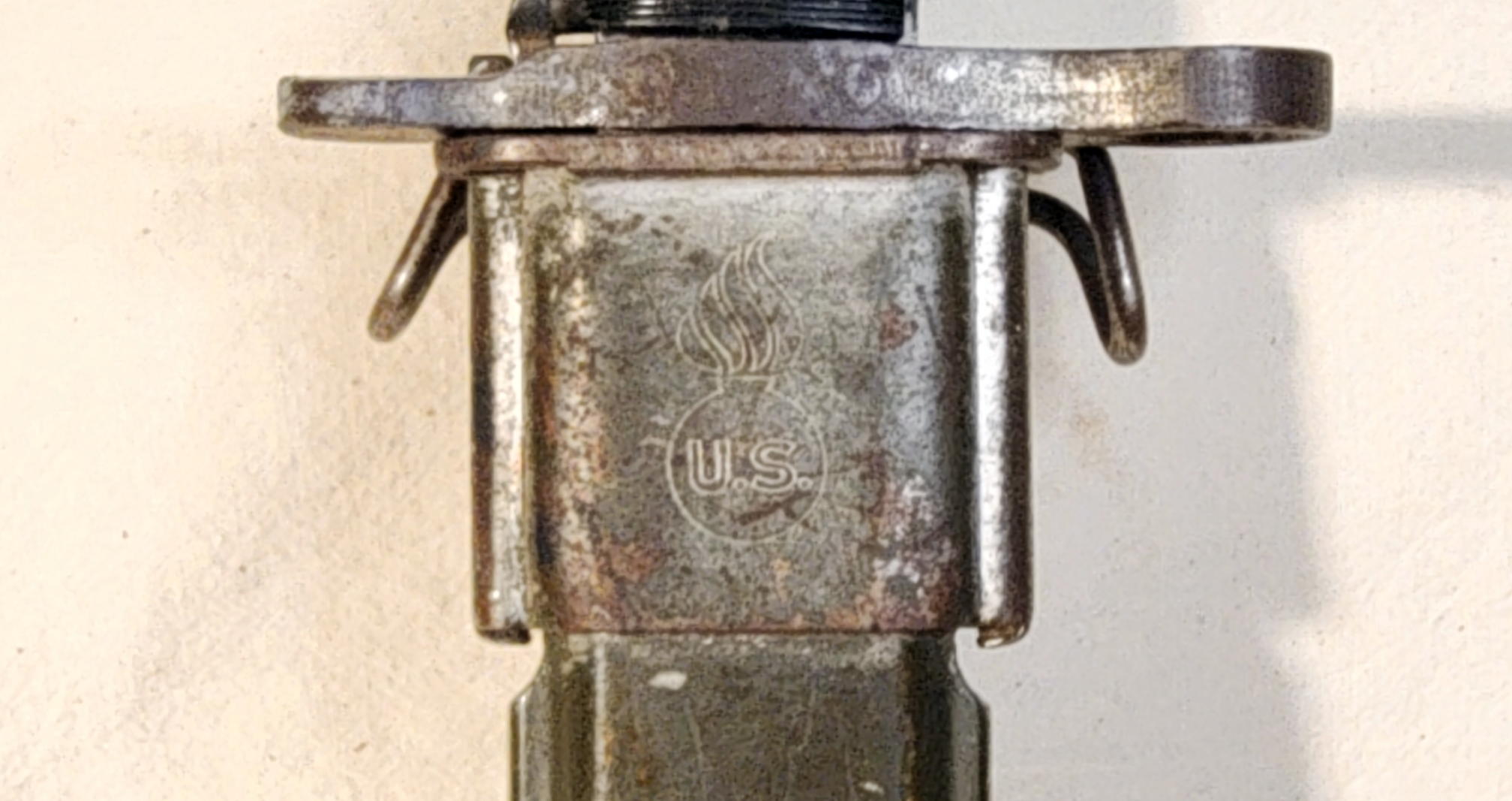
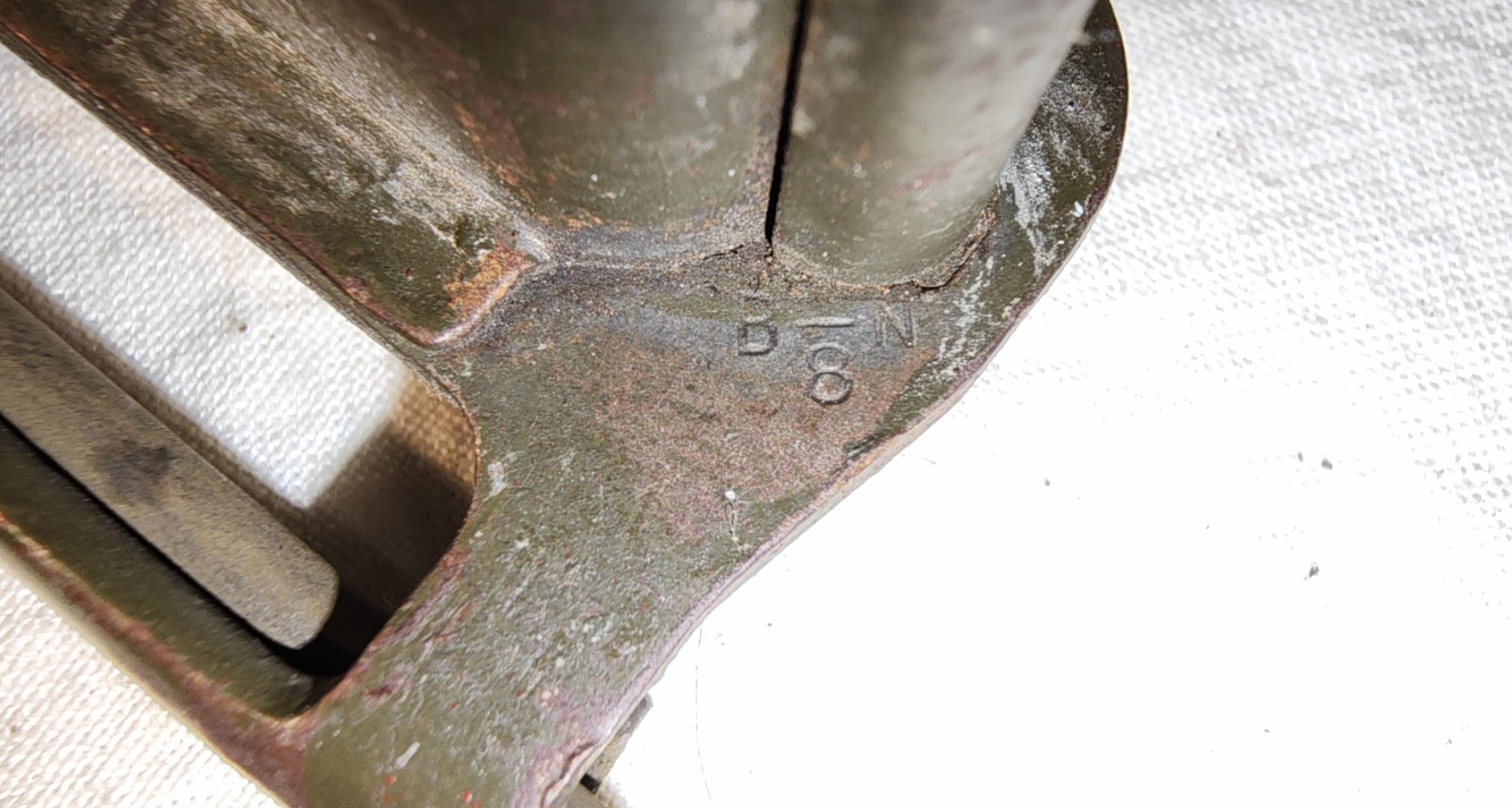
| Scabbard Markings | U.S. Ordnance shell-and-flame emblem on throat; B /8 N beneath top plate |
Identification
This is a Union Fork & Hoe M1 bayonet made for the ten-inch-blade pattern adopted during the Second World War. The fuller ends before the spear point, consistent with a blade manufactured at M1 length. Its surviving ricasso mark identifies the maker.
The bayonet is accompanied by a short U.S. scabbard. Its earlier-pattern throat stamp makes a wartime M3-to-M7 conversion likely.
Development of the M1 Bayonet
American forces entered the war with the sixteen-inch Model 1905 bayonet, used with the M1903-series rifles and the M1 Garand. Following trials of shorter bayonets, the Army standardized the ten-inch Bayonet, M1 in 1943. Contractors manufactured new M1 bayonets, while existing long M1905 bayonets were also shortened to the same blade length.
The original M1 and a shortened M1905 share the Army's M1 designation, but the fuller and blade markings can distinguish their manufacturing histories. On this example, the original-length M1 fuller ends well before the tip and the blade has the undated U.F.H. marking.
Blade and Pommel Markings
One ricasso bears U.F.H. above the U.S. Ordnance shell-and-flame emblem and U.S. The reverse face is plain. The hilt has a muzzle ring at the crossguard and a spring-loaded catch at the pommel for attachment to a rifle's bayonet lug.
An H is stamped on the underside of the pommel near the T-slot. Bayonet researcher Gary Cunningham documented another UFH M1 with an H in the same location. He discussed a possible heat-treatment association for H marks found on wartime bayonets but did not establish that meaning for this UFH stamp.
Norton Laboratories Grip Panels
The black, finely grooved grip panels are marked NOR LOC 14 and NOR LOC 1 underneath, as recorded when the grips were removed. The NOR LOC identification points to Norton Laboratories of Lockport, New York, a maker of molded phenolic bayonet grips during the war.
The differing numbers are believed to be mold identifiers used for production control. Norton grips are appropriate to a wartime M1 bayonet.
M7-Length Scabbard
The scabbard has a green molded composite body and a steel throat marked with the U.S. Ordnance shell-and-flame emblem. Its underside carries the code B /8 N. In Gary Cunningham's study of Beckwith scabbards, B is associated with Beckwith Manufacturing and N with New England Pressed Steel, which supplied the metal throat assemblies. The numbers identify a production sequence.
Cunningham recorded B /8 N within the range on the earlier, longer M3 scabbards, while recorded scabbards newly made at M7 length have later throat codes. This example's short body and early throat code therefore strongly suggest an M3 scabbard shortened to M7 length. Wartime M3 scabbards were converted after the shorter M1 bayonet was adopted.
Condition and Interpretation
The blade shows scratches, finish wear, and localized oxidation, especially near the point and on the exposed metal. The crossguard and pommel retain an aged surface. The grip panels remain intact. The scabbard has wear and oxidation around its metal throat, while its green body retains a comparatively even finish.
The visible marks support identification of a wartime UFH M1 bayonet, Norton-supplied grips, and a converted M3 scabbard. No unit, owner, theater, or individual service history.
Selected Research References
- Gary Cunningham, Bayonet Points No. 24 — M1 adoption, contracts, and wartime production.
- Gary Cunningham, Bayonet Points No. 23 — UFH markings, H-stamped pommels, and Norton Laboratories grips.
- Gary Cunningham, Bayonet Points No. 6 — M3 and M7 scabbard construction, throat codes, and shortening program.