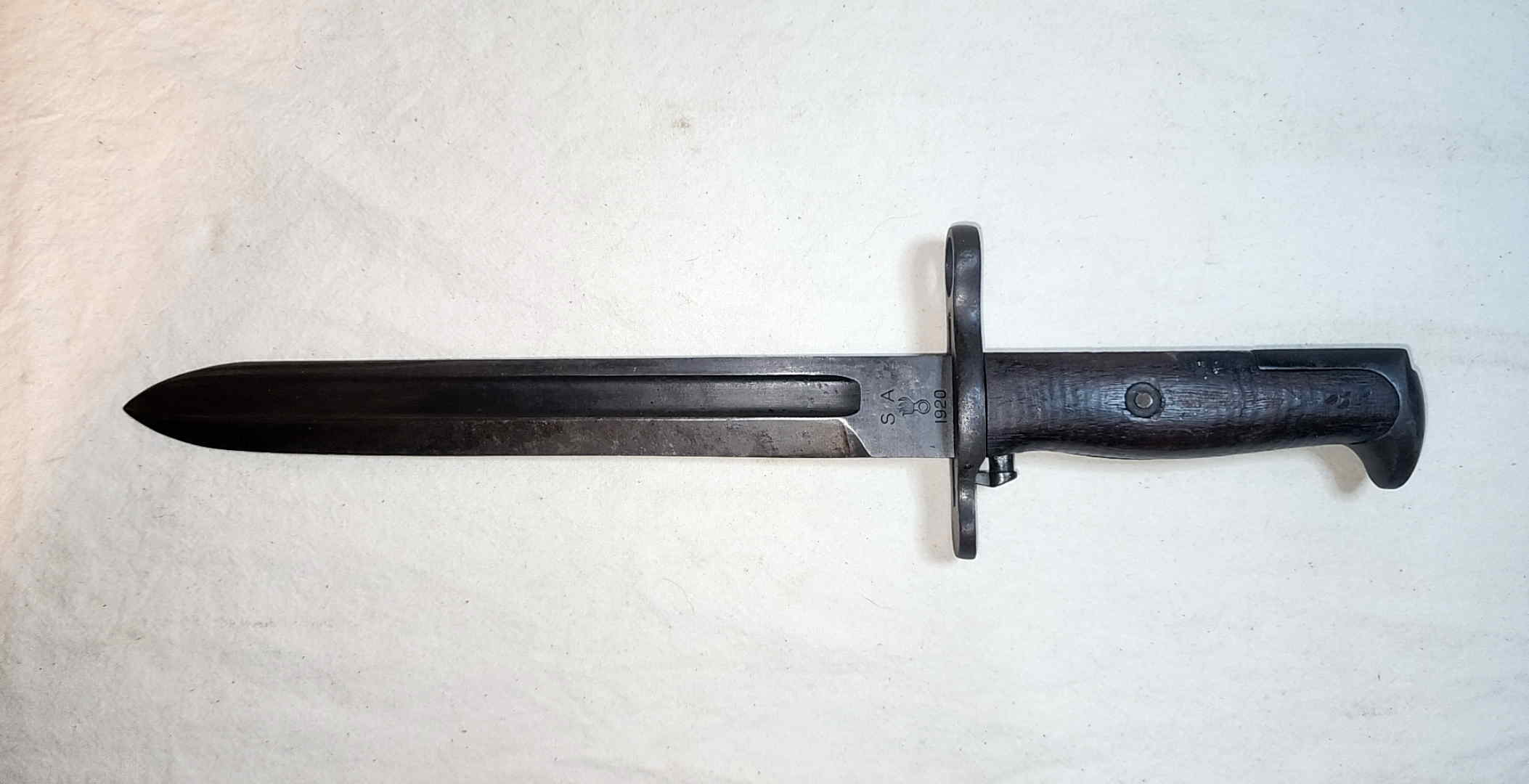
U.S. Model 1905 Bayonet, Springfield Armory 1920
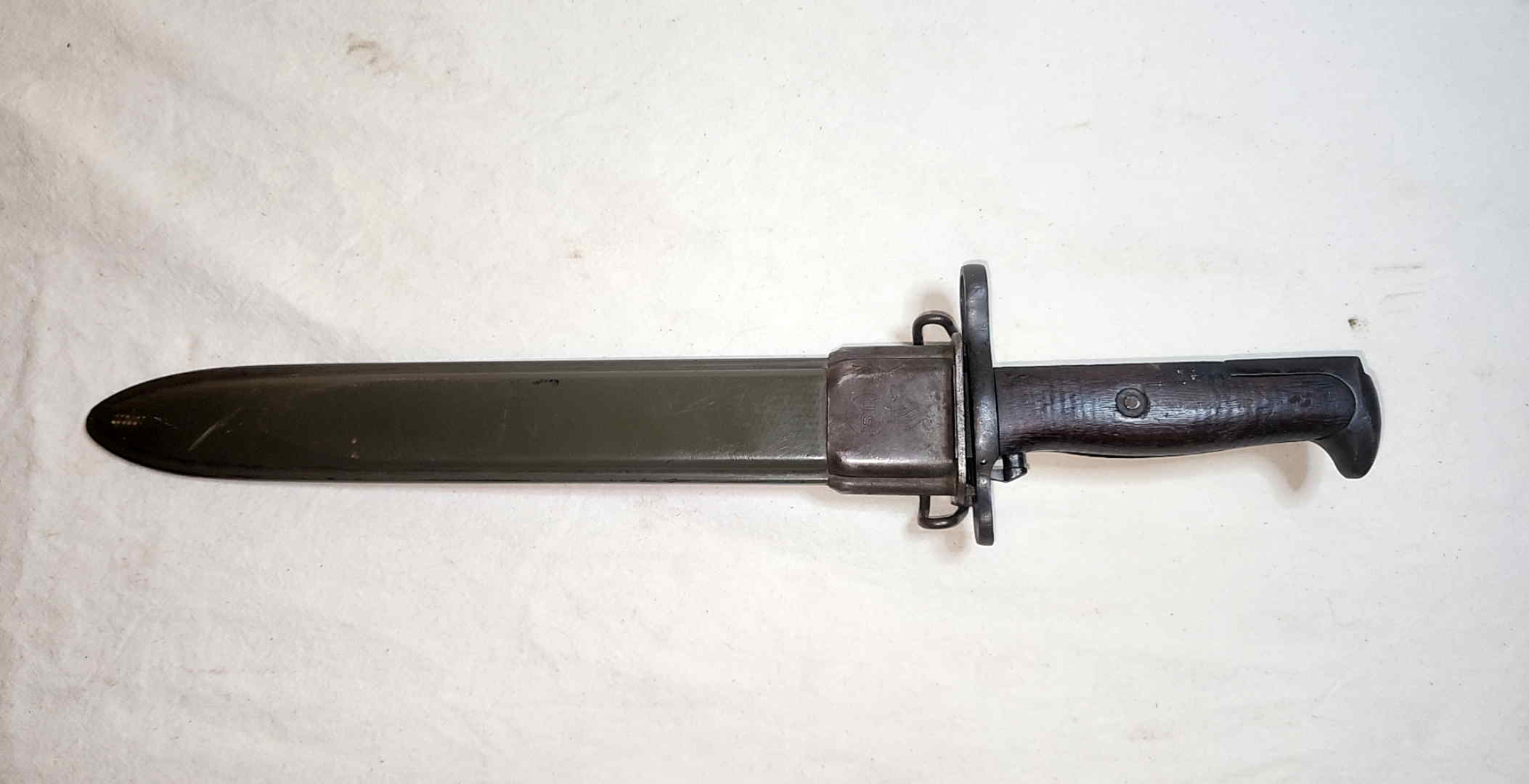
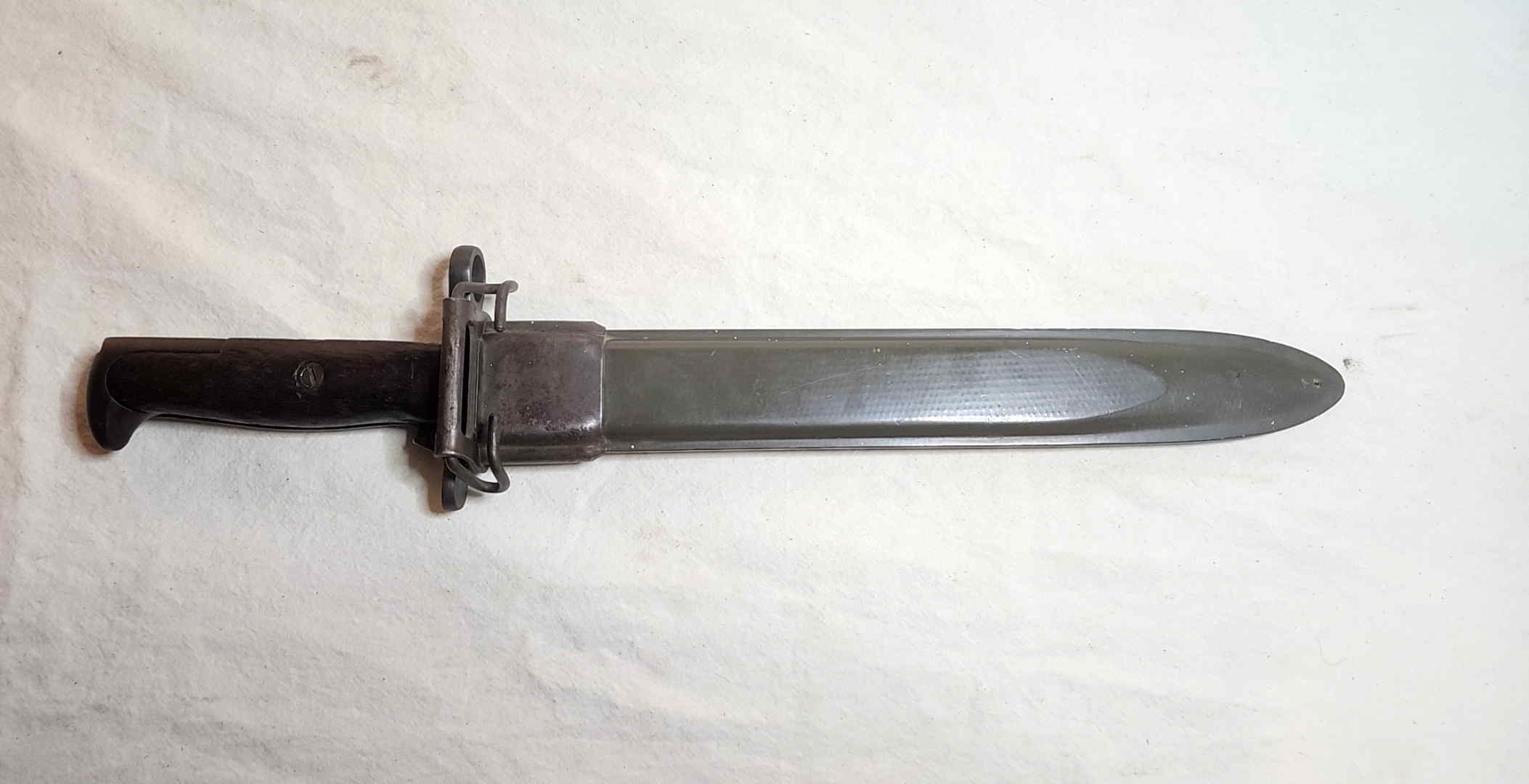
World War II shortened M1 conversion with walnut grips, spear-point blade, serial number 1138784, and M7-length fiberglass scabbard
Images
Specifications
| General Information | |
|---|---|
| Identification | U.S. Model 1905 bayonet shortened during World War II to the M1 configuration |
| Country | United States |
| Original Manufacturer | Springfield Armory, Springfield, Massachusetts |
| Original Date | 1920 |
| World War II Modification | Shortened from the original 16-inch M1905 blade to the standard 10-inch M1 length, circa 1943-1945 |
| Official WWII Classification | Bayonet, M1; shortened examples are commonly called M1905E1 by collectors |
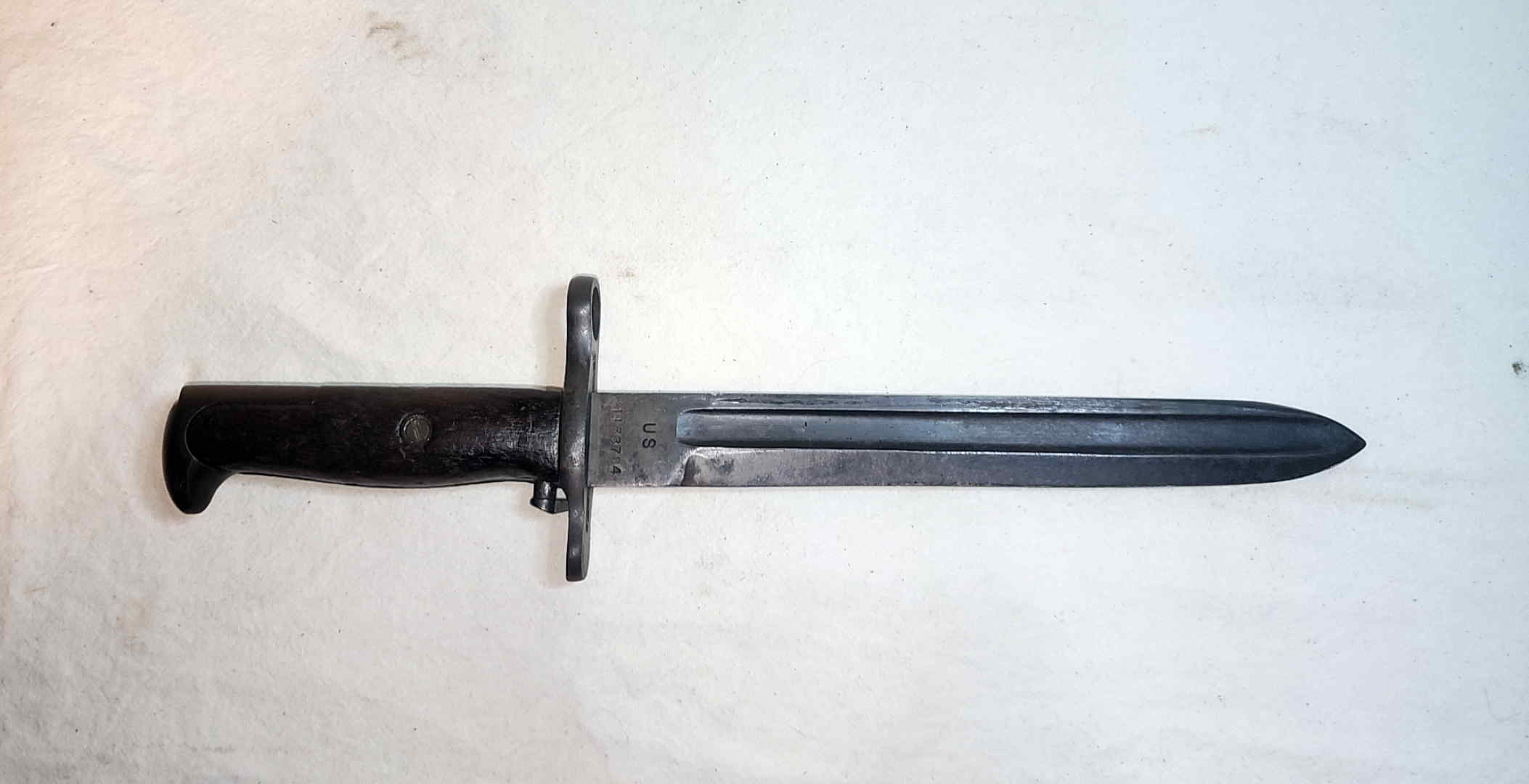
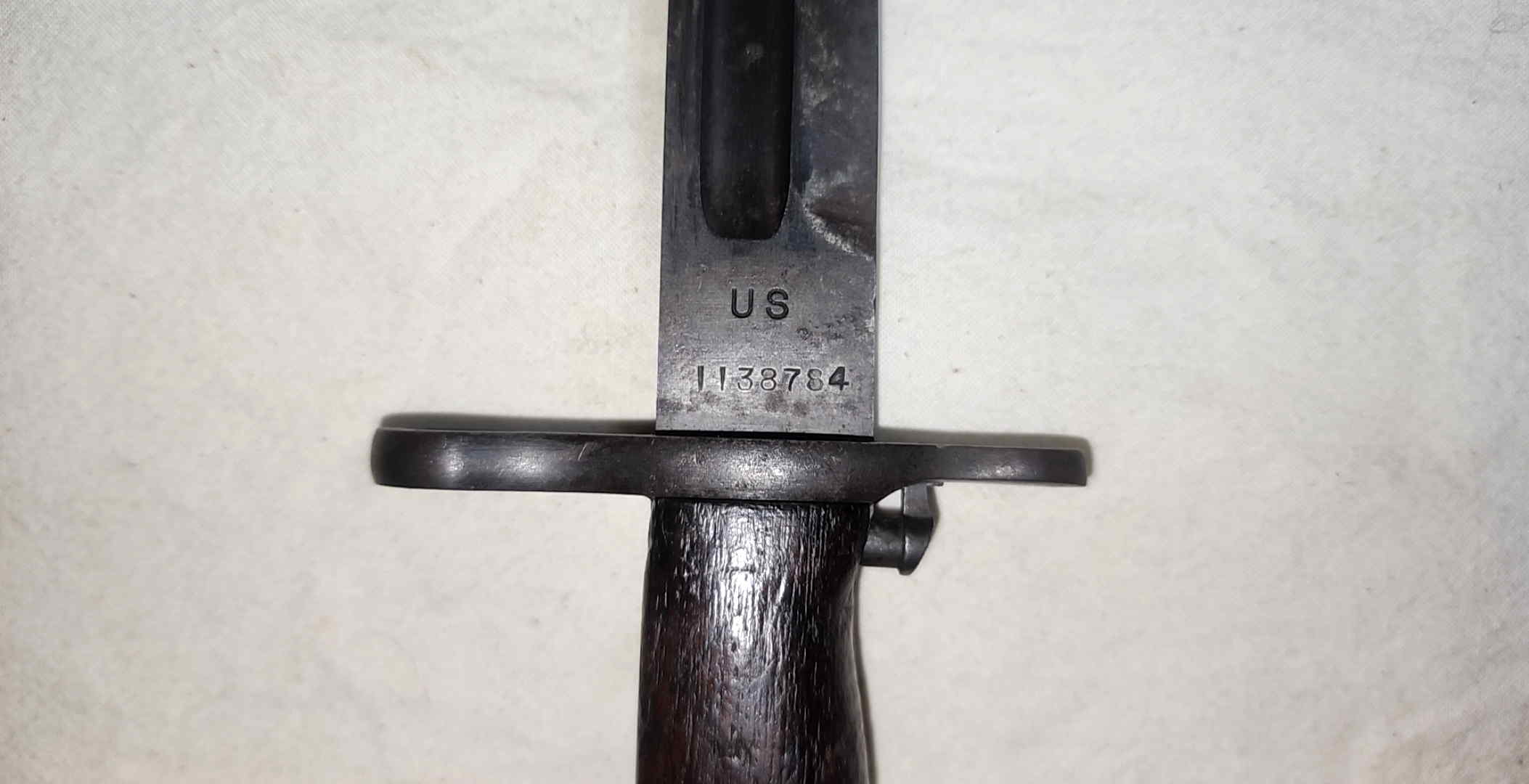
| Serial Number | 1138784 |
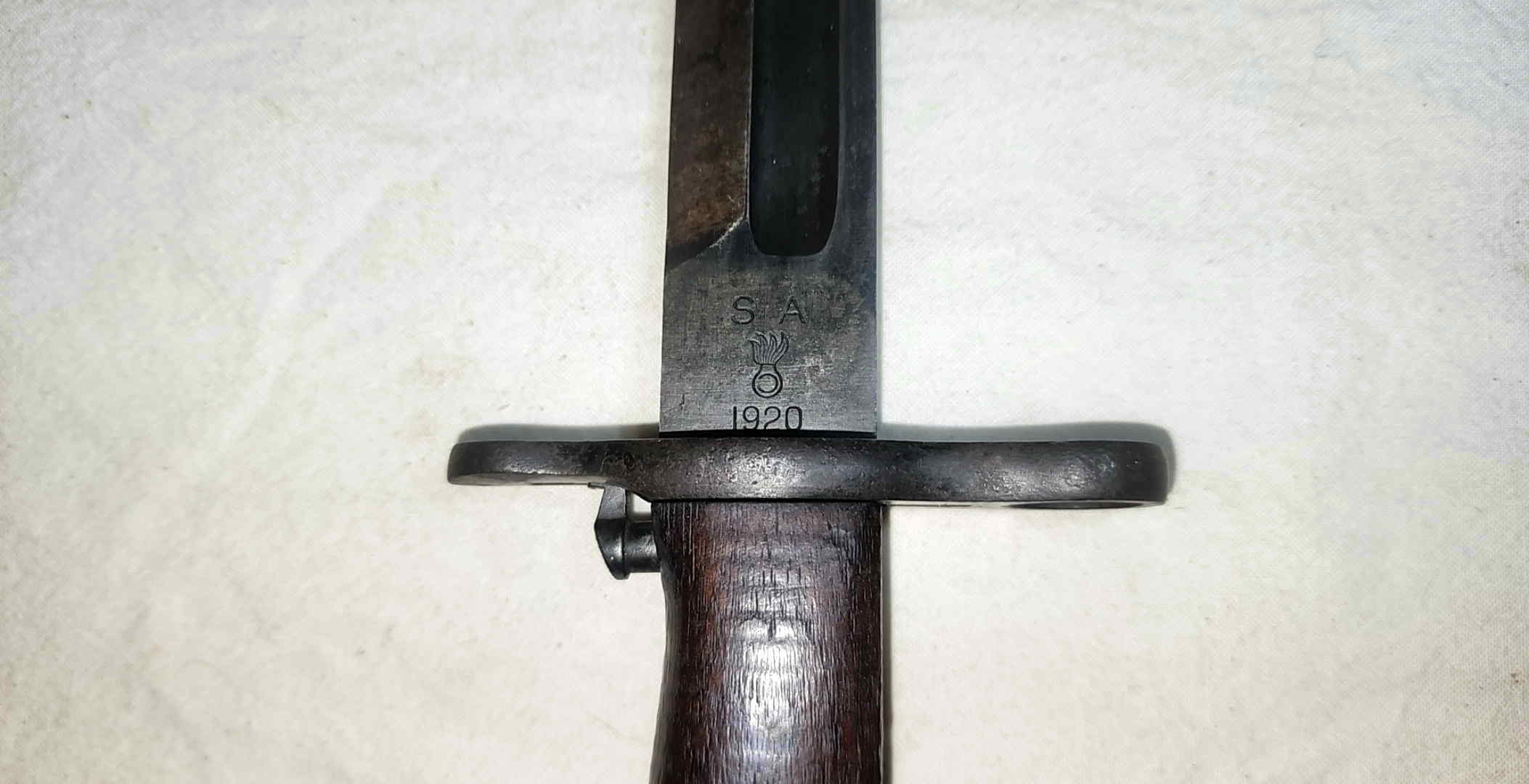
| Left Ricasso Markings | S A above the U.S. Ordnance shell-and-flame emblem and 1920 |
| Right Ricasso Markings | U S above serial number 1138784 |
| Visible Conversion Mark | None observed |
| Blade | Single-edged, fullered steel blade reground to a symmetrical spear point |
| Grips | Contoured walnut grip panels secured by slotted screw fasteners |
| Mounting System | Muzzle-ring crossguard, T-slot pommel, and spring-loaded push-button catch |
| Compatible Rifles | U.S. M1903, M1903A3, and M1 Garand rifles |
| Overall Bayonet Length | Approximately 14.5 in (368 mm) |
| Blade Length | Approximately 10 in (254 mm) |
| Blade Width at Ricasso | Approximately 1 in (25.4 mm) |
| Handle and Pommel Length | Approximately 4.5 in (114 mm) |
| Scabbard | World War II M7-length olive-drab resin-impregnated fabric body with steel throat and M1910-pattern wire hanger |
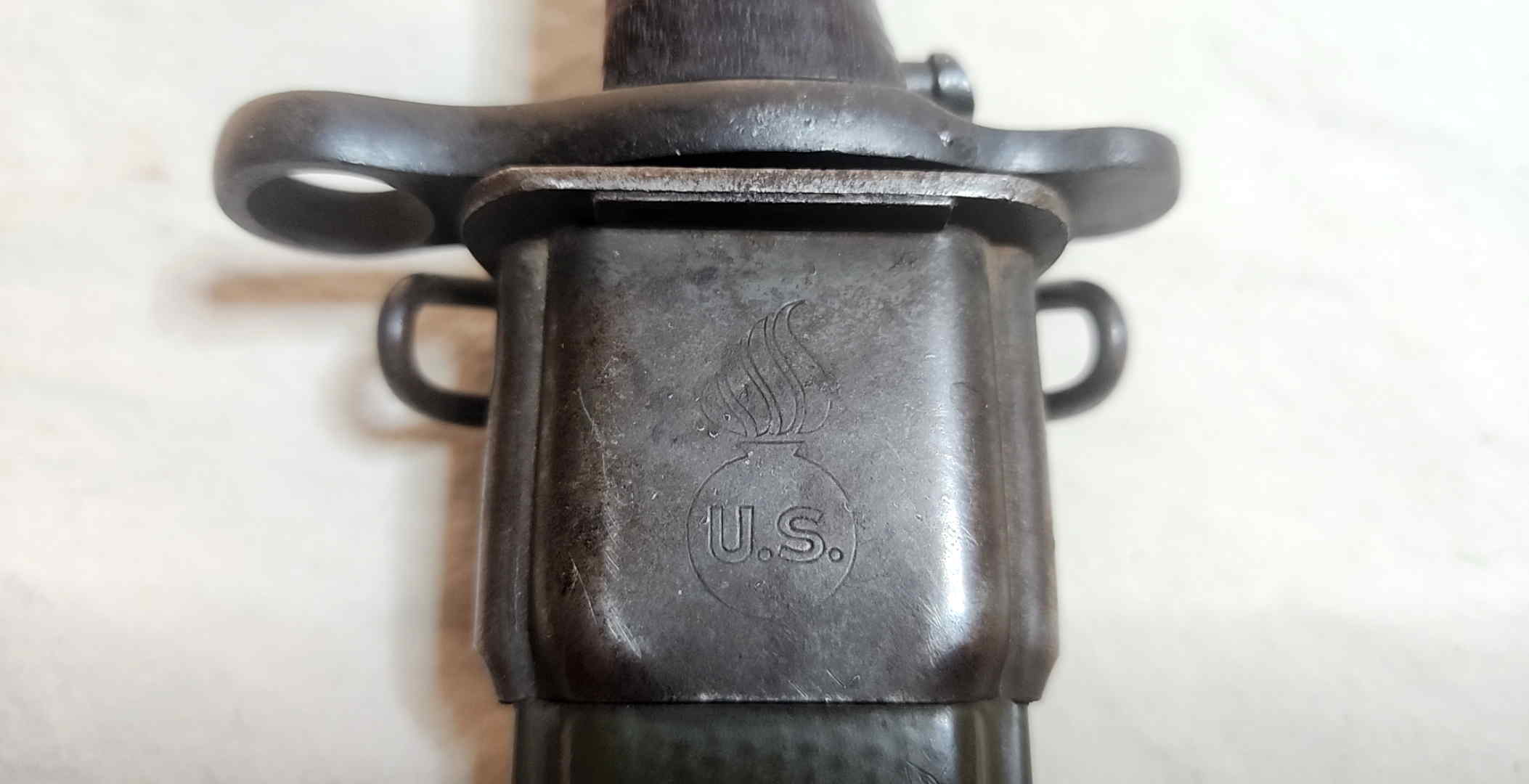
| Scabbard Marking | U.S. Ordnance shell-and-flame emblem enclosing U.S. |
| Overall Scabbard Length | Approximately 11.25 in (286 mm) |
| Overall Length When Sheathed | Approximately 15.75 in (400 mm) |
Identification
This artifact is an original U.S. Model 1905 bayonet manufactured at Springfield Armory in 1920 and later shortened during the Second World War to the standard 10-inch M1 bayonet configuration. Its original maker, date, and serial number remain clearly visible on the ricasso, while the broad early-production fullers continue close to the reground spear point.
The shortened form is often called an M1905E1 by collectors. That term is useful for distinguishing a converted Model 1905 from a newly manufactured M1 bayonet, although the Army classified the shortened weapons as Bayonet, M1 after adoption of the 10-inch pattern.
The Model 1905 Bayonet
The Model of 1905 bayonet was developed for the U.S. M1903 Springfield rifle and entered production at Springfield Armory in 1906. It used a long 16-inch fullered blade, walnut grips, a muzzle-ring crossguard, and a T-slot pommel with a spring-loaded locking catch. The same mounting dimensions later allowed it to be used on the M1903A3 and the M1 Garand.
Springfield Armory and Rock Island Arsenal produced the original generation of Model 1905 bayonets through 1922. When this example left Springfield Armory in 1920, it would have measured about 20 inches overall and carried the full 16-inch blade associated with American service bayonets of the First World War period.
World War II Shortening Program
Combat experience and testing led the Army to adopt a shorter bayonet for the M1 Garand in 1943. New 10-inch bayonets were manufactured as the M1, while large numbers of existing M1905 bayonets were recalled, shortened by approximately six inches, refinished, inspected, and returned to service in the same M1 classification.
Deliveries of shortened bayonets began in September 1943 and continued through August 1945. Approximately one million M1905 bayonets were converted. Work was performed by the five wartime M1 bayonet contractors, and Springfield Armory also recorded modification work. Some conversions carry a contractor mark on the ricasso or tang, while others, including this example, have no visible modification mark.
Spear-Point Conversion
Converted M1905 bayonets are encountered with either a symmetrical spear point or an asymmetrical beak point. This example has the symmetrical spear-point conversion. The wide, square-bottomed fuller from the original 1920 blade extends close to the new point, providing an immediate visual indication that the bayonet began life with the longer 16-inch blade.
The spear point is correctly formed and remains substantially symmetrical. Square-fullered blades were later more commonly given a beak point to leave additional metal around the shortened tip, but early and accepted spear-point conversions are well documented.
Markings and Serial Number
The left ricasso is marked S A above the U.S. Ordnance shell-and-flame emblem and the date 1920. The opposite ricasso is marked U S above serial number 1138784. The maker and date identify Springfield Armory production, while the serial number falls within the observed 1920 range of approximately 1,125,000 to 1,172,000.
No separate wartime shortening-contractor mark is visible. Unmarked conversions are well known, and the absence of such a stamp does not detract from the identification. The original Springfield markings, early serial number, broad fullers, walnut grips, and shortened point collectively document both phases of the bayonet's service history.
Construction and Rifle Compatibility
The bayonet retains its original dark walnut grip panels and slotted fasteners. The grips show age and handling wear but remain intact. The steel crossguard incorporates the muzzle ring, while the bird's-head pommel contains the T-shaped mounting mortise and push-button catch used to engage the rifle's bayonet stud.
The mounting system is compatible with the U.S. M1903 Springfield, M1903A3 Springfield, and M1 Garand rifles. The ability to use the same bayonet on the older bolt-action Springfields and the semiautomatic Garand helped make shortened M1905 bayonets useful throughout the Second World War.
M7-Length Fiberglass Scabbard
The accompanying scabbard is a correct World War II M7-length fiberglass scabbard. Its olive-drab body is made from resin-impregnated fabric, commonly described by collectors as fiberglass, and is fitted with a steel throat and M1910-pattern wire hanger for attachment to U.S. cartridge belts and other web equipment.
The front of the throat carries the U.S. Ordnance shell-and-flame emblem enclosing U.S.. During the wartime shortening program, existing 16-inch M3 scabbards were converted to the shorter M7 length, while M7 scabbards were also produced at the new length. The available exterior views establish this as a correct WWII M7-length example, although they do not conclusively distinguish a purpose-made M7 from a shortened M3.
The scabbard's approximately 11.25-inch length correctly accommodates the converted 10-inch blade. The bayonet seats fully, making the pair an appropriate World War II service combination.
Condition & Collector Notes
The bayonet is in good service-used condition. The blade retains a substantial dark military finish within the fullers, with gray-brown patina, scattered oxidation, and normal age wear on the exposed surfaces. The converted spear point remains well shaped, and no major breakage or severe blade loss is visible.
The walnut grips exhibit scratches, compression marks, darkening, and honest handling wear. The crossguard, muzzle ring, pommel, and catch components remain present, with an even aged finish. The scabbard retains most of its olive-drab surface coating and shows expected scratches and handling marks. Its steel throat and wire hanger are complete, with light surface oxidation and patina.
Dating & Authentication
The clearly struck Springfield Armory maker mark, 1920 date, correctly placed U.S. Ordnance emblem, serial number within the documented 1920 range, walnut grips, early broad fullers, and proper M1905 hilt construction authenticate the bayonet as an original Springfield Armory Model 1905.
Its approximately 10-inch blade, 14.5-inch overall length, spear-point regrind, and fuller extending close to the point establish the later World War II conversion to M1 dimensions. The accompanying Ordnance-marked M7-length fiberglass scabbard completes a historically correct wartime pairing and preserves the bayonet's transition from a 1920 service weapon to a reused Second World War implement.
Selected Research References
- World Bayonets: United States Second World War Era Bayonets - M1905, M1, shortened-bayonet, M3, and M7 scabbard identification and measurements.
- Gary Cunningham, Bayonet Points No. 2 - Point styles, contractor markings, shortening procedures, and wartime conversion totals.
- Gary Cunningham, Bayonet Points No. 19 - Springfield Armory Model 1905 production and observed serial-number ranges.