Japanese Type 30-Pattern School Training Bayonet
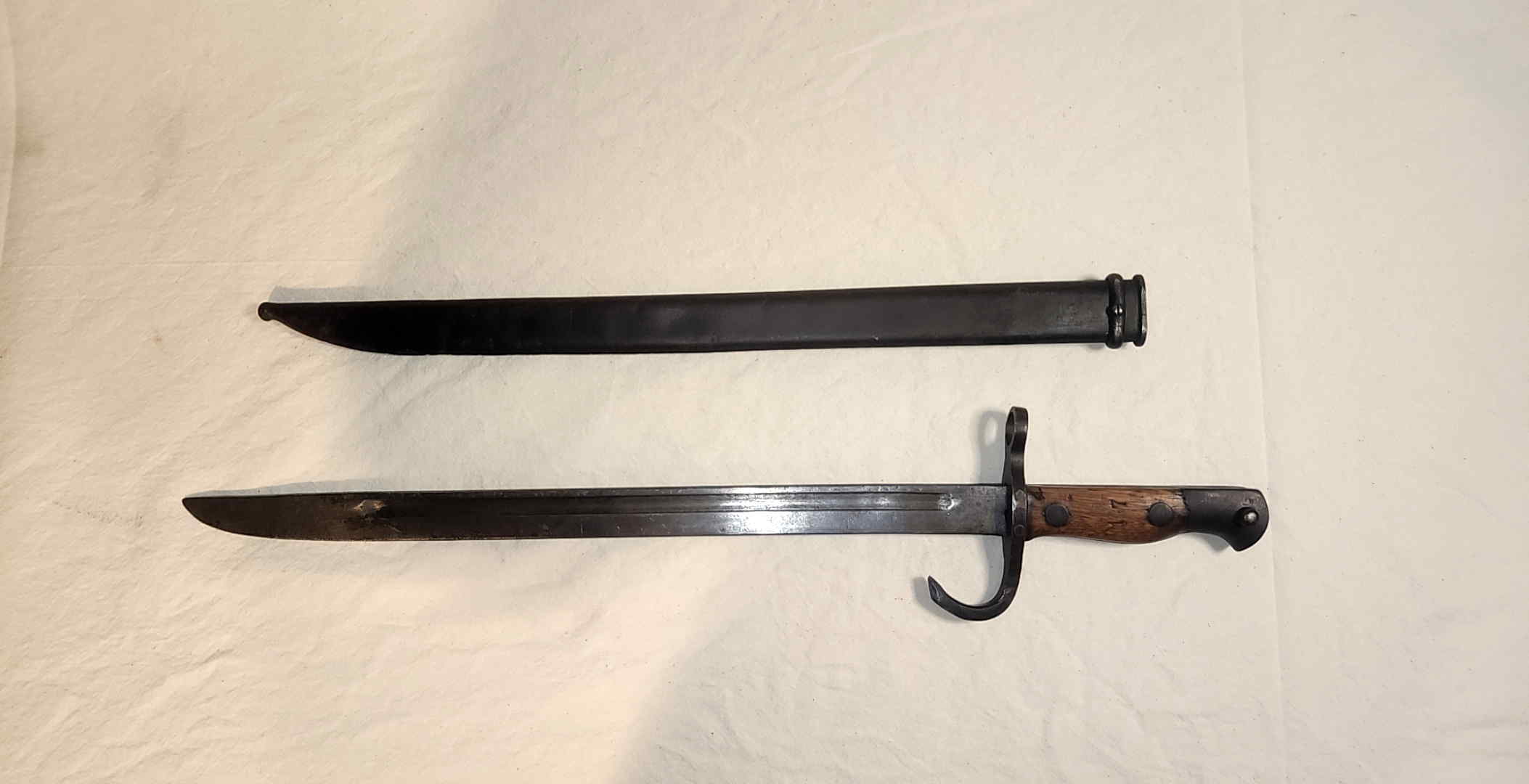
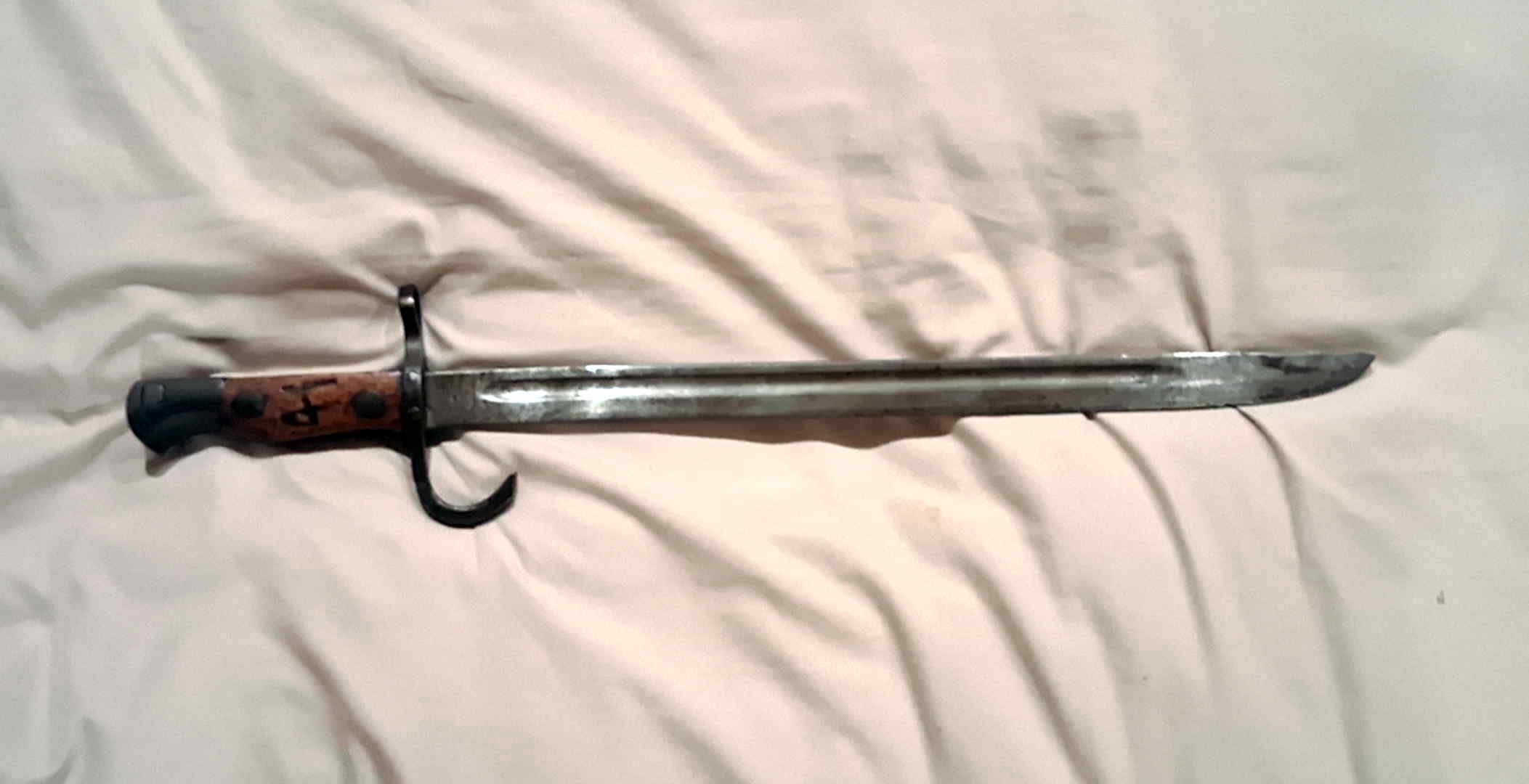
Full-size hooked-quillon school bayonet with riveted grips, rack number 17, functional Type 99 mounting system, and school-pattern steel scabbard
Images
Specifications
| General Information | |
|---|---|
| Identification | Type 30-pattern school training bayonet |
| Country | Imperial Japan |
| Probable Date | Circa early 1930s to 1945 |
| Intended Use | Military drill and bayonet instruction with school training rifles |
| Manufacturer | Unknown; likely local or private workshop manufacture |
| Arsenal or Contractor Marks | None present; the ricasso does not appear to have been scrubbed |
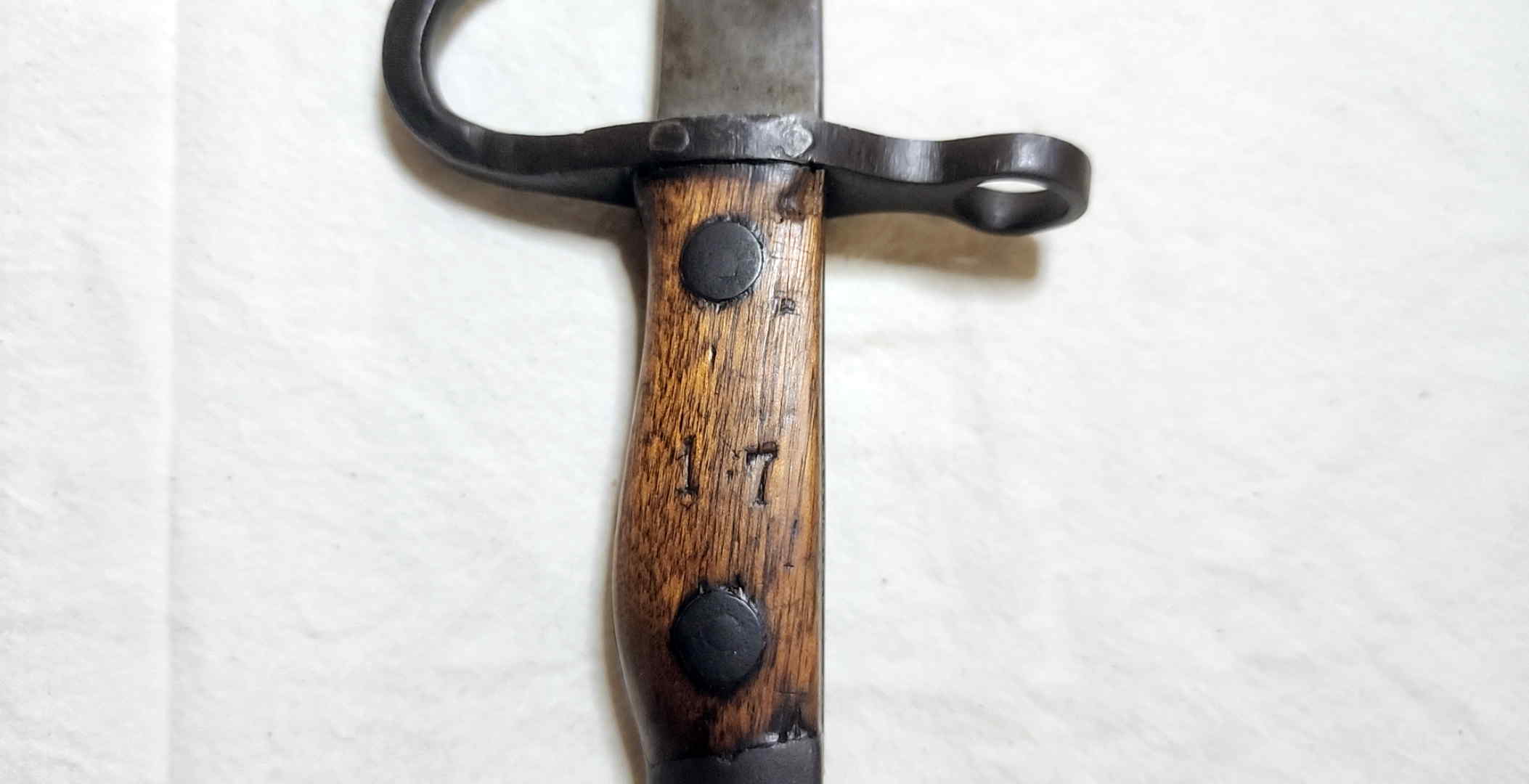
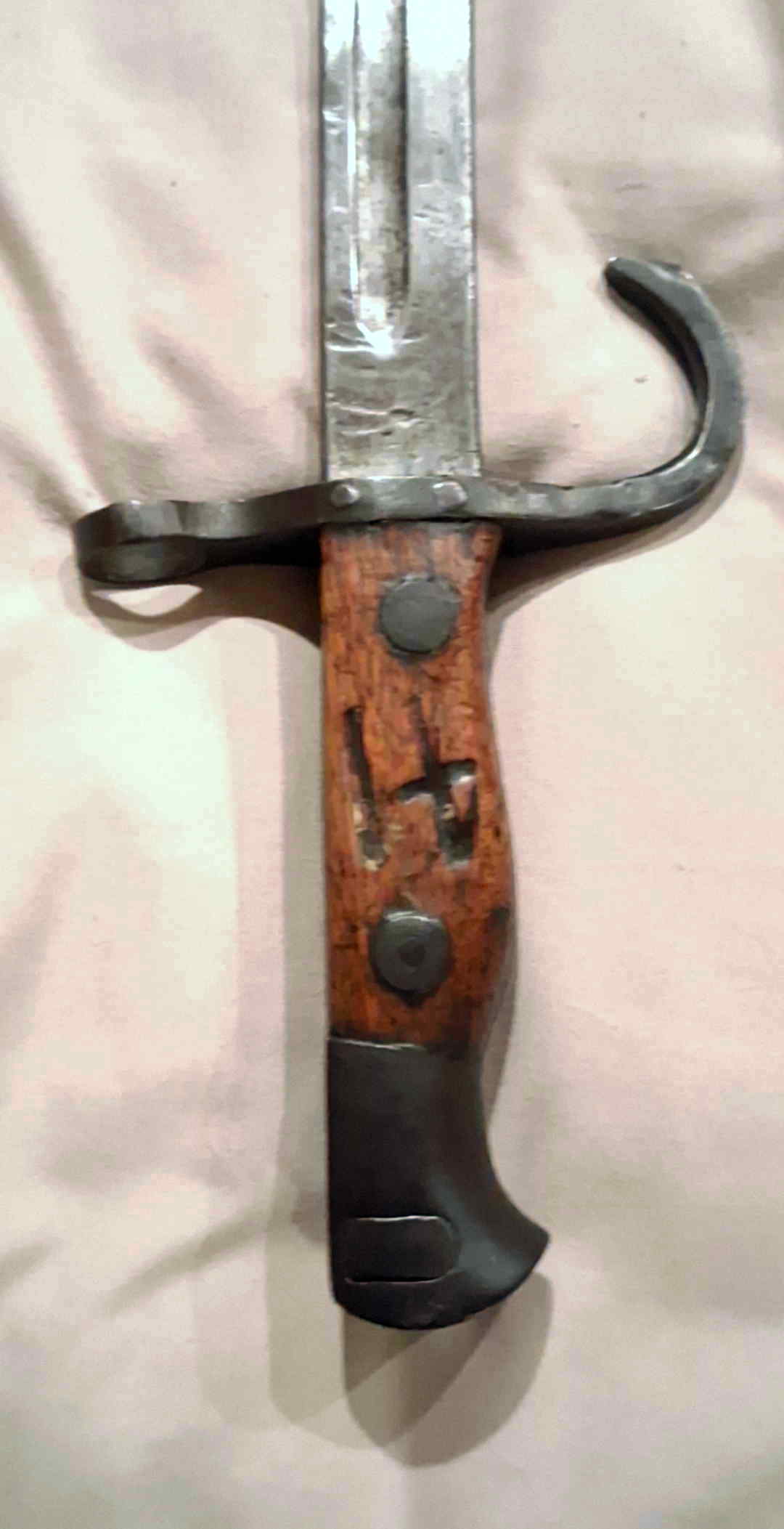
| Grip Markings | Deeply stamped number 17 and an unidentified branded or burned property mark |
| Blade | Single-edged fullered steel blade with a Type 30 spear-point profile |
| Crossguard | Early Type 30-style hooked quillon with muzzle ring |
| Grips | Contoured wooden grip scales secured by two rivets per side |
| Pommel and Lock | Bird's-head pommel with T-section mounting mortise and functional spring-loaded push-button catch |
| Overall Bayonet Length | 19.25 in (489 mm) |
| Blade Length | 15 in (381 mm) |
| Blade Width at Ricasso | 0.875 in (22.2 mm) |
| Approximate Crossguard Span | 3.75 in (95 mm) |
| Approximate Muzzle-Ring Diameter | 9/16 in (about 14.3 mm) |
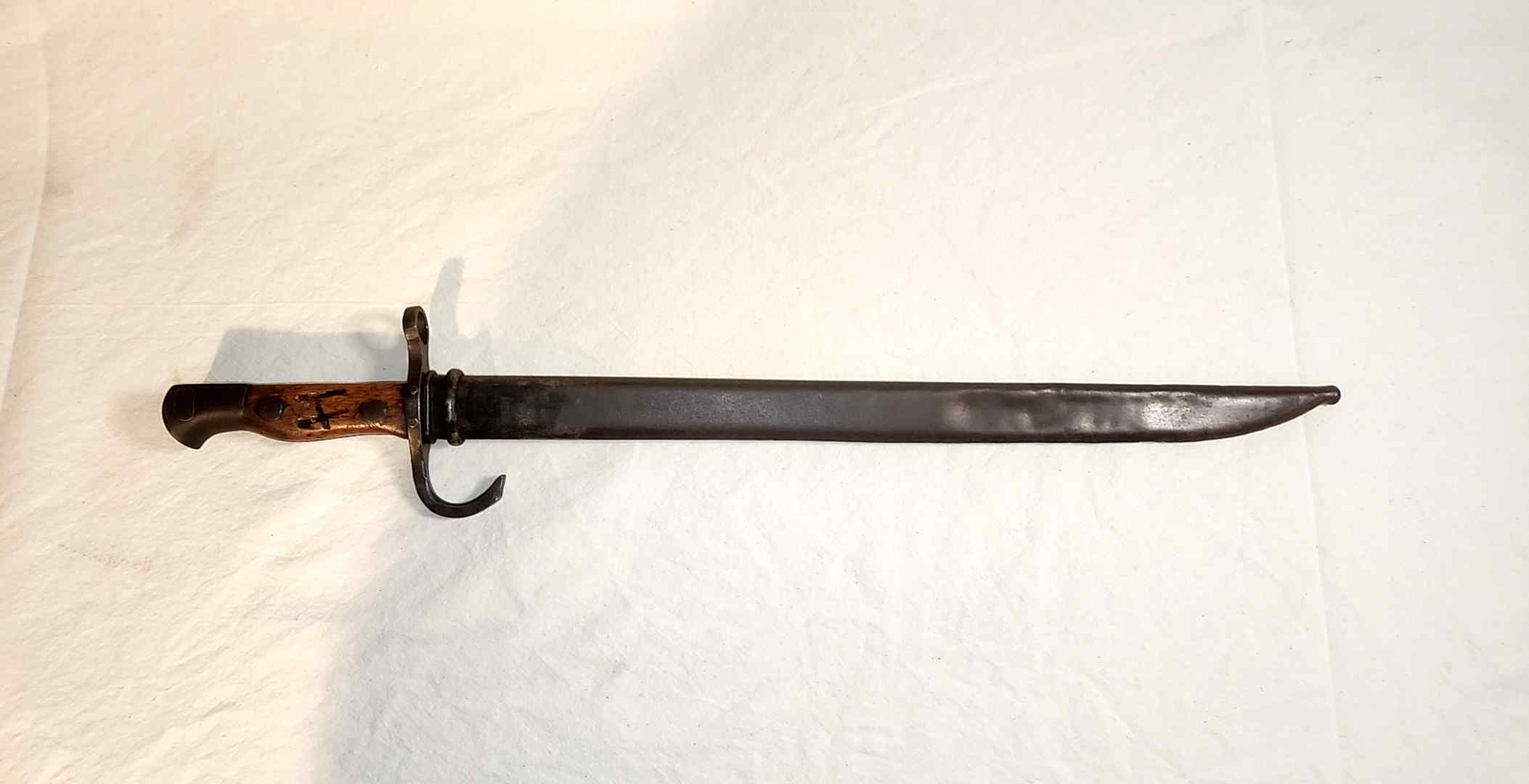
| Scabbard | Simplified flattened steel school-pattern scabbard with wire-form throat bands and rounded tip |
| Overall Scabbard Length | 16.375 in (416 mm) |
| Verified Rifle Fit | Mounts securely and locks correctly on a Japanese Type 99 Short Rifle |
Identification
This artifact is an original Imperial Japanese Type 30-pattern school training bayonet. It is a full-size training piece made to reproduce the general form and mounting system of the standard Type 30 service bayonet. The hooked quillon, muzzle ring, fullered blade, wooden grips, bird's-head pommel, T-section mounting slot, and spring-loaded locking catch all follow the established Type 30 arrangement.
Its school-bayonet identity is established by the complete combination of features rather than by any single detail. The blade has a shallow and unevenly finished fuller, the ricasso carries no arsenal or contractor mark, the crossguard and blade finishing are less refined than regular Army production, and the grip bears a large inventory number. The flattened steel scabbard also corresponds to a pattern associated with Japanese school bayonets rather than the standard tubular service scabbards.
School Military Training in Imperial Japan
Military drill became a normal part of Japanese secondary-school education during the early 1930s and continued through the end of the Second World War. Schools used purpose-made training rifles and bayonets for marching, rifle handling, and bayonet exercises. Training rifles could be blank-firing, cap-firing, mechanically clicking, or completely non-firing.
School rifles and bayonets were often assembled by private makers or local workshops using soft steel, cast components, scrap service-rifle parts, and simplified manufacturing methods. They were not normally expected to meet the durability standards of Army-issued weapons. As a result, surviving school bayonets vary greatly in quality. Some are extremely crude and will not mount on a service rifle, while better-made examples were produced close enough to regulation dimensions to fit and lock correctly.
Construction & Distinguishing Features
This example is notably better made than many surviving school bayonets. Its full-size mounting system is functional, the press button and spring-loaded locking bolt operate smoothly, and the bayonet mounts securely on a Type 99 Short Rifle. These points show that it was manufactured as a practical rifle-mounted training bayonet rather than as a nonfunctional parade prop.
The hooked quillon copies the early service Type 30 configuration. Its presence does not by itself prove early manufacture, since school workshops copied several versions of the Type 30 over a broad period. Riveted wooden grips also occur on some wartime service bayonets, so the rivets alone are not diagnostic. Here, the school identification rests on the riveted grips together with the unmarked ricasso, irregular fuller, simplified finish, numbered wood grip, and distinctive school-pattern scabbard.
Markings
One grip is deeply and cleanly stamped 17. This is best interpreted as a school rack, inventory, or property-control number rather than a military production serial number. Large one- and two-digit numbers are known on Japanese school bayonets and were often stamped or burned directly into the wood.
The opposite grip carries a larger dark mark that appears to have been deliberately branded or burned into the surface. It may be an institutional, school, unit, or property mark, but the surviving form is not clear enough for a responsible identification. It is recorded here as an unidentified branded property mark.
No arsenal or contractor emblem is present on either ricasso. Examination of the surface does not show the localized grinding or dishing normally associated with removal of a stamped mark. The bayonet appears to have been manufactured without standard arsenal markings.
Dimensions and Rifle Compatibility
At 19.25 inches overall with a 15-inch blade, this bayonet is slightly shorter than a typical arsenal-made Type 30 service bayonet, but it remains a full-size training example. Its approximate 9/16-inch muzzle-ring opening is within the normal service-bayonet range, and the complete hilt geometry aligns properly with the bayonet lug of the Type 99 Short Rifle.
The bayonet has been physically test-fitted to a Type 99 Short Rifle. It slides into position, seats correctly around the muzzle, and is retained by the working pommel catch. This proper fit distinguishes it from many lower-quality school bayonets that were made only to approximate Type 30 dimensions.
Scabbard
The accompanying scabbard is a simplified steel pattern associated with school training bayonets. Unlike the more rounded tubular construction of standard Type 30 service scabbards, it has a flattened blade-shaped body, a curved profile near the tip, a small rounded terminal, and simple wire-form bands around the throat. Its 16.375-inch length corresponds closely to the 15-inch blade.
The bayonet seats fully in the scabbard, and the matching school-type construction strongly indicates that the two pieces belong together as a training set.
Condition & Collector Notes
The bayonet is complete and mechanically functional. The blade shows old polishing or cleaning, scattered oxidation and pitting, and visible irregularities from its original workshop manufacture. The fuller is uneven and terminates less cleanly than on arsenal-produced service bayonets. The hooked quillon, muzzle ring, grip rivets, pommel, mounting slot, push button, and locking mechanism remain intact.
The wooden grips show substantial service and training wear. The number 17 remains sharply defined, while the opposite branded mark is worn and partially obscured by surface loss. The steel scabbard retains a dark aged finish with normal handling wear and shallow surface irregularities.
Dating & Authentication
The bayonet's Type 30 mounting arrangement, period materials, aged finish, riveted wood grips, school-style inventory markings, unmarked ricasso, crude fuller, and specialized training scabbard are consistent with an original Japanese school bayonet from the militarized education era of the early 1930s through 1945.
This is not a standard arsenal-issued combat Type 30. It is a comparatively well-made, full-scale school training example that was manufactured closely enough to service dimensions to mount and lock on an original Type 99 rifle. Its combination of functional construction, early hooked-quillon styling, identifiable rack number, and matching school-pattern scabbard makes it a strong representative artifact of prewar and wartime Japanese military education.
Selected Research References
- World Bayonets: Bayonets of Japan - Type 30 service, substitute-standard, and school-bayonet comparisons.
- Australian War Memorial: Arisaka Type 30 Bayonet - Reference example showing the standard Type 30 hilt, riveted grips, mounting mortise, push-button latch, and fullered blade.