
Carcano M38 T.S. 8mm Carbine, 8×57 JS, Serial No. 2062
Carcano M38 T.S. 8mm Carbine (8×57 JS, Serial No. 2062)
Italian Carcano T.S.-pattern carbine converted to 8×57 JS, strongly consistent with the postwar Egyptian-contract T.S. conversion group. This example later received German commercial nitro proofing at the Munich proof house and bears two separate U.S. importer markings from Century Arms and Numrich Gun Parts Corporation.
Images




Specifications
| General Information | |
|---|---|
| Country | Italy |
| Model | Carcano M38 T.S. / M91/38 T.S.-pattern 8mm conversion |
| Caliber | 8×57 JS (7.92×57mm Mauser) |
| Action | Carcano turn-bolt action with Mannlicher-type en-bloc clip magazine system |
| Receiver Serial Number | 2062 |
| Stock Number | 2062 |
| Conversion | Postwar 8mm conversion strongly consistent with the Egyptian-contract T.S. group, generally associated with F.N.A. Brescia production after the 1948 Arab-Israeli War. |
| Stock | T.S.-pattern wood with two transverse reinforcing lugs and dual side/bottom sling provision; rear side fitting is an earlier-style configuration. |
| German Proofs | Eagle/N definitive nitro proof on barrel shank and receiver; Munich proof-house shield on barrel shank. |
| Additional German-Era Markings | Standalone 9, shield-like mark containing 98, and 300. Exact meanings remain unresolved. |
| Other Barrel Number | 5150, possibly an earlier barrel or component number; exact significance unknown. |
| Bolt Mark | Overlapping PS-type stamp; exact significance unknown. |
| U.S. Import Marks | C.A.I. ST. ALB. VT / CARCANO ITALY; later Terni M38 Italy / N.G.P.C. Kingston NY marking. |
Historical Summary
The Carcano T.S. family was developed for artillery, engineers, communications troops, and other specialist formations that required a shorter arm than the full-length Mod. 91 rifle. By the interwar period the T.S. pattern had evolved into a standardized carbine with shortened furniture, Carcano-pattern sights and bayonet fittings, and side-sling provisions suited to carrying the weapon across the back.
After the Second World War, Italy possessed large stocks of Carcano carbines while newly independent and reorganizing Middle Eastern armies were seeking inexpensive arms for training and second-line service. Current Carcano research attributes approximately 25,000 postwar 8×57 JS T.S. conversions to F.N.A. for Egypt, with additional cavalry-type carbines associated with Franchi. The best-known identifying feature of the T.S. group is the pair of reinforcing lugs through the stock, a feature clearly present on this rifle.
Postwar 8×57 JS Conversion
The barrel is plainly marked 8×57 JS, confirming conversion to the German 7.92×57mm cartridge. The rifle retains the recognizable T.S. stock, fore-end, front sight and bayonet-lug arrangement, while the reinforced stock reflects the additional structural measures associated with the postwar 8mm program.
The two transverse stock reinforcement lugs are especially significant. They closely match the documented postwar Egyptian-contract T.S. conversions, which were produced in large numbers as economical training and second-line arms. Many rifles in that group received a prominent S marking to indicate the 8mm conversion, but the group is also documented with variation in markings and reused components.
German Commercial Proofing
The barrel shank carries the German Eagle/N definitive smokeless-powder proof together with a Bavarian lozenge shield matching the Munich proof-house locality mark. A second Eagle/N is present on the receiver, consistent with German practice of marking major pressure-bearing components during proof.
A further sequence consists of a standalone 9, a shield-like stamp containing 98, and the number 300. May represent a proof-house, control, or administrative number; its exact significance remains unknown.
Serial Numbers and Component Markings
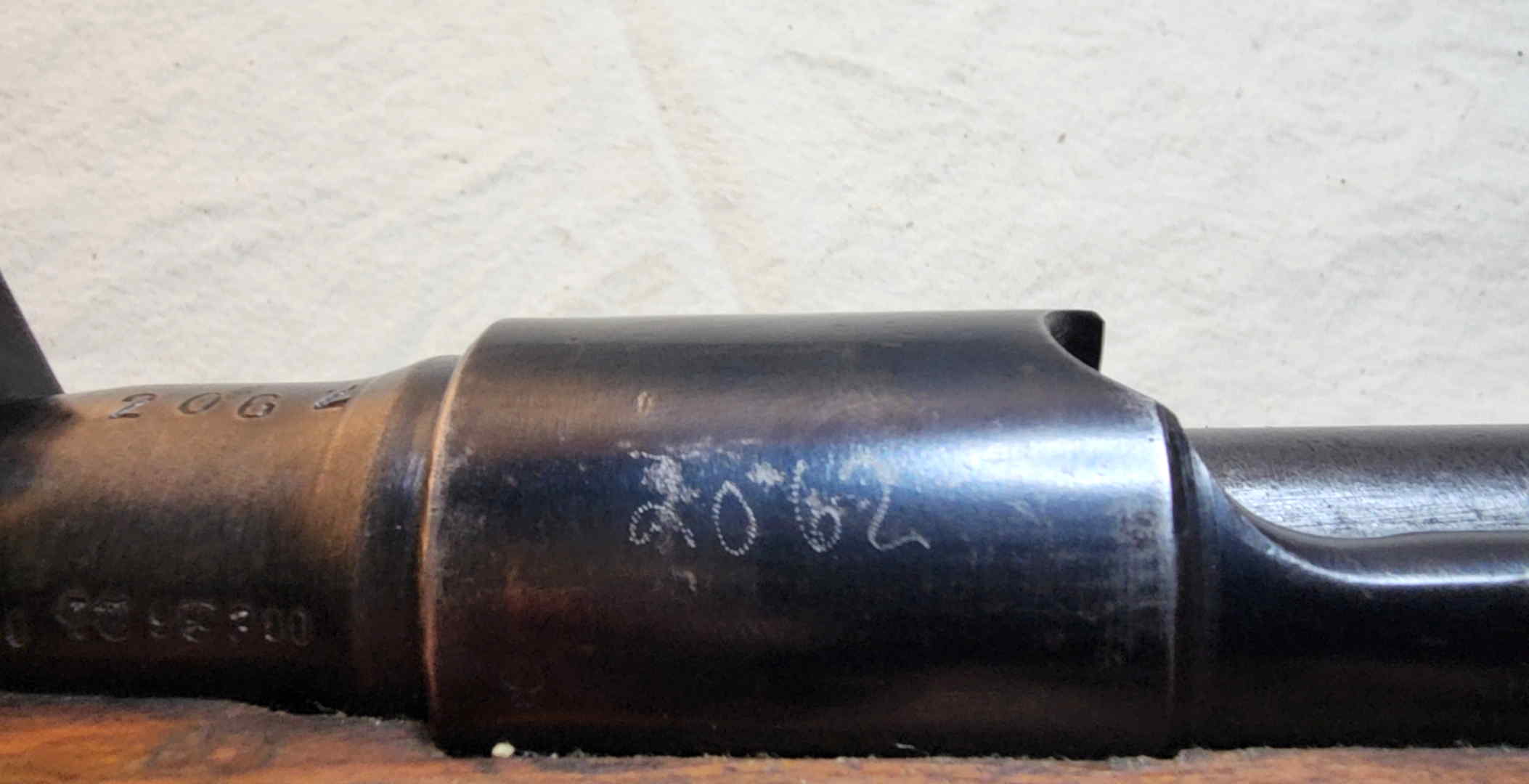
Serial number 2062 is stamped on the receiver and repeated on the buttstock. An additional 2062 is electrically applied on the receiver-ring area.
The barrel shank also carries the number 5150. Its placement and difference from the 2062 serial suggest that it may be an earlier barrel, component, assembly, or conversion-related number, although no definitive interpretation has been established. The overlapping PS-type stamp on the bolt is likewise retained as an unidentified inspection or component mark.
Number 2062 is also stamped on the left side buttstock.
Stock, Reinforcement, and Sling Arrangement
The stock is one of the strongest clues to the rifle’s history. Two transverse reinforcing lugs pass through the wood, matching the reinforcement pattern associated with the postwar 8mm T.S. conversions. The front furniture remains recognizably Carcano T.S. in form, including the front sight, barrel-band arrangement, bayonet fitting, and sling hardware.
The buttstock retains both bottom and side sling attachment points. Dual sling arrangements are documented on T.S. carbines from the interwar period, allowing the same carbine to be carried conventionally or slung across the back. The exact rear side fitting on this example is less common than the later fixed metal-bar style and may represent an earlier-style fitting or reused/refurbished T.S. furniture.
U.S. Import History
This rifle carries two distinct U.S. importer markings. One is the older C.A.I. ST. ALB. VT / CARCANO ITALY marking associated with Century Arms International in St. Albans, Vermont. A later marking reads Terni M38 Italy / N.G.P.C. Kingston NY, identifying Numrich Gun Parts Corporation of Kingston, New York.
The two markings document more than one stage in the rifle’s commercial history. The Century marking predates the Numrich marking on this example, while the rifle’s German Munich proofing represents an additional European commercial stage. The exact chronological relationship between the earlier Century import and the later German proof event remains unresolved. The rifle’s most recent documented U.S. provenance is Numrich Gun Parts Corporation.
Collector Notes
- Chambering is clearly marked 8×57 JS.
- Receiver and stock are both numbered 2062, with an additional light 2062 marking on the receiver-ring area.
- The stock has two transverse reinforcing lugs, a hallmark strongly associated with the postwar Egyptian-contract T.S. conversion group.
- The rifle retains a T.S.-pattern dual sling arrangement with both side and bottom attachment points.
- German Eagle/N nitro proofs appear on the barrel shank and receiver.
- The Bavarian lozenge shield on the barrel shank is consistent with the Munich proof house.
- The 9 / shielded-98 300 grouping may be a German-era proof-house, control, or administrative marking; exact significance unknown.
- The number 5150 may be an earlier barrel or component number; exact significance unknown.
- The bolt carries an overlapping PS-type stamp of unresolved significance.
- Two U.S. importer markings are present: Century Arms International, St. Albans, Vermont, and N.G.P.C. / Numrich Gun Parts Corporation, Kingston, New York.
Provenance
Original Italian Carcano service manufacture, later reworked to 8×57 JS in a configuration strongly consistent with the postwar Egyptian-contract T.S. conversion program. The rifle subsequently entered the German commercial proof system, where it received Eagle/N nitro proofs and a Munich proof-house mark. It later passed through U.S. surplus-import channels, carrying an earlier Century Arms International St. Albans, Vermont mark and a later N.G.P.C. Kingston, New York mark. The present rifle was acquired through Numrich Gun Parts Corporation.
Editorial Note
These pages are presented for historical and collector-reference purposes. Relics & Rifles does not sell firearms or facilitate transactions. Any discussion of configuration, markings, proofing, or accessories is descriptive and intended to preserve context for research.