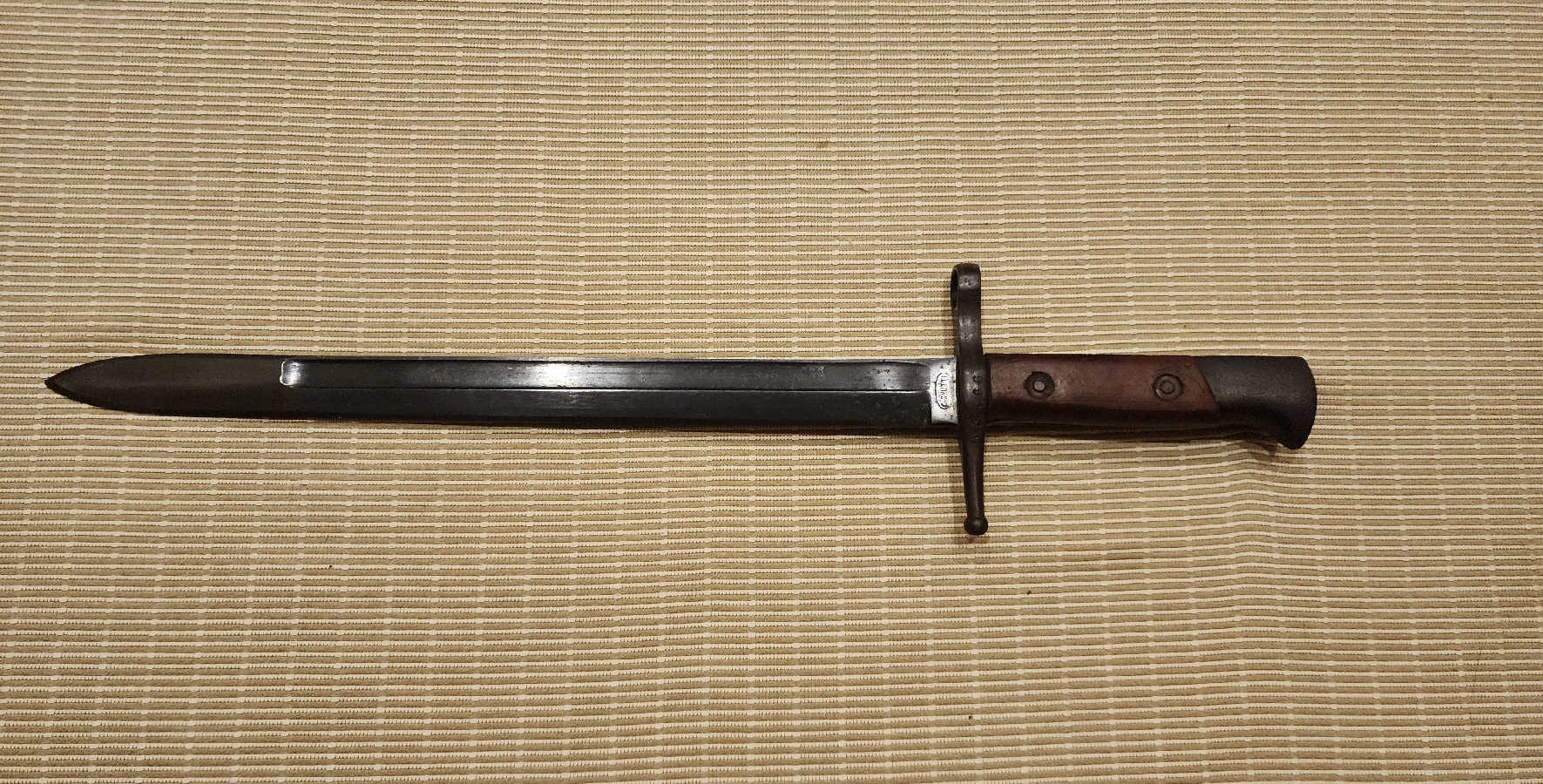
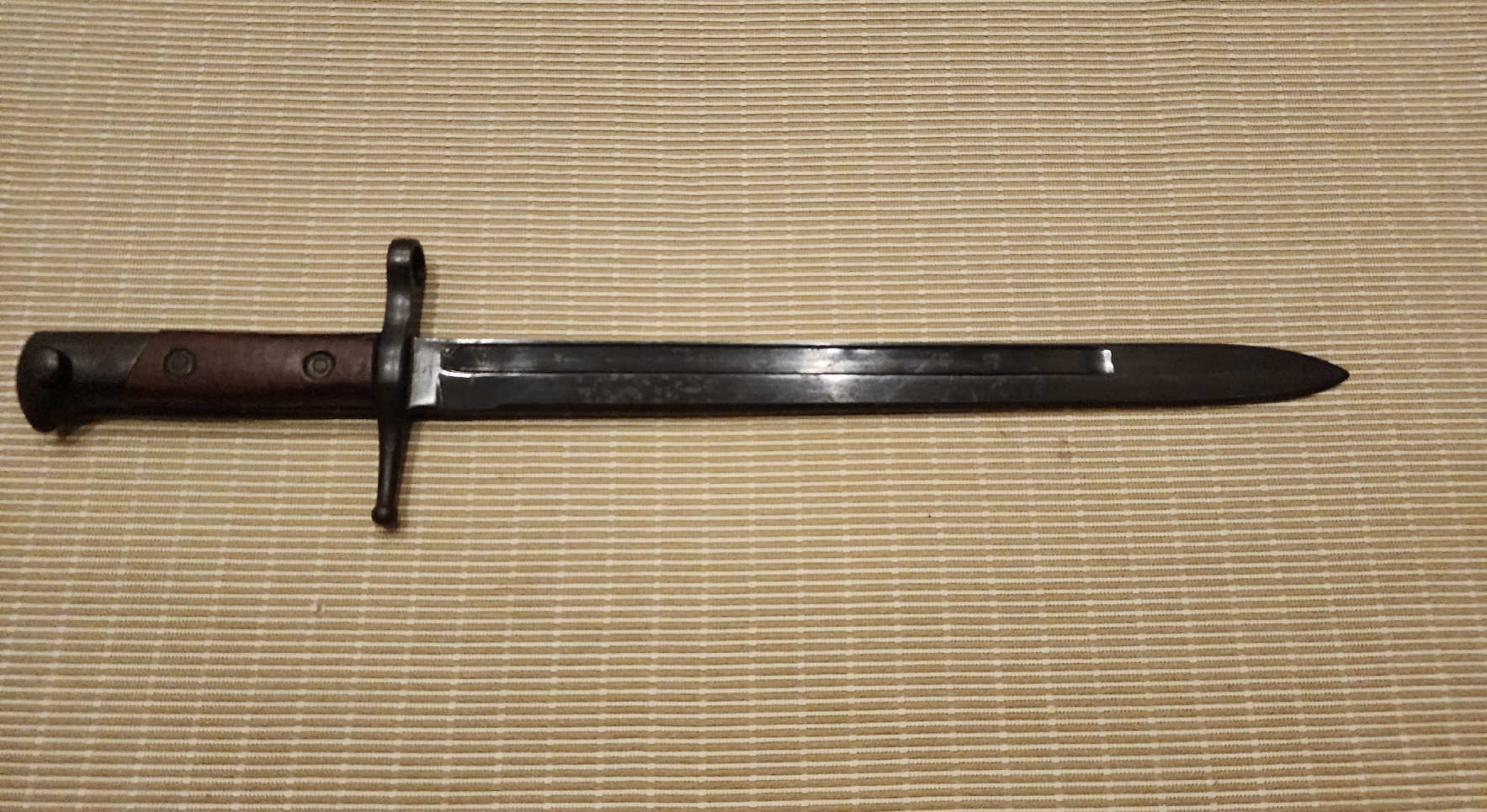
Italian M1891 Knife Bayonet – C. Gnutti (Brescia)
Standard knife bayonet for the 6.5 mm M1891 Mannlicher–Carcano rifle and most M1891/38 carbines.
Images
Specifications
| General Information | |
|---|---|
| Official Designation | Baionetta Modello 1891 (M1891 Knife Bayonet) |
| Country | Kingdom of Italy |
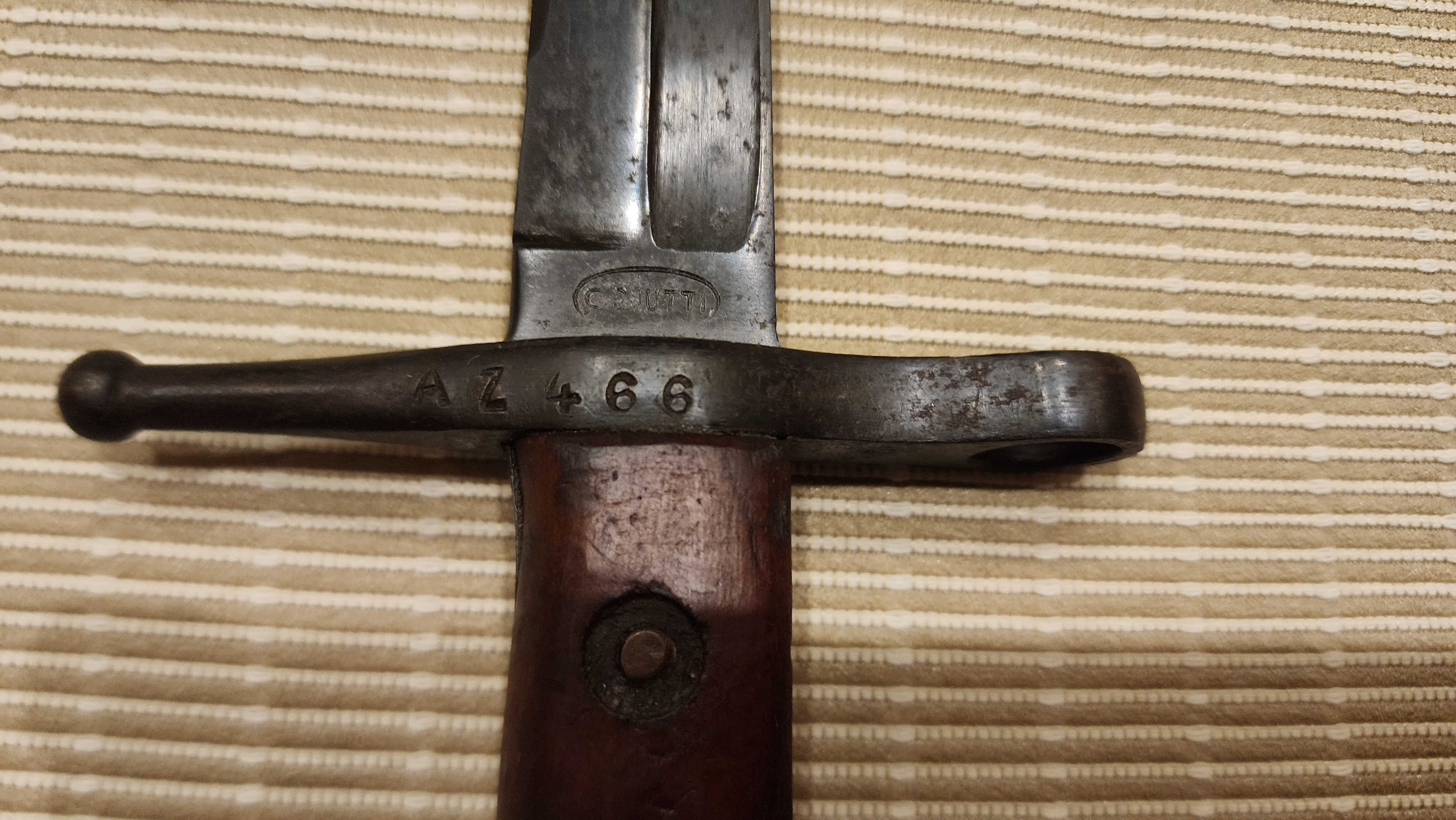
| Manufacturer | C. GNUTTI – Brescia |
| Serial Number | AZ466 (on crossguard, matched to rifle batch) |
| Dimensions | |
| Blade Length | Approx. 11.875 in (302 mm) |
| Overall Length | Approx. 16.375 in (416 mm) |
| Blade Type | Single-edged knife blade with fullers |
| Attachment & Scabbard | |
| Attachment | Under-barrel muzzle ring & pommel T-slot (M1891 rifle pattern) |
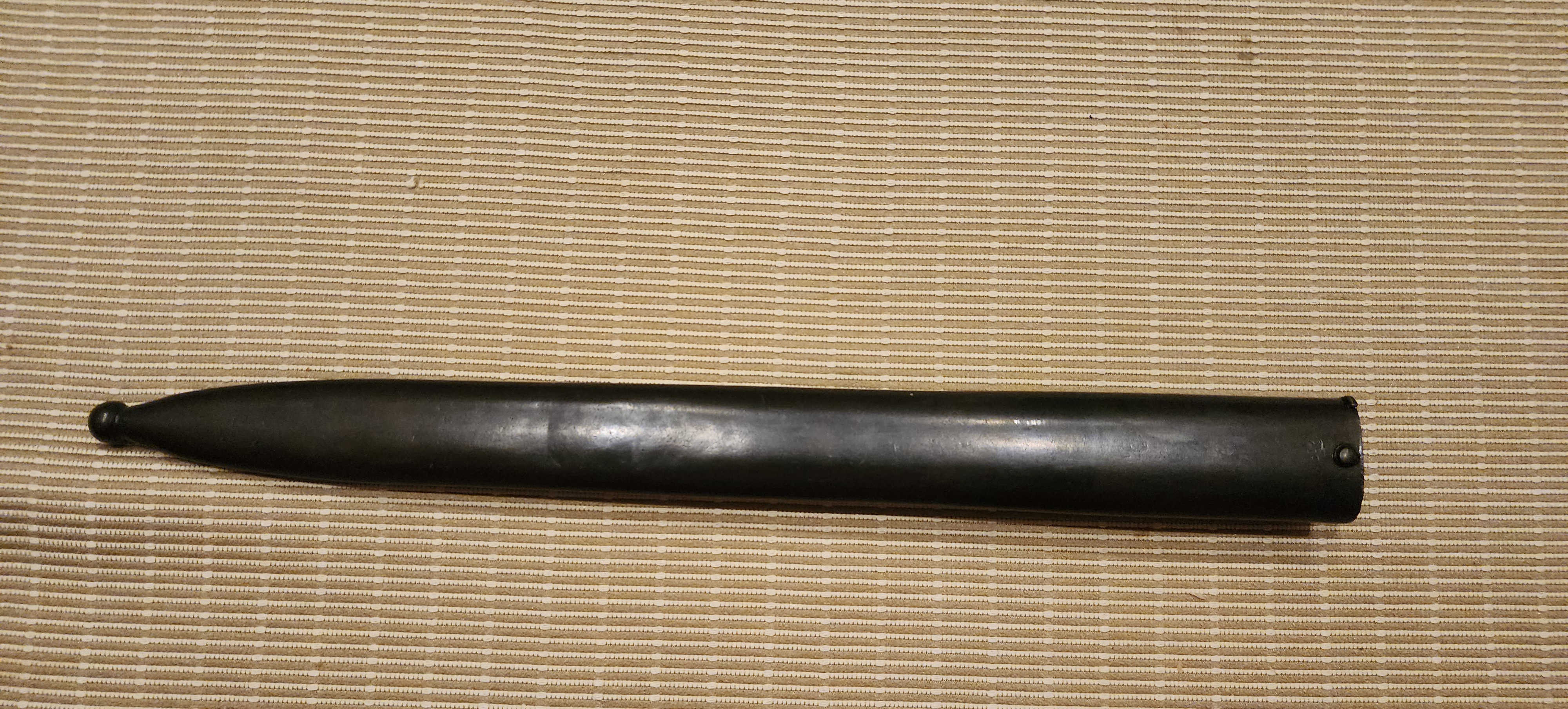
| Scabbard | Smooth steel scabbard (wartime-type); other variants include leather with brass or steel mounts and ribbed steel scabbards |
| Compatibility | |
| Designed For | 6.5 mm M1891 Mannlicher–Carcano long rifles and most M1891/38 carbines |
| Not Compatible With | M1891 Cavalry Carbine (Moschetto da Cavalleria), 2nd model M1891 TS Carbine (Moschetto per Truppe Speciali), and the M1938 Short Rifle (Fucile Corto) |
| Service Life | Approx. 1890s–1940s (nearly 50 years of Italian service) |
Manufacturer History – C. Gnutti (Brescia)
The bayonet is stamped C. GNUTTI, one of the principal blade and bayonet subcontractors in the Brescia arms district. The Gnutti firm traced its origins to the late 19th century in the Lumezzane–San Sebastiano area and produced blades, bayonets, and small components for the Royal Army and Brescia’s state arsenals.
During the First World War, C. Gnutti produced large quantities of standard infantry M1891 bayonets, often marked with their name and production year. Their output continued into the interwar years and the Second World War, supplying bayonets and other small-arms parts for M1891 rifles and the later M91/38 carbines.
By the late 1940s and 1950s, Italian arms production declined and many specialist firms like Gnutti either reduced or abandoned bayonet work altogether. Today, C. GNUTTI markings are a key identification feature for collectors of Carcano accessories.
Identification & Notes
- Correct knife bayonet pattern for the 6.5 mm M1891 rifle and many M91/38 carbines.
- Not designed for the 1891 Cavalry Carbine, 2nd model M1891 TS, or the M1938 Short Rifle.
- Blade shows the typical wartime-simplified finish but retains clean geometry and fullers.
- Marked C. GNUTTI on the ricasso with serial AZ466 on the crossguard.
- Includes a smooth steel scabbard, a correct mid-war pattern frequently encountered on long-service examples.
Historical Overview
As Italy pushed toward simplified wartime manufacture between 1914 and 1943, the M1891 knife bayonet remained the standard pattern for long rifles and many derivatives. Unlike later spike bayonets, this design maintained a full-length blade that could serve both as a close-combat weapon and a general field knife.
These bayonets saw nearly fifty years of service through World War I, the interwar period, and World War II. Over that lifetime, they were paired with a wide variety of scabbards— leather with brass or steel fittings, ribbed steel, and smooth steel—reflecting both peacetime and emergency wartime production.
The example documented here, numbered AZ466, is typical of late-war production associated with Brescia-area workshops. Its presence alongside a correct M91/38 TS carbine forms a historically coherent set that illustrates Italy’s mid-20th-century small-arms system.